Awesome Programmer Longevity
Extend your runtime — with graded evidence.
10 chapters · Dual-ruler evidence grading · 111 verified references
Dr. Xiong · DeepoMe · 2026-10 · v2.0
👉 Tap left/right edges to flip · Swipe works too · Links are clickable · Top button switches language
Preface · Why this guide exists
This guide exists because of a gap.
Over the past few decades, sleep medicine, nutritional epidemiology and neuroscience have piled up evidence on how to live longer and better. It sits in PubMed, in paper titles, waiting to be translated. Meanwhile, most people's health knowledge comes from forwarded wellness posts and advice from relatives.
You don't have to wait for this research to trickle down. You can read it yourself. PubMed is public. Every section here comes with PMIDs: don't trust me, check.
I also don't want the walls between fields to keep standing. Sleep medicine, nutrition cohorts, cell biology and modern research on Chinese medicine should form one picture, not a handful of disciplines that ignore each other. This guide puts them on the same table and grades them with the same ruler.
Finally, everyday experience and traditional medicine shouldn't be ignored: some of it is real. Face and neck massage, Baduanjin (a traditional Chinese exercise), herbal soups: some already have partial evidence, some are being tested. We neither mythologize nor dismiss.
You can extend your runtime with science. Let's begin.
— Dr. Xiong
Maintainer: Dr. Xiong · updated as a series (see "About Dr. Xiong")
How to read this guide
The guide is made of standalone sections. Each covers one thing, takes a few minutes, and can be read in any order. Sections are grouped into chapters.
| Time you have | Start here |
|---|---|
| 2 minutes | "Series highlights" above: pick what you're most curious about |
| 5 minutes | The Ten Big Rocks: the ten things that matter most |
| A weekend | Pick your pain point: sleep, neck and back, eyes, anxiety, focus |
| The full picture | The Twelve Pillars: twelve hallmarks of aging, mapped to every section |
🔭 What makes this guide different
Most longevity books cover the same ground: exercise, sleep, diet, supplements. We cover those too (see The Ten Big Rocks), but four things are hard to find elsewhere:
- East and West at one table: traditional practices and molecular mechanisms graded with the same ruler. We turn tradition into testable scientific questions. Examples: ⭐ Yang Qi and Mitochondria (with a new menu and falsifiable predictions), ⭐ Face-and-Neck Lymphatic Massage.
- Fresh from the frontier: 2023–2026 findings from Nature, Cell, Nat Hum Behav and Cell Metab, translated into plain language.
- In programmer language: your circadian clock is NTP sync, sleep is garbage collection, chronic inflammation is a memory leak.
- Honest all the way down: two-ruler grading, a "why not higher" note in every section, an honest blank among the twelve pillars, a 💸 label on supplements whose evidence doesn't justify the price, and a conflict-of-interest statement.
Sections marked ⭐ are original to this guide.
How we grade evidence (v2: two rulers)
Every tip gets two labels: how strong the evidence is, and what you should do about it.
Ruler 1: Strength of evidence
| Grade | Meaning | Typical evidence |
|---|---|---|
| A | Strong human evidence | Randomized controlled trials (RCTs) or large cohorts/meta-analyses with hard outcomes like death or disease |
| B | Human evidence | Human studies, but with surrogate outcomes (blood sugar, melatonin rhythm, symptom scores) or only associations |
| C | Mechanism + early data | Mechanistic studies, animal experiments, small or single human studies |
| D | Tradition, untested | Traditional or popular belief without direct scientific evidence yet |
Ruler 2: What to do
| Label | Meaning |
|---|---|
| ✅ Do it | Enough evidence, low cost and low risk |
| 🧪 Worth a try | Limited evidence, but cheap and safe: try it and observe |
| 📖 Good to know | Knowledge only, or not something to do on your own |
| 💸 Save your money | A paid product whose evidence doesn't justify the price |
The grade applies to the advice itself, not to how hot the underlying science is.
A wrong grade is worse than none. If you spot an error in a grade or a citation, please open an Issue or PR.
Conflict of interest
This guide is maintained by Dr. Xiong, founder of DeepoMe, a company whose business includes DNA methylation testing and the DeepKang health platform. Sections directly related to that business (The Methylation Clock, Your Face Can Reveal Your Biological Age, and the "Toolbox" appendix) are flagged. They explain concepts only and recommend no testing product, including ours.
"Say exactly as much as the evidence supports" applies to us too.
Chapter 1 · Your Brain's Hidden Ops
Behind the scenes, your brain is doing three things you never noticed: draining waste, cutting its own DNA, and tuning your immune system. Most of the evidence here comes from Nature, Cell and similar journals, 2015–2026.
Face-and-Neck Lymphatic Massage (Brain Drain) ⭐
Evidence C (direct evidence in mice) | 🧪 Worth a try | Pain point: brain fog | Pillar: H10 Altered intercellular communication (brain–lymph crosstalk)
In one line: Your brain's "wastewater" leaves through a route that runs under the skin of your face and neck. In 2025, a Nature study showed that gently pressing this route through the skin doubled cerebrospinal fluid outflow in mice.
Sound familiar? Four hours of debugging and your head feels like porridge. Coffee doesn't help.
How: once or twice a day, 1–2 minutes each time, always stroking downward, toward the neck: 1. From around the eyes and the sides of the nose, stroke gently down to the jawline. 2. Along the lower edge of the jaw, glide from the chin to just below the earlobe. 3. From below the ear, stroke down the side of the neck to just above the collarbone.
Use the pressure you'd use to apply face cream: just enough to move the skin. It shouldn't ache.
Why:
Think of it this way: the brain has no garbage truck. It dissolves metabolic waste into cerebrospinal fluid (CSF) and flushes it out through a network of pipes, like the drainage system of a server room.
That drainage system was mapped surprisingly late. Only in 2015 did scientists confirm that the membranes around the brain contain lymphatic vessels; until then, textbooks said the brain had none. In 2025, a Korean team published the full route in Nature: CSF leaves from the base of the skull, passes through lymphatic vessels around the eye sockets, in the nasal cavity and the palate, joins the superficial lymphatic vessels of the neck, and finally drains into the lymph nodes under the jaw. That neck segment sits just beneath the skin, wrapped in a layer of smooth muscle that can contract.
The key experiment: in old mice, this route works less well. When researchers used a force-controlled device to gently press the superficial neck lymphatics through the skin, CSF outflow doubled and the drainage deficit in old mice was corrected.
"Massage the face and neck to help the brain drain" now has direct animal evidence for the first time. The routine above follows that map.
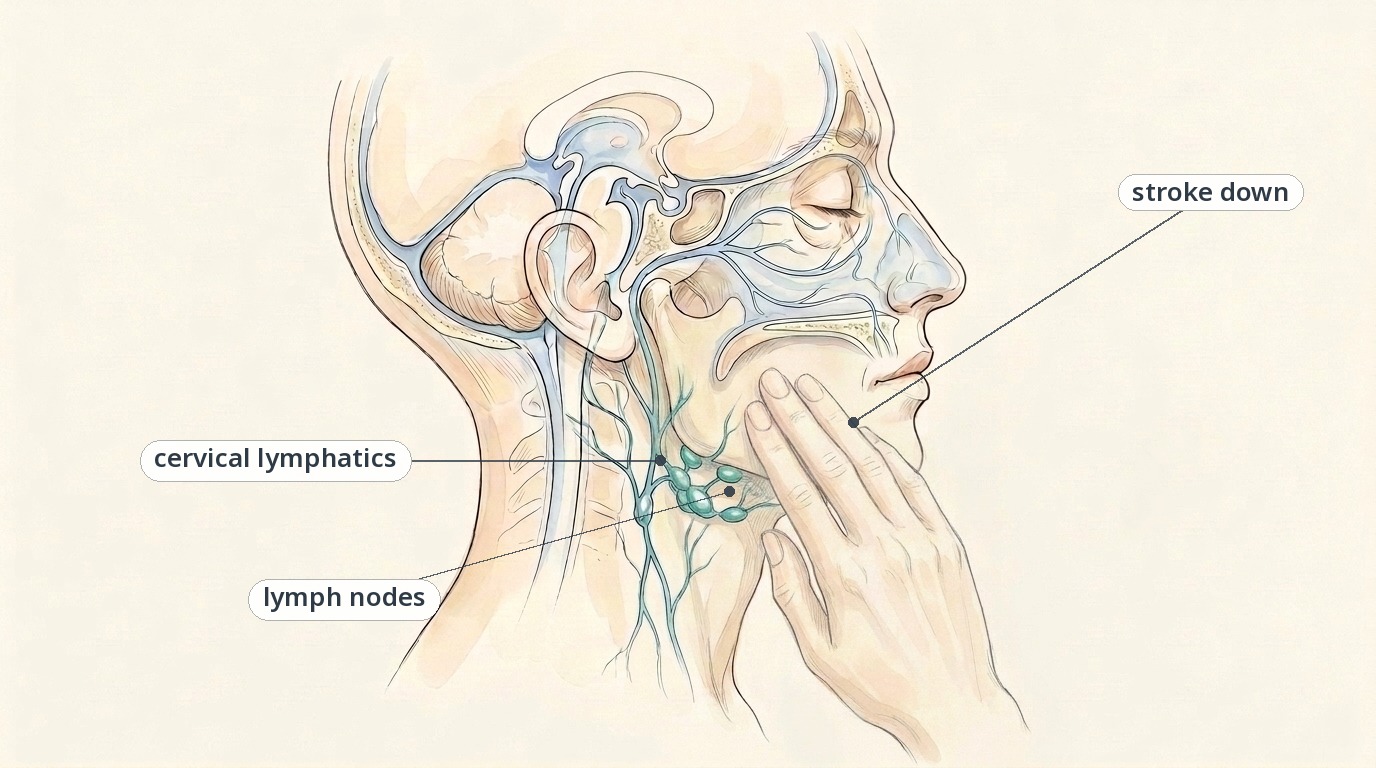
▲ Right direction, light touch: CSF drains through superficial neck lymphatics to the lymph nodes under the jaw
🔬 Deeper: aging pipes and nitric oxide
Metabolic waste in the brain (including β-amyloid) enters the CSF through the glymphatic system, and is cleared fastest during sleep (Xie 2013). After leaving the skull through meningeal lymphatics, part of the CSF travels through extracranial lymphatics in the nasopharynx and palate into the superficial cervical lymphatics, then to the submandibular lymph nodes. Old mice have fewer lymphatic vessels in the nasal mucosa and palate, and less eNOS protein in their superficial cervical lymphatics, which impairs nitric oxide signaling. External mechanical stimulation increases outflow by **compressing** the superficial vessels, with little effect on their own spontaneous contractions (Jin 2025).How solid is the evidence? (C): - 2015: two landmark papers confirmed that meningeal lymphatic vessels exist and drain the brain (Louveau 2015; Aspelund 2015). - 2018: meningeal lymphatic function declines with age and is linked to Alzheimer's-related pathology (Da Mesquita 2018). - 2025: the route from CSF to the superficial neck lymphatics and the submandibular nodes was mapped; controlled mechanical stimulation through the skin doubled CSF outflow in mice (Jin 2025). - Why still C: the evidence comes from mice, using a force-controlled device, not human hands. Whether hand massage in humans does the same, or makes anyone think more clearly, has not been tested in people.
For programmers: do one round when you're stuck on a bug instead of scrolling your phone; do another before bed, when the brain's waste clearance peaks (see Sleep Debt Repayment Plan).
Limits: skip it if you have a lump in your neck, thyroid disease, or an acute infection with fever. Don't press on the pulsing carotid artery. Keep it gentle.
Author's note: This is the grade I hesitated over most. This 2025 Nature paper was a relief: the map exists, and pressing on it works in animals. But between "mouse + device" and "human + hand" there's still a human trial missing. When it arrives, this may become the first section in the guide to be upgraded from speculation.
📚 References (5, verified on PubMed)
1. Jin H, et al. Increased CSF drainage by non-invasive manipulation of cervical lymphatics. *Nature*. 2025;643(8072):755-767. (PMID: 40468071) 2. Louveau A, et al. Structural and functional features of central nervous system lymphatic vessels. *Nature*. 2015;523(7560):337-41. (PMID: 26030524) 3. Aspelund A, et al. A dural lymphatic vascular system that drains brain interstitial fluid and macromolecules. *J Exp Med*. 2015;212(7):991-9. (PMID: 26077718) 4. Da Mesquita S, et al. Functional aspects of meningeal lymphatics in ageing and Alzheimer's disease. *Nature*. 2018;560(7717):185-191. (PMID: 30046111) 5. Xie L, et al. Sleep drives metabolite clearance from the adult brain. *Science*. 2013;342(6156):373-7. (PMID: 24136970)Your Brain Cuts Its Own DNA to Learn ⭐
Evidence C (animal mechanism, top-journal evidence chain) | 📖 Good to know | Pain point: "my brain is fried" from learning a new framework | Pillar: H1 Genomic instability
In one line: To write a new memory, neurons deliberately cut their own DNA, then repair it. The price of remembering is a controlled bit of "genome damage".
Sound familiar? Three days into a new framework, your brain feels like an overloaded server. You sleep on it, and the next morning it suddenly clicks.
Why:
Think of it as a hot patch in production. To ship a new config fast, the system takes a piece of code apart, edits it, and puts it back. Taking things apart is risky, so you need solid rollback and repair.
The brain really does this. Three top-journal papers form a chain: - Cut, to boot up fast: when a neuron fires, an enzyme called topoisomerase IIβ deliberately cuts the DNA near certain genes, so a set of "immediate early genes" can switch on quickly (Cell 2015). - After the cut, a dedicated repair crew: synaptic activity recruits a protein complex (NPAS4–NuA4) that couples neural activity to DNA repair (Nature 2023). - The break becomes part of the memory: hours after learning, a small cluster of neurons in the mouse hippocampus shows persistent DNA double-strand breaks, then activates a DNA-sensing inflammatory pathway (TLR9) to repair them. Switch that pathway off, and the mice remember worse. The very neurons that went through "break and repair" are the ones recruited into the memory circuit (Nature 2024).
The authors also warn: if repair goes wrong, this basic memory mechanism could become a gateway to genomic instability and cognitive decline.
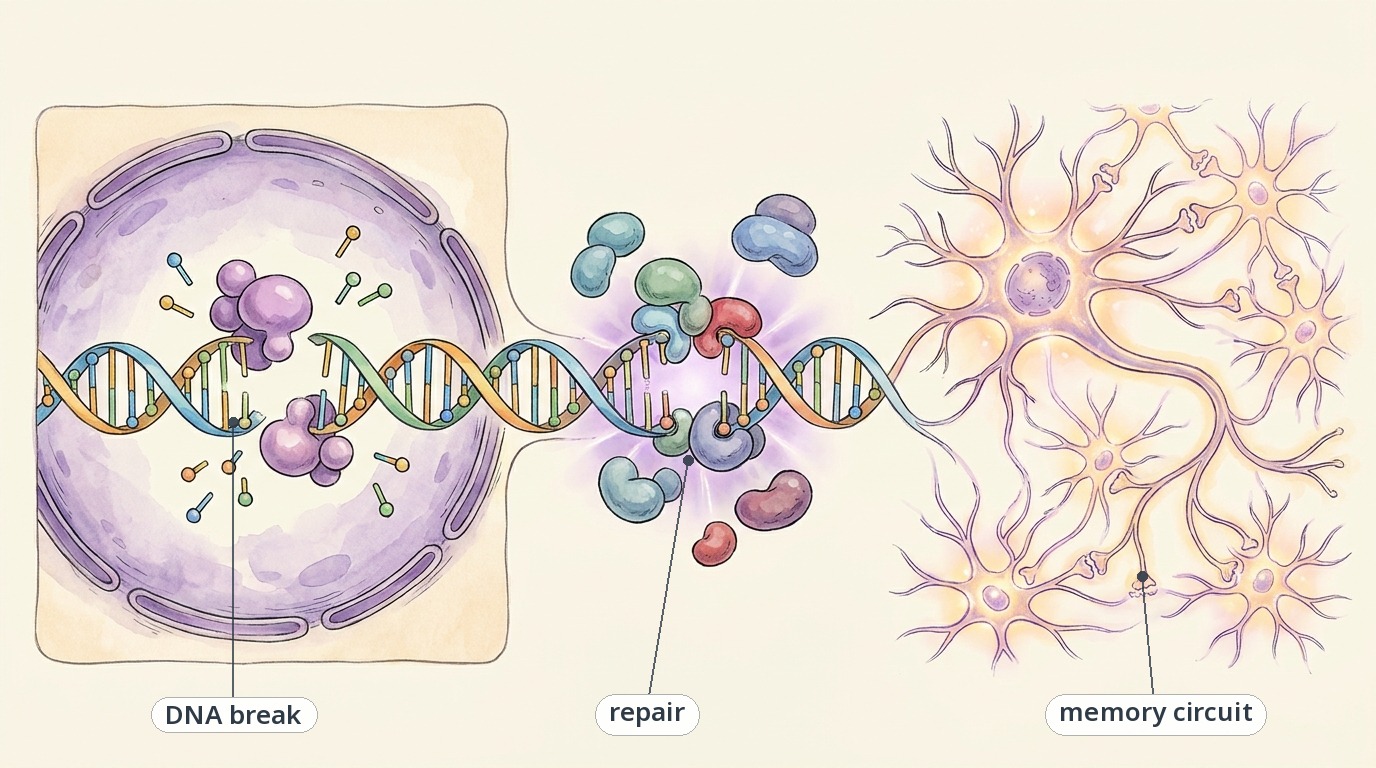
▲ A memory is born: cut the DNA → repair → join the memory circuit
How: this section is about understanding your brain; there's nothing you need to "do". What you can take away: - While learning something new, protect your sleep (Sleep About 7 Hours) to give your brain recovery time. - Aim for "hard but not crashing". Don't pull consecutive all-nighters to cram.
How solid is the evidence? (C): the mechanism comes from top journals and the chain is complete, but it's mostly mouse and cell work. Whether the human brain works the same way, and whether lifestyle can influence it, has no direct evidence yet.
For programmers: when you're learning something new, your brain is physically refactoring. Give it time to compile.
Limits: "adaptive breaks" doesn't mean "the more you learn, the more breaks, the better". This is a mechanism explainer; don't stretch it into "learning damages your brain".
Author's note: To write one new memory, the brain snaps its own DNA and stitches it back together. Of everything in this guide, this is the one I most want to animate. It changes how you see every "I got it".
📚 References (3, verified on PubMed)
1. Madabhushi R, et al. Activity-Induced DNA Breaks Govern the Expression of Neuronal Early-Response Genes. *Cell*. 2015;161(7):1592-605. (PMID: 26052046) 2. Pollina EA, et al. A NPAS4-NuA4 complex couples synaptic activity to DNA repair. *Nature*. 2023;614(7949):732-741. (PMID: 36792830) 3. Jovasevic V, et al. Formation of memory assemblies through the DNA-sensing TLR9 pathway. *Nature*. 2024;628(8006):145-153. (PMID: 38538785)Attention Can Tune Inflammation ⭐
Evidence C (one human study, three preregistered experiments) | 🧪 Worth a try | Pain point: mind–body interaction | Pillar: H10 Altered intercellular communication (neuro–immune crosstalk)
In one line: Gently directing your attention to a bodily sensation made an acute skin inflammation about a third smaller. In 2026, this was measured in humans for the first time.
Sound familiar? A mosquito bite: does it itch more when you ignore it, or when you focus on it? We usually assume "don't think about it" is best.
Why:
Think of it this way: the brain doesn't just read the body's sensor data; it can also push configuration back down.
A 2026 study in Nature Human Behaviour used a controlled acute skin inflammation as a model and ran three preregistered experiments. The same person either attended to the bodily sensation or was distracted by something else. Results: - With attention on the body, the inflammatory response was about two-thirds of what it was when distracted (the paper reports roughly a 1.5-fold difference). - The effect was consistent: about 90% of participants across two independent groups showed it. - Two mechanisms: attention changed how much the brain "amplified" the same sensory input, and it engaged the parasympathetic (vagal) system from the top down.
Interestingly, distraction reduces how much pain hurts. But for inflammation, this study suggests that paying attention to the body kept the immune response more controlled.
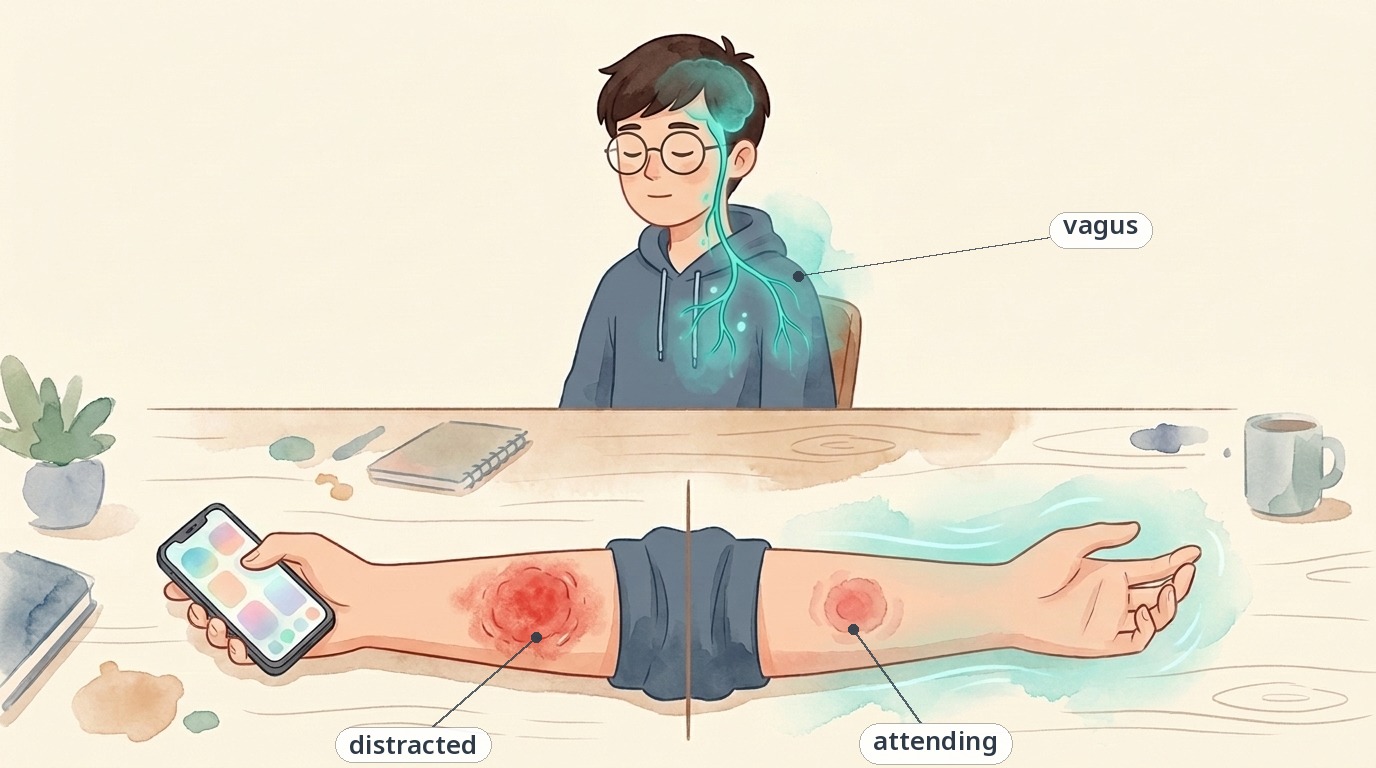
▲ Distracted vs. attending to the body: same skin inflammation, different response
How: when you get an acute, local discomfort (a bug bite, a local irritation), gently direct your attention to that spot for 2–3 minutes. Just observe the sensations (warmth, itch, throbbing). Don't try to "visualize healing", and don't scratch.
How solid is the evidence? (C): a single paper, but it contains three preregistered experiments and two independent samples with consistent results. Other teams still need to replicate it, and so far it has only been tested on acute skin inflammation.
For programmers: irritation after an interruption, a sore back from sitting: spend 2 minutes observing it first, then decide what to do (see Ten Minutes of Meditation).
Limits: this does not replace any treatment. For chronic inflammation or autoimmune disease, follow your doctor. The size and scope of the effect need more research.
Author's note: "Healing with your mind" is a hotbed of wellness nonsense. But this paper shows that the conversation between attention and immunity is real. It's about steering, not curing. I included it to show how to tell "surprising with early evidence" from "just surprising".
📚 References (1, verified on PubMed)
1. Mizrachi N, et al. Voluntary attention regulates acute immune responses in humans. *Nat Hum Behav*. 2026. (PMID: 42608466)40Hz Light-and-Sound Stimulation
Evidence C (early human trials in Alzheimer's; healthy people = extrapolation) | 📖 Good to know (devices 💸) | Pain point: "brain boosting" | Pillar: H10 Altered intercellular communication
In one line: Light flickering 40 times a second plus a 40Hz tone helps mouse brains flush out more amyloid. Human trials have only just started, and there's no evidence it "boosts" healthy brains.
Sound familiar? Your feed is full of "40Hz focus music" and "40Hz sleep lamps". The comments say they sharpen focus and prevent dementia. Devices cost from tens to hundreds of dollars.
Why:
Think of the brain's neurons as a choir. When you're awake and focused, they keep a tight beat of about 40 per second, called the gamma rhythm. In Alzheimer's disease, that beat falls apart.
Li-Huei Tsai's lab at MIT had a simple idea: supply a 40Hz beat from outside and let the brain lock back on. - Mice: daily 40Hz light and sound improved pathology and cognition in Alzheimer's model mice (Cell 2019). - Why it works: a 2024 Nature paper offered an answer: 40Hz stimulation boosts glymphatic clearance of amyloid, helping the brain drain. That's the same drainage system as in Face-and-Neck Lymphatic Massage: one pushes from the inside, the other presses from the outside. - Humans: a small trial in mild Alzheimer's (15 randomized participants) found that 1 hour a day for 3 months was safe and feasible, and the brain did follow the beat (PLoS One 2022). In an extension study, 5 patients used it for 2 years with no adverse events; 3 of them declined more slowly than a comparison population (2025).
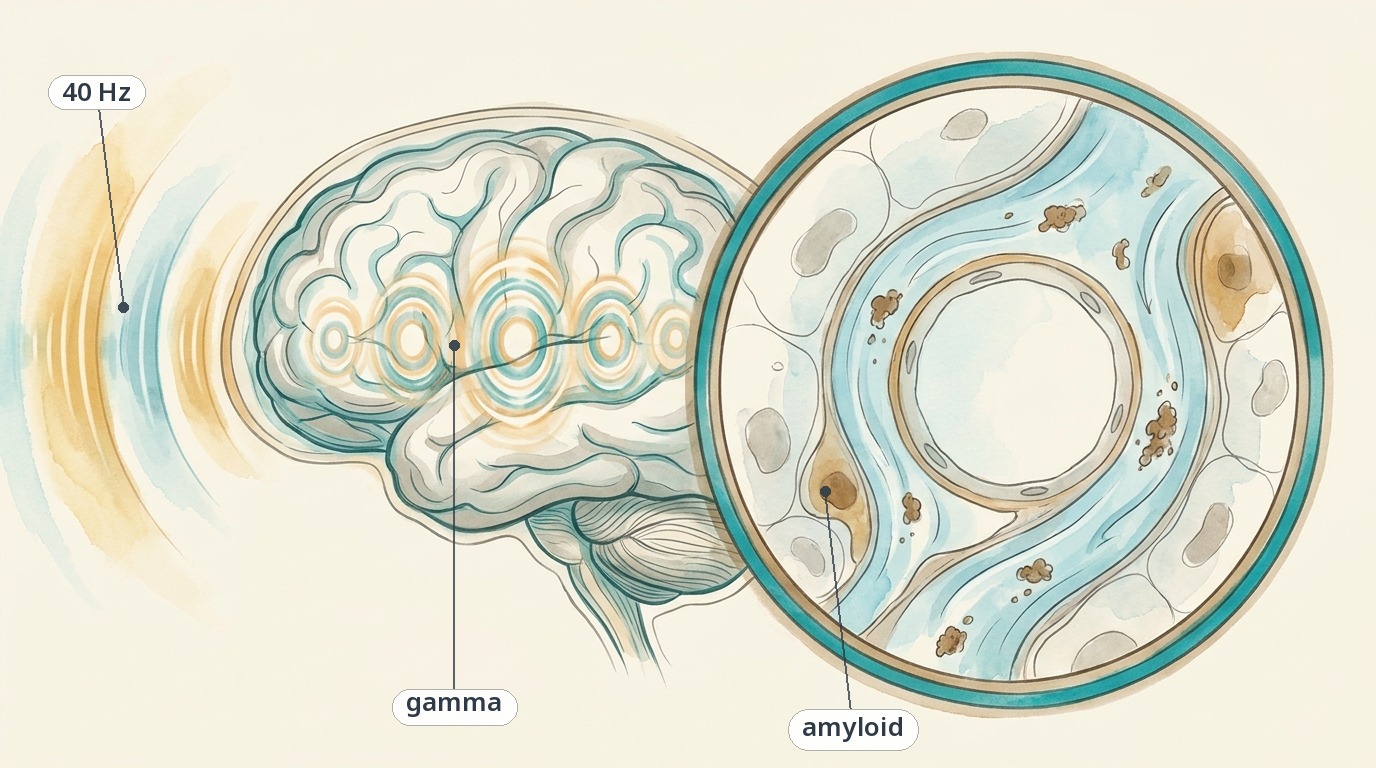
▲ The brain's choir: the 40Hz beat and glymphatic clearance
How: - Just know about it. We don't recommend any device yet. - If you're healthy and want to keep your brain in rhythm, exercise, socializing and learning new things are free sources. - If an older relative has mild cognitive impairment or Alzheimer's, look for legitimate clinical trials and take part under a doctor's guidance.
How solid is the evidence? (C): mechanism and animal data come from top journals, but they don't all agree: György Buzsáki's lab at NYU repeated 40Hz flicker in two Alzheimer's mouse models, recorded directly with electrodes, and saw no gamma entrainment in deep regions like the hippocampus and no drop in amyloid (Soula 2023). human data are limited to small and open-label studies in Alzheimer's patients, with no large RCT. There is no trial evidence at all for healthy young people using it to boost the brain, sleep better or focus. That's extrapolation.
For programmers: stay skeptical of "40Hz focus music". The use case selling best is exactly the one with the thinnest evidence.
Limits: people with epilepsy or photosensitivity should not use flickering light. Don't buy expensive devices to "boost" a healthy brain.
Author's note: 40Hz is the most futuristic section in the book: it comes from MIT, the story is great, and in 2024 it even got a "brain flushing" mechanism. But another top lab couldn't reproduce it in mice, and for healthy brains it's pure extrapolation. Wait for the human evidence; don't buy a ticket to the trailer.
📚 References (6, verified on PubMed)
1. Martorell AJ, et al. Multi-sensory Gamma Stimulation Ameliorates Alzheimer's-Associated Pathology and Improves Cognition. *Cell*. 2019;177(2):256-271.e22. (PMID: 30879788) 2. Murdock MH, et al. Multisensory gamma stimulation promotes glymphatic clearance of amyloid. *Nature*. 2024;627(8002):149-156. (PMID: 38418876) 3. Chan D, et al. Gamma frequency sensory stimulation in mild probable Alzheimer's dementia patients: Results of feasibility and pilot studies. *PLoS One*. 2022;17(12):e0278412. (PMID: 36454969) 4. Chan D, et al. Gamma sensory stimulation in mild Alzheimer's dementia: An open-label extension study. *Alzheimers Dement*. 2025;21(10):e70792. (PMID: 41137616) 5. Blanco-Duque C, et al. Audiovisual gamma stimulation for the treatment of neurodegeneration. *J Intern Med*. 2024;295(2):146-170. (PMID: 38115692) 6. Soula M, et al. Forty-hertz light stimulation does not entrain native gamma oscillations in Alzheimer's disease model mice. *Nat Neurosci*. 2023;26(4):570-578. (PMID: 36879142)Chapter 2 · Yang Qi and Mitochondria
What does the "Yang Qi" of Chinese medicine have to do with the power plants inside your cells? A bold mapping, a new warming menu, and two ways to train and protect your mitochondria.
Yang Qi and Mitochondria: A New Warming Menu ⭐
Evidence: the mapping itself D | menu items B–C | 📖 Good to know + 🧪 food is worth a try | Pain point: always cold, tired, out of battery by mid-afternoon | Pillar: H7 Mitochondrial dysfunction
In one line: What Chinese medicine calls "Yang Qi" looks a lot like what mitochondria do. Following that mapping, we can write a new "warming" menu that traditional recipes never included.
Sound familiar? Cold hands and feet, always chilly, out of energy by 3 p.m. Your relatives say you're "Yang-deficient" and tell you to drink ginger tea and eat lamb in winter.
Why:
In Chinese medicine, "Yang Qi" mainly does three things: warming (keeping the body warm), driving (giving you energy) and guarding (protecting and repairing). Coincidentally, mitochondria also do three things: make heat, make energy, and run quality control on themselves. In 2022, a Chinese research team formally proposed in a journal that mitochondria are the body's "essence of Yang Qi" (Luo 2022).
| Yang Qi function | Mitochondrial counterpart | In programmer terms |
|---|---|---|
| Warming: warm hands and feet | Heat: mitochondria in brown fat can "uncouple", turning energy straight into heat | The power supply runs warm |
| Driving: energy | Power: making ATP, the cell's universal currency | Supplying power |
| Guarding: recovery | Quality control: damaged mitochondria are recycled (mitophagy) and new ones are built | Bad-block recycling + scaling out |
The value of this table isn't proving Chinese medicine right. It's that it generates new questions: if "warming Yang" means helping mitochondria do these three jobs, which foods do the same work without being traditionally called "warming"?
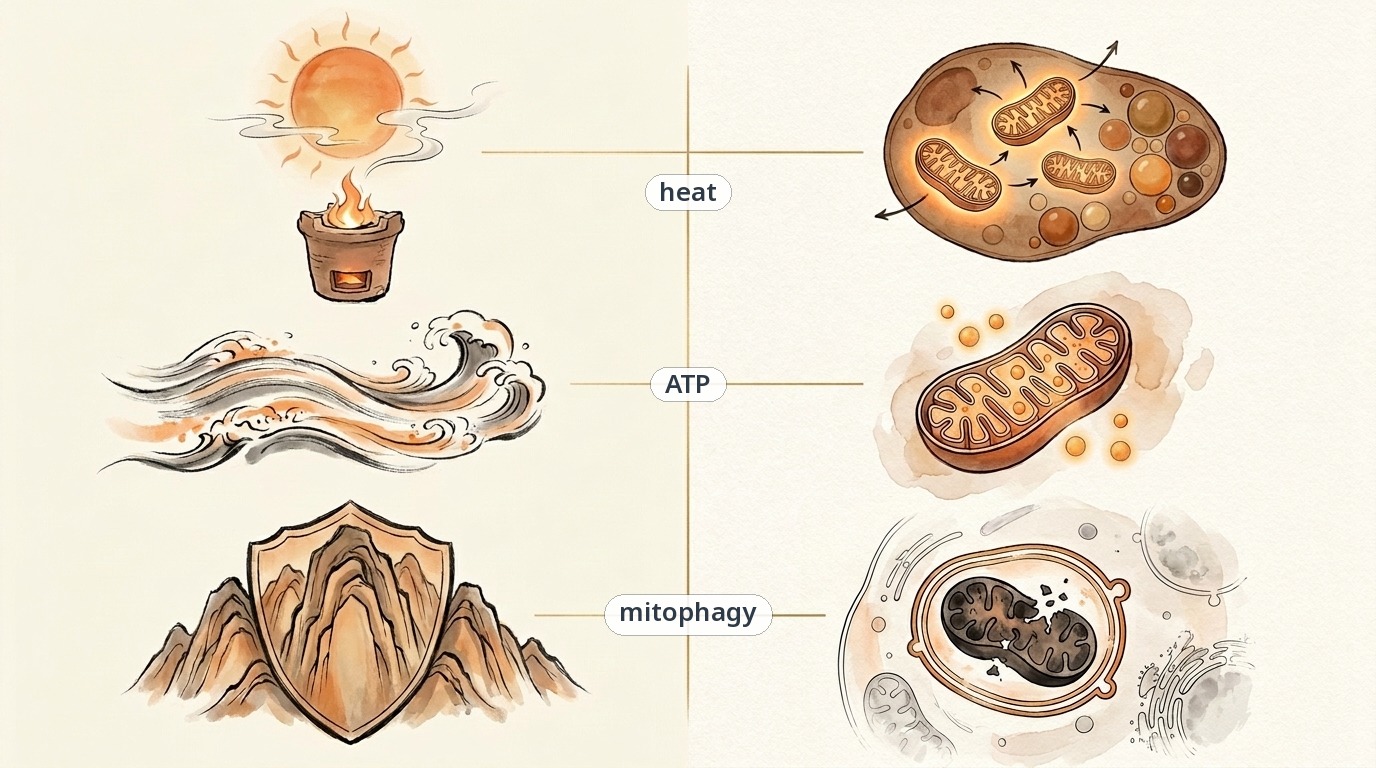
▲ Three jobs of Yang Qi × three jobs of mitochondria (a mapping hypothesis)
Step 1: traditional warming foods, through a modern lens
| Food | Traditional view | Possible modern counterpart | Evidence |
|---|---|---|---|
| Ginger | Warms the middle, dispels cold | Small human study: a ginger drink with breakfast increased post-meal heat production (Mansour 2012, 10 men) | C |
| Chili pepper | "Hot" in nature | Capsaicin and non-pungent capsinoids activate brown-fat heat production via the TRPV1 receptor, with human data (Saito 2020 review) | B |
| Cinnamon | Strengthens the fire, supports Yang | Cinnamaldehyde makes fat cells produce heat directly (Jiang 2017, cells and mice) | C |
| Lamb | Warming tonic | Rich in L-carnitine, the "porter" that carries fatty acids into mitochondria; but gut bacteria turn carnitine into TMAO, linked to atherosclerosis (Koeth 2013) | C ⚠️ |
| Walnut | Tonifies kidney, warms lung | Rich in ellagitannins, which gut bacteria can convert into urolithin A, a mitophagy activator (see below) | B–C |

▲ New warming menu: traditional warming foods on the left, foods chosen by mitochondrial logic on the right
Step 2: new "warming" foods, chosen by mitochondrial logic
Traditional food therapy doesn't classify these as warming, but by mitochondrial logic they do the same kind of work. This is our mapping hypothesis, and each item is graded on its own.
| New food | Which job it helps mitochondria with | Evidence |
|---|---|---|
| Pomegranate, raspberry, walnut (→ urolithin A) | Guarding: triggers mitophagy to recycle damaged mitochondria. In human RCTs, urolithin A supplements improved muscle strength and exercise performance in middle-aged adults, and some muscle endurance measures in older adults (the primary endpoint in the older-adult trial, walking distance, did not improve) (Andreux 2019; Singh 2022; Liu 2022) | B (supplement trials); how much your gut makes from food varies with your microbiome |
| Beetroot, spinach, arugula (dietary nitrate) | Driving: in humans, dietary nitrate made mitochondrial energy production more "fuel-efficient" (Larsen 2011) | B |
| Mushrooms (ergothioneine) | Guarding: mitochondrial antioxidant; see Ergothioneine and Mushrooms | C |
| Wheat germ, natto (spermidine) | Guarding: autophagy; see Spermidine and Wheat Germ | C |
Testable predictions (researchers welcome): 1. If the mapping holds, people who feel "Yang-deficient" should have lower brown-fat activity, lower resting metabolic rate, or poorer muscle mitochondrial function. 2. Both traditional warming foods and the "new warming foods" above should produce measurable changes in heat production or mitochondrial markers.
Both can be tested with existing methods: PET-CT for brown fat, indirect calorimetry for metabolic rate, magnetic resonance spectroscopy for muscle mitochondrial function. A mapping earns its place only if it can be falsified.
How: if you're often cold and tired: 1. Put the big rocks in first: Zone 2 Walking (the most reliable way to train mitochondria), strength training (Strength Training Twice a Week), and sleep. 2. At the table: cook with ginger; add chili if you like heat; a handful of walnuts a day; a few times a week, pomegranate or raspberries, beetroot or dark leafy greens, and mushrooms. 3. Lamb in winter is fine, but keep total red meat in check. 4. Don't take strong "warming" herbs such as aconite or deer antler on your own; they require a qualified practitioner.
How solid is the evidence?: the mapping itself is D (hypothesis). Each menu item is graded separately (B–C). Overall: a direction worth studying, and something you can try cheaply at the table.
For programmers: "boosting Yang Qi" in three lines of code: train your mitochondria (Zone 2), repair them (sleep), feed them (the new warming menu).
Limits: "Yang deficiency" is a diagnostic concept in Chinese medicine and needs professional judgment. Hypothyroidism and anemia also make people cold and tired; rule them out at a hospital first. If your stomach is sensitive, go easy on chili. Urolithin A and nitrate supplements are not what this section recommends; it's about food only.
Author's note: I put the deepest water in the book right at the start. However beautiful "Yang Qi = mitochondria" is, it's a hypothesis. But a good hypothesis can produce a new menu and falsifiable predictions, which is far more useful than arguing over whether Chinese medicine is "scientific". The grade on this section is the attitude of the whole guide: we say exactly as much as the evidence supports.
📚 References (11, verified on PubMed)
1. Luo B, et al. Mitochondria as the Essence of Yang Qi in the Human Body. *Phenomics*. 2022. (PMID: 36939762) 2. Yang J, et al. From ancient wisdom to modern science: Gut microbiota sheds light on property theory of traditional Chinese medicine. *J Integr Med*. 2024. (PMID: 38937158) 3. Mansour MS, et al. Ginger consumption enhances the thermic effect of food and promotes feelings of satiety without affecting metabolic and hormonal parameters in overweight men: a pilot study. *Metabolism*. 2012;61(10):1347-52. (PMID: 22538118) 4. Saito M, et al. Brown Adipose Tissue, Diet-Induced Thermogenesis, and Thermogenic Food Ingredients: From Mice to Men. *Front Endocrinol (Lausanne)*. 2020;11:222. (PMID: 32373072) 5. Jiang J, et al. Cinnamaldehyde induces fat cell-autonomous thermogenesis and metabolic reprogramming. *Metabolism*. 2017;77:58-64. (PMID: 29046261) 6. Koeth RA, et al. Intestinal microbiota metabolism of L-carnitine, a nutrient in red meat, promotes atherosclerosis. *Nat Med*. 2013;19(5):576-85. (PMID: 23563705) 7. Ryu D, et al. Urolithin A induces mitophagy and prolongs lifespan in C. elegans and increases muscle function in rodents. *Nat Med*. 2016;22(8):879-88. (PMID: 27400265) 8. Andreux PA, et al. The mitophagy activator urolithin A is safe and induces a molecular signature of improved mitochondrial and cellular health in humans. *Nat Metab*. 2019;1(6):595-603. (PMID: 32694802) 9. Singh A, et al. Urolithin A improves muscle strength, exercise performance, and biomarkers of mitochondrial health in a randomized trial in middle-aged adults. *Cell Rep Med*. 2022;3(5):100633. (PMID: 35584623) 10. Liu S, et al. Effect of Urolithin A Supplementation on Muscle Endurance and Mitochondrial Health in Older Adults: A Randomized Clinical Trial. *JAMA Netw Open*. 2022;5(1):e2144279. (PMID: 35050355) 11. Larsen FJ, et al. Dietary inorganic nitrate improves mitochondrial efficiency in humans. *Cell Metab*. 2011;13(2):149-59. (PMID: 21284982)Zone 2 Walking
Evidence B (activity and mortality: large cohorts) | ✅ Do it | Pain point: low stamina, out of battery by afternoon | Pillar: H7 Mitochondrial dysfunction
In one line: An intensity where you can still talk in full sentences but can't sing, 3–5 times a week, is the cheapest class you can give your mitochondria.
Sound familiar? Three flights of stairs and you're out of breath. Your battery is empty by 3 p.m. You bought a gym membership and went three times all year.
Why:
Think of mitochondria as the cell's power supply units. Leave them idle and they throttle down and shrink. Give them a steady moderate load and they scale out: more of them, running more efficiently.
Zone 2 is a moderate intensity range: heart rate around 60–70% of your maximum, fueled mainly by mitochondria burning fat, without getting too breathless to talk. It challenges your mitochondria enough, while staying easy enough to recover from, so you can do it often.
Back in 1967, Holloszy found in animal muscle that endurance training sharply increased the activity of mitochondrial respiratory enzymes. That finding has been confirmed again and again for more than half a century. And declining mitochondrial function is one of the twelve hallmarks of aging (see The Twelve Pillars).
This is the "train your mitochondria" from Yang Qi and Mitochondria: if you want to feel warmer and stronger, the most reliable approach isn't what you eat, it's moving.
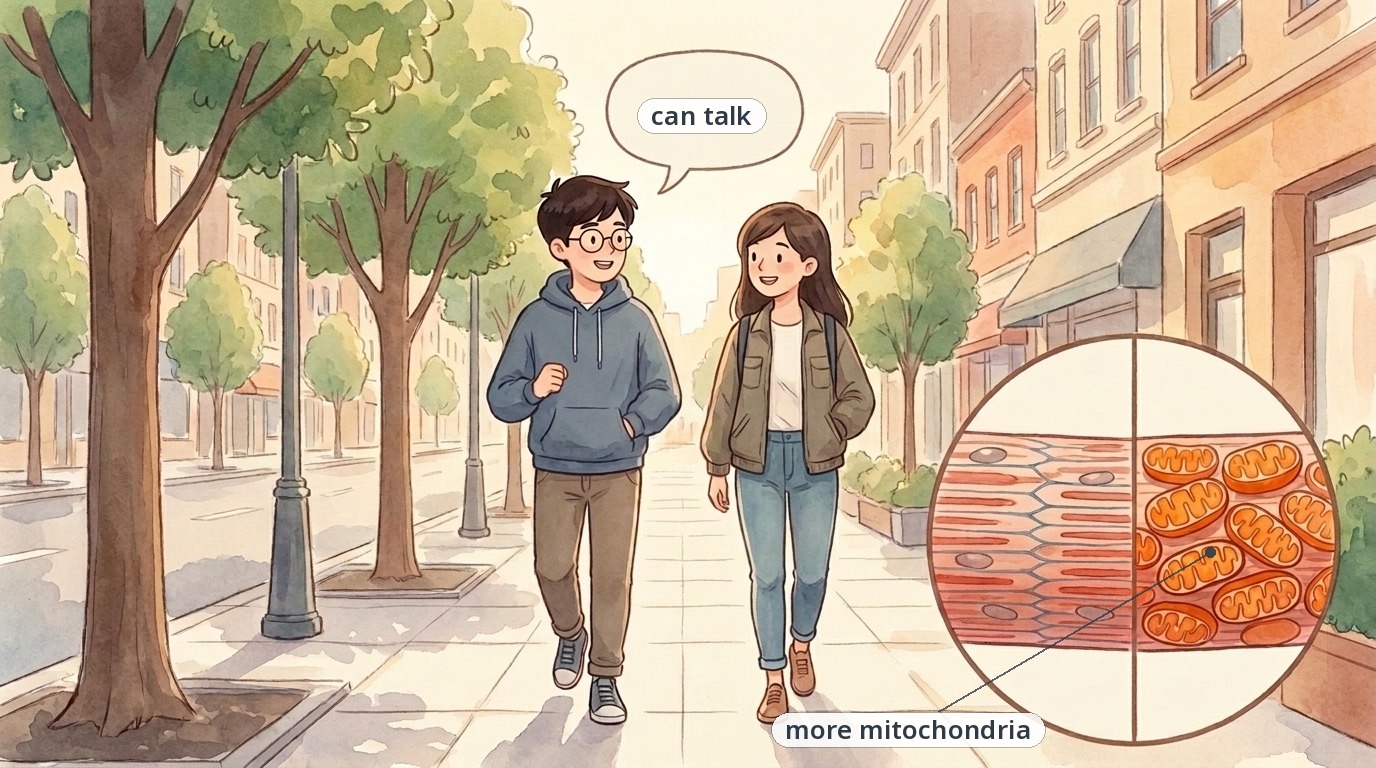
▲ A training class for mitochondria: you can talk, but you can't sing
How: 3–5 times a week, 30–45 minutes each: brisk walking, easy jogging or cycling all count. Use the talk test: you can speak full sentences but can't sing. No heart-rate monitor needed.
How solid is the evidence? (B): - A pooled analysis of 660,000 people followed for 14 years found a dose–response relationship between leisure-time moderate-to-vigorous activity and death. People meeting the guideline minimum (150 minutes of moderate activity a week) had about a 30% lower risk of death than inactive people; at 3–5 times the minimum, about 40% lower; no harm was seen at higher levels (Arem 2015). - Why not A: these are cohort studies, not randomized trials, and they measured total activity, not "Zone 2" specifically. Zone 2 is a sensible range in exercise physiology for training mitochondria, but direct evidence that it beats other intensities is limited.
For programmers: walk the last kilometer of your commute briskly; loop the building before a code review; cycle instead of taking a cab on weekends. No change of clothes, no gym.
Limits: if you have a history of heart disease, check with your doctor first. Start with 15–20 minutes a session.
Author's note: Longevity research keeps coming back to mitochondria, and Zone 2 is the cheapest class you can give them: no membership, no gear. "Can talk, can't sing" is all you need to remember.
📚 References (2, verified on PubMed)
1. Holloszy JO. Biochemical adaptations in muscle. Effects of exercise on mitochondrial oxygen uptake and respiratory enzyme activity in skeletal muscle. *J Biol Chem*. 1967;242(9):2278-82. (PMID: 4290225) 2. Arem H, et al. Leisure time physical activity and mortality: a detailed pooled analysis of the dose-response relationship. *JAMA Intern Med*. 2015;175(6):959-67. (PMID: 25844730)Ergothioneine and Mushrooms
Evidence C (observational cohorts) | 🧪 Food is worth a try; supplements 💸 | Pain point: the "longevity vitamin" | Pillars: H7 Mitochondrial dysfunction · H11 Chronic inflammation
In one line: Your body built a dedicated transporter just to absorb ergothioneine, found mainly in mushrooms, and older adults with more of it in their blood have a lower risk of dementia. Cooking some mushrooms is the cheapest longevity bet there is.
Sound familiar? Every time you order takeout, you agonize over what counts as "healthy".
Why:
If a system ships a dedicated installer for one dependency, that dependency is probably important.
Ergothioneine is an antioxidant the human body can't make; it has to come from food, and mushrooms are the main source. Human cells carry a transporter dedicated to it, which actively pulls it into cells so it accumulates in some tissues. That's why some scientists call it a "longevity vitamin".
Population evidence is building: - Japan's Hisayama Study: 1,344 adults aged 65+ without dementia at baseline, followed for a median of 11.2 years. Higher serum ergothioneine was linked to lower risk of all-cause dementia and Alzheimer's disease, even after adjusting for cardiovascular factors, lifestyle and vegetable intake (2025). - Older adults at memory clinics: low plasma ergothioneine predicted faster cognitive and functional decline (2022). - A Singapore community study: older adults who ate mushrooms more often had lower rates of mild cognitive impairment (2019, cross-sectional).
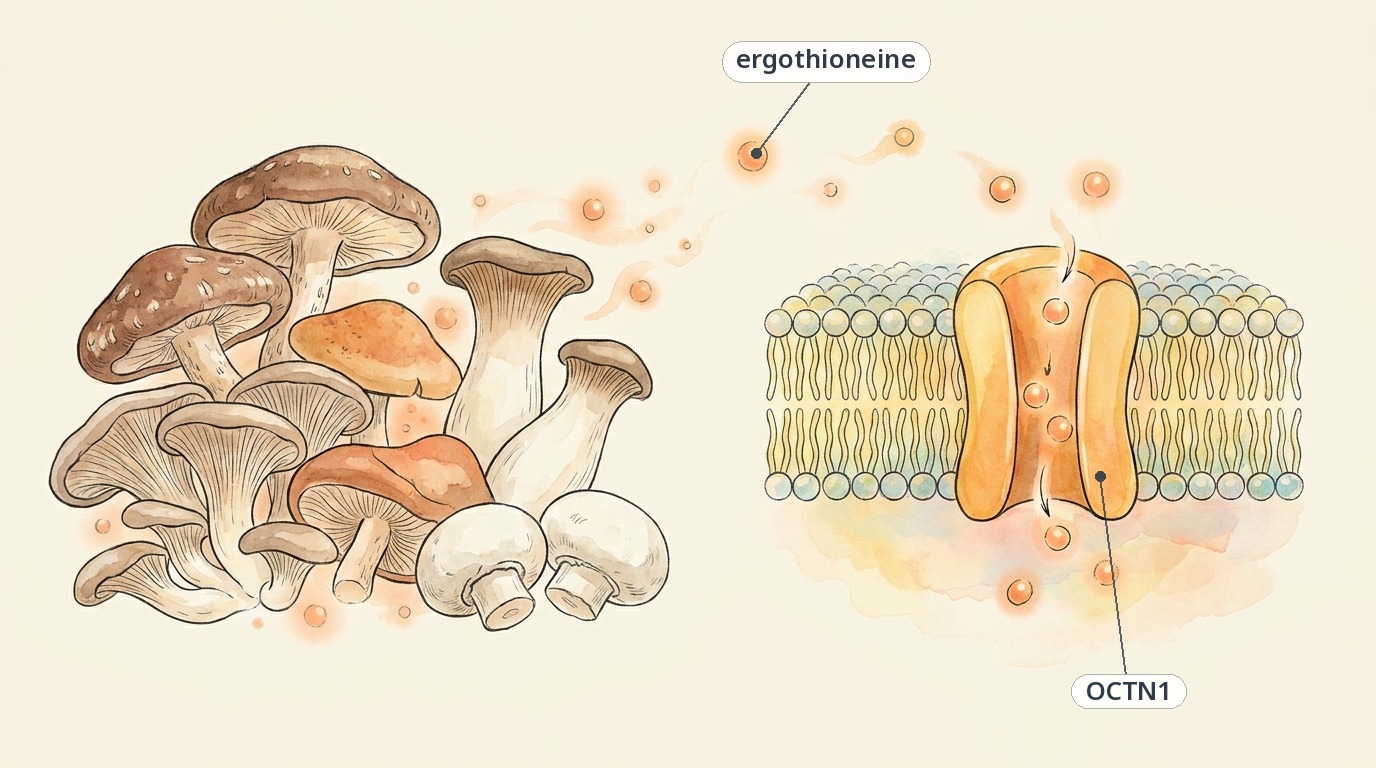
▲ A dedicated porter: ergothioneine from mushrooms enters cells through its own transporter
How: put mushrooms in your meals (shiitake, oyster, king oyster, button), 2–3 times a week, rotating varieties. Food first; we don't recommend supplements yet.
How solid is the evidence? (C): all observational. It shows association, not proof that eating mushrooms prevents dementia. No large human trial has tested whether ergothioneine supplements prevent cognitive decline.
For programmers: adding a mushroom dish to your takeout order is the laziest longevity investment you can make.
Limits: observational evidence isn't causation. Don't stock up on pricey ergothioneine supplements. Make sure wild mushrooms are positively identified as edible.
Author's note: Correlation isn't causation. But when the thing to do is as near-zero-risk as cooking mushrooms, observational evidence is enough to place the order. Call it Bayesian menu planning.
📚 References (3, verified on PubMed)
1. Meng X, et al. Serum ergothioneine and risk of dementia in a general older Japanese population: the Hisayama Study. *Psychiatry Clin Neurosci*. 2025;79(12):808-816. (PMID: 40908798) 2. Wu LY, et al. Low Plasma Ergothioneine Predicts Cognitive and Functional Decline in an Elderly Cohort Attending Memory Clinics. *Antioxidants (Basel)*. 2022;11(9). (PMID: 36139790) 3. Feng L, et al. The Association between Mushroom Consumption and Mild Cognitive Impairment: A Community-Based Cross-Sectional Study in Singapore. *J Alzheimers Dis*. 2019;68(1):197-203. (PMID: 30775990)Chapter 3 · Age Is Not a Number
A face, a tube of blood, a history of stress: each one can tell you a little about how old you "really" are, though none gives an exact reading.
Your Face Can Reveal Your Biological Age ⭐
Evidence C (large-sample models, holds at the population level) | 📖 Good to know | ⚠️ Conflict of interest | Pain point: am I aging fast? | Pillar: none (a clock that reads age from the face; read alongside The Methylation Clock)
In one line: Grandma used to say "a dark shadow between your brows means you need rest." A Chinese research team turned that kind of face reading into an AI clock built on thermal images of the face. It predicts metabolic disease, and the "face age" it reads can be changed by exercise.
Sound familiar? At a class reunion, some people look ten years younger than their age and some look ten years older. Does "how old you look" actually mean anything?
Why:
Think of your face as a free monitoring dashboard that nobody knew how to read.
- The thermal clock (ThermoFace, Cell Metab 2024): the team took infrared thermal images of the faces of 2,811 Han Chinese people aged 20–90 and trained a "thermal age" model. Its average error was about 5 years, and 5.18 years when tested on a separate, independent group. The gap between someone's thermal age and their real age tracked their metabolic markers and sleep time, along with changes in blood pathways such as DNA repair and fat breakdown. The same method predicted metabolic diseases like fatty liver fairly accurately. The key line: this gap can be changed by exercise.
- The multimodal clock (AURORA, Cell Metab 2026): the same team (Han Jing-Dong's group at Peking University) pooled seven kinds of data (gene expression, metabolites, gut microbes, 3D and thermal face images, routine lab tests) from 581,763 samples and 425,258 people, and trained a generative AI platform on them. Give it just a face or a routine check-up, and it fills in a "multi-omics" profile covering gene expression, metabolism, microbes and more, then estimates aging and disease risk.
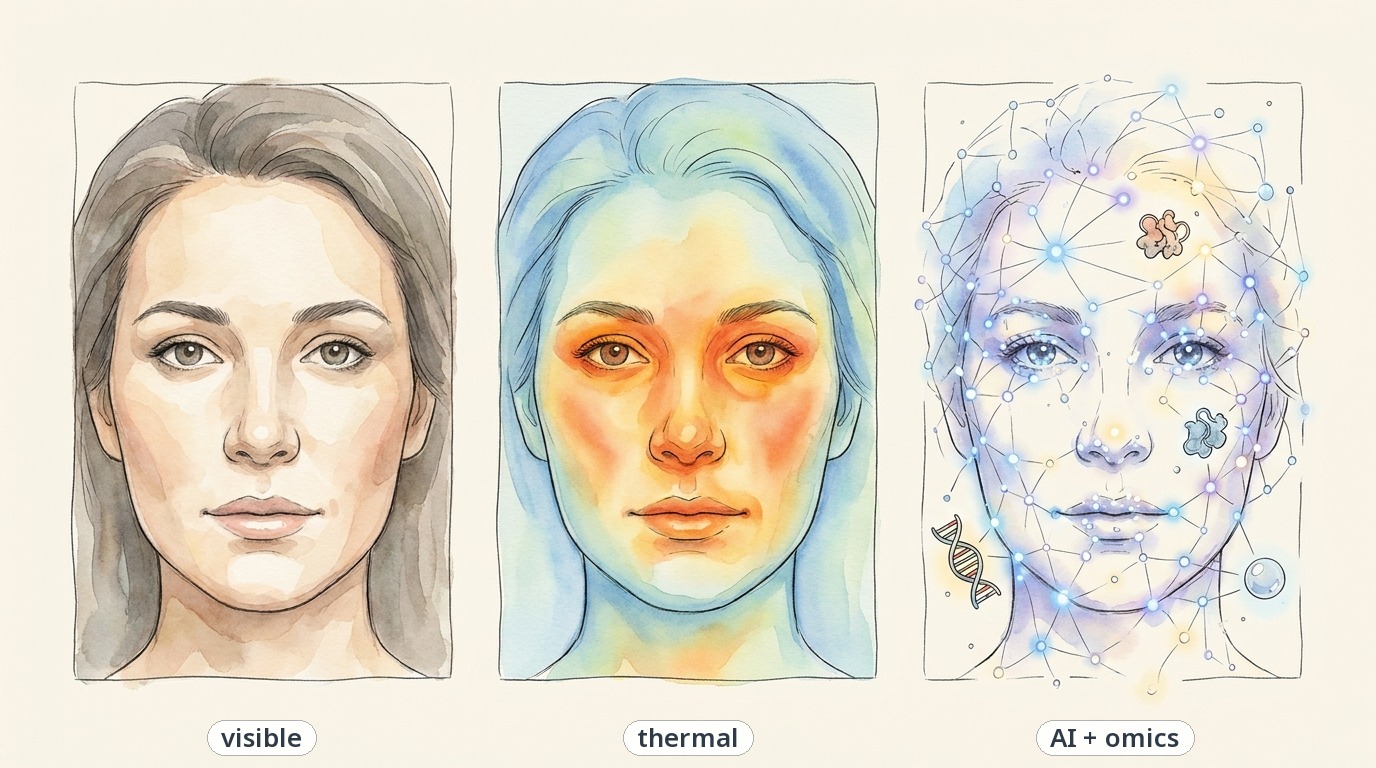
▲ One face, three readings: the naked eye, an infrared heat map, AI-completed multi-omics
How: - Understand what "face-reading" clocks like this can and can't answer. - The part you can act on is the key finding: thermal age can be changed by exercise. So go back to Move Every Day and Zone 2 Walking. - Be cautious with commercial "AI face aging tests": the models aren't transparent and their error is unknown.
How solid is the evidence? (C): - Large samples with independent validation: it holds at the population level. - Why not B: the individual error is about 5 years; these are associations, not causes; "exercise changes thermal age" so far comes mainly from this one team and needs replication; the model was trained on Han Chinese people and needs re-validation in other populations.
For programmers: the face you see in the mirror each morning is a low-end version of a free multimodal sensor. Take a proper look.
Limits: the error is large. Face-reading fortune-telling has nothing to do with this research; don't mix them up. The maintainer works in aging testing; see the conflict-of-interest statement.
Author's note: Grandma's "a dark shadow between your brows means you need rest" becomes, in machine-learning terms, "facial heat distribution has shifted, suggesting an older metabolic age." Two languages a century apart, describing the same face. Read this next to The Methylation Clock: one reads blood or saliva, the other reads your face, and both point to the same idea: age is not a number.
📚 References (2, verified on PubMed)
1. Yu Z, et al. Thermal facial image analyses reveal quantitative hallmarks of aging and metabolic diseases. *Cell Metab*. 2024;36(7):1482-1493. (PMID: 38959862) 2. Chen J, et al. A generative AI framework unifies human multi-omics to model aging. *Cell Metab*. 2026;38(6):1229-1244. (PMID: 42019500)The Methylation Clock
Evidence B (as a measurement) | 📖 Good to know | ⚠️ Conflict of interest | Pain point: how old is my body, really? | Pillar: H3 Epigenetic alterations
In one line: Chemical "bookmarks" on your DNA get messier with age, and reading them gives an estimate of biological age. What a single test should make you do is still an open question.
Sound familiar? An ad says "Find out your biological age is 8 years younger than your real one!" You're tempted. Then you wonder: how is that number calculated, and what am I supposed to do with it?
How: - First, get the concept: biological age can be measured, and different "clocks" give different readings. - When you see a commercial test, ask four questions: Which clock does it use? Does the population it was trained on look like you? How much does the result vary when the same sample is tested twice? Is there a before-and-after comparison, or just a single reading? - The real actions aren't in the test. They're in the big rocks: Move Every Day, Sleep About 7 Hours.
Why:
Think of DNA as a codebase. Methylation is the comments and feature flags attached to that code, deciding which functions get called and which are commented out. When you're young, the flags are tidy. With age, some regions pick up more and more flags while others lose theirs, like an old project maintained for years where the comments keep getting messier.
In 2013, Horvath took about 8,000 samples, picked 353 sites that change most reliably with age, and fit a model to them. Its error was only three to four years, and it worked in almost every tissue. That was the first-generation methylation clock. Later clocks got more specialized: some predict risk of death, some measure the "pace" of aging.
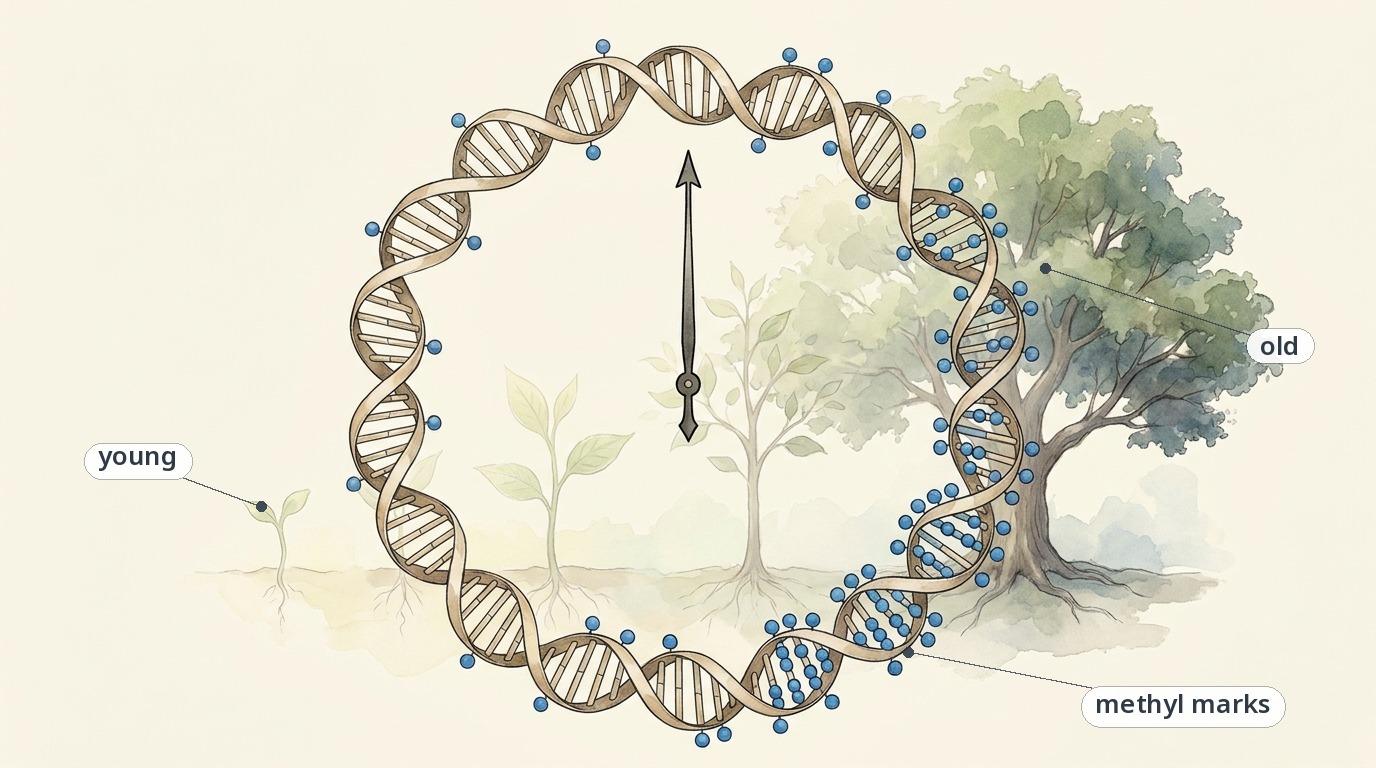
▲ The methylation clock: methyl marks on DNA change with age, and reading them estimates age
🔬 Going deeper: what the clock actually reads
Methylation means a methyl group (–CH₃) attached to a cytosine (C) in DNA, mostly at so-called CpG sites. It doesn't change the DNA sequence, but it affects whether a gene can be read. That makes it "epigenetic." In the 2023 list of twelve hallmarks of aging, epigenetic alterations are one of the pillars (see *The Twelve Pillars*). The clock itself is a statistical model: it finds that changes at these sites track age closely. That doesn't mean these sites cause aging.How solid is the evidence? (B): - As a measuring tool, the evidence is solid: clocks estimate age reliably across groups of people (Horvath 2013), and people whose newer-generation clock reads "older" go on to have higher risk of disease and death (GrimAge, Lu 2019). - As a guide to action, the evidence isn't there: "an intervention made the clock younger, so it makes you live longer" has not been shown. - Why only "Good to know": a single personal reading has error. Test the same sample twice, and some classic clocks can differ by up to 9 years; an improved algorithm brings most repeats within 1.5 years (Higgins-Chen 2022). Different clocks also give different numbers. A single reading has limited value for decisions.
For programmers: treat it as one metric on a dashboard, not an SLA. A metric drifting is worth noticing, but don't change the system just to make the metric look good.
Limits: a clock is not destiny; one test proves nothing; results from different companies or different clocks can't be compared directly. The maintainer works in aging testing; see the conflict-of-interest statement.
Author's note: This is my own field, which is exactly why I need to be clear: a clock can tell you whether you're drifting, but not yet how to fix it. Read this next to Your Face Can Reveal Your Biological Age: one reads blood or saliva, the other reads your face, and both point to the same idea: age is not a number.
📚 References (4, verified on PubMed)
1. Horvath S. DNA methylation age of human tissues and cell types. *Genome Biol*. 2013;14(10):R115. (PMID: 24138928) 2. Lu AT, et al. DNA methylation GrimAge strongly predicts lifespan and healthspan. *Aging (Albany NY)*. 2019;11(2):303-327. (PMID: 30669119) 3. Higgins-Chen AT, et al. A computational solution for bolstering reliability of epigenetic clocks: Implications for clinical trials and longitudinal tracking. *Nat Aging*. 2022;2(7):644-661. (PMID: 36277076) 4. López-Otín C, et al. Hallmarks of aging: An expanding universe. *Cell*. 2023;186(2):243-278. (PMID: 36599349)Emotion and Genome Stability
Evidence B (association) | 📖 Good to know (for action, see Ten Minutes of Meditation, Zone 2 Walking, Sleep Debt Repayment Plan) | Pain point: does long-term stress leave a mark on the body? | Pillars: H1 Genomic instability · H2 Telomere attrition · H8 Cellular senescence
In one line: Long-term stress leaves a record at the ends of your chromosomes. Managing your emotions isn't being soft; it's part of maintaining your genome.
Sound familiar? Months of crunch, firefighting production incidents, telling yourself "just push through." The project ships, and you feel years older.
How: - Treat chronic stress as something with physical consequences: 10 minutes of meditation a day (Ten Minutes of Meditation), brisk walks a few times a week (Zone 2 Walking), and paying back your sleep (Sleep Debt Repayment Plan). - Have someone you can talk to (see the big rock Someone to Talk To). - After a big stressful stretch, schedule a recovery period. Don't roll straight into the next sprint.
Why:
Think of the protective caps at both ends of a chromosome, called telomeres, as the plastic tips on shoelaces. Each time a cell divides, the tip wears down a little. Once it's too short, the cell stops dividing and becomes senescent.
In 2004, Epel and Blackburn (who later won a Nobel Prize) studied mothers caring for chronically ill children. The more stressed they felt and the more years they'd been caregiving, the shorter the telomeres in their white blood cells, and the lower the activity of telomerase, the enzyme that repairs them. Compared with the least-stressed group, the most-stressed women had telomeres shorter by the equivalent of at least ten extra years of aging. But the study had only 58 women.
Later, larger studies cooled this story down: - Pooling 22 studies and nearly 9,000 people, self-reported stress was indeed linked to telomere length, but the link was very weak, about the same size as the link between obesity and telomeres (Mathur 2016). - Pooling 38 studies and 34,000 people, people with depression had shorter telomeres, with a small effect size (Ridout 2016). - A 2025 mouse study found that long-term social stress (being chronically dominated by other mice) increased senescent cells in the body; but clearing those cells didn't improve the mice's measured health (Lyons 2025).
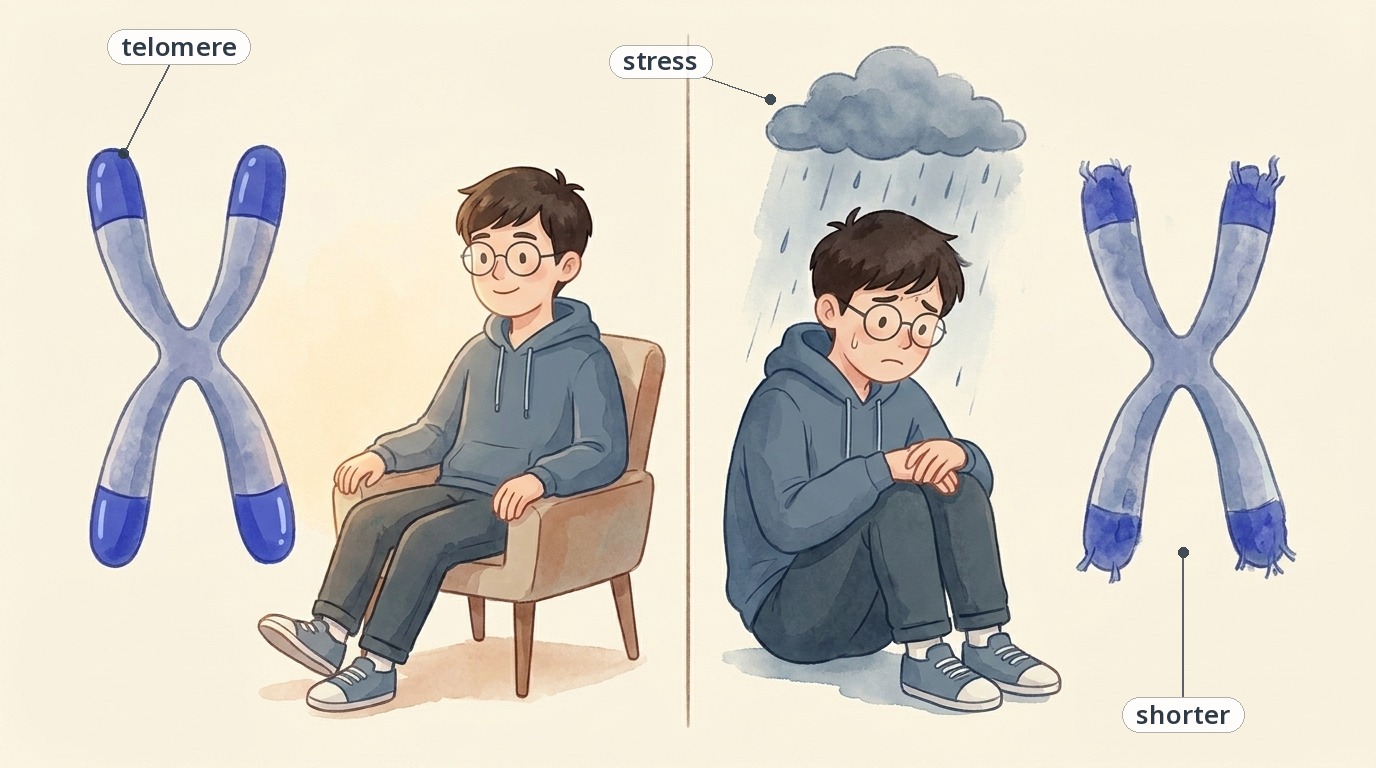
▲ Emotion and the genome: under long-term stress, the telomeres at chromosome ends are shorter
🔬 Going deeper: how stress might "wear down" telomeres
The main explanations: chronically high levels of the stress hormone cortisol, more oxidative stress, and chronic low-grade inflammation. Telomeres are rich in G bases, which are especially sensitive to oxidative damage; and with telomerase activity suppressed, the wear doesn't get repaired. Mouse studies suggest chronic stress can also drive senescent cells to build up through the p16 pathway. None of these mechanisms is fully nailed down in humans.How solid is the evidence? (B): - Human studies point the same way: stress and depression are linked to shorter telomeres (Epel 2004; Mathur 2016; Ridout 2016). - But the effect is small: for any one person, stress is just one of many factors affecting telomeres. - Why not A: these are mostly association studies; the direction of cause (does stress shorten telomeres, or does something else drive both?) is still being studied, and intervention evidence that "managing emotions lengthens telomeres" is still building.
For programmers: after a high-pressure sprint, schedule a "low-load iteration" week: no new features, leave on time, catch up on sleep. Like letting a system cool down.
Limits: association isn't causation. Depression is an illness, and treatment comes first. Telomere length is not a KPI, and we don't recommend getting it tested.
Author's note: Emotions have molecular consequences; this isn't feel-good fluff. But the larger studies also remind us that, for any single person, the effect is smaller than that first paper made it look. What I want programmers to remember isn't the word "telomere" but an engineering intuition: a system running overloaded for a long time always wears; the logs are just written somewhere you can't see.
📚 References (4, verified on PubMed)
1. Epel ES, et al. Accelerated telomere shortening in response to life stress. *Proc Natl Acad Sci U S A*. 2004;101(49):17312-5. (PMID: 15574496) 2. Mathur MB, et al. Perceived stress and telomere length: A systematic review, meta-analysis, and methodologic considerations for advancing the field. *Brain Behav Immun*. 2016;54:158-169. (PMID: 26853993) 3. Ridout KK, et al. Depression and telomere length: A meta-analysis. *J Affect Disord*. 2016;191:237-47. (PMID: 26688493) 4. Lyons CE, et al. Chronic social stress induces p16-mediated senescent cell accumulation in mice. *Nat Aging*. 2025;5(1):48-64. (PMID: 39528642)Chapter 4 · Old Remedies, New Lens

Two thousand years of experience, measured with the same evidence ruler: what already has evidence, what's still on the way, and what's only a mapping.
Ganmai Dazao Decoction and Wheat Germ ⭐
Evidence C | 📖 Good to know | Pain point: low mood, restless mind | Pillars: H5 Disabled macroautophagy · H11 Chronic inflammation
In one line: An 1,800-year-old Chinese herbal formula has wheat as its lead ingredient. Today, wheat germ is a star food in autophagy research. For the formula, see a Chinese medicine practitioner; the wheat germ can go into your breakfast.
Sound familiar? During a stressful few weeks you feel teary for no reason, your heart races, you sleep badly. An older relative once said "Ganmai Dazao decoction calms the mind," and you wonder whether that's true.
How: - Ganmai Dazao decoction is a prescription, not a recipe. If you want to use it, see a qualified Chinese medicine practitioner. - The everyday version: put wheat germ in your staple foods, for example a spoonful or two in your morning oats, or choose whole-wheat bread that keeps the germ. - If low mood lasts more than two weeks and affects work or life, see a doctor first.
Why:
Two threads meet in the same grain of wheat.
The formula thread: in Essentials from the Golden Cabinet by Zhang Zhongjing (Eastern Han dynasty, about 1,800 years ago), Ganmai Dazao decoction has just three ingredients: wheat, licorice and jujube. It was used for "zang zao," roughly emotional instability: grief, crying spells, restlessness. A 2014 meta-analysis pooled 10 randomized trials of it for depression. The results leaned positive, but all 10 were published in Chinese and their methodological quality was generally low. A 2025 mouse study suggests it may work through a "gut microbes–metabolism–inflammation" axis.
The modern thread: wheat germ is the small part of the grain that would sprout. It's the most nutrient-dense part, and one of the richest dietary sources of spermidine. Spermidine activates autophagy, the cell's garbage collection (more in Spermidine and Wheat Germ).
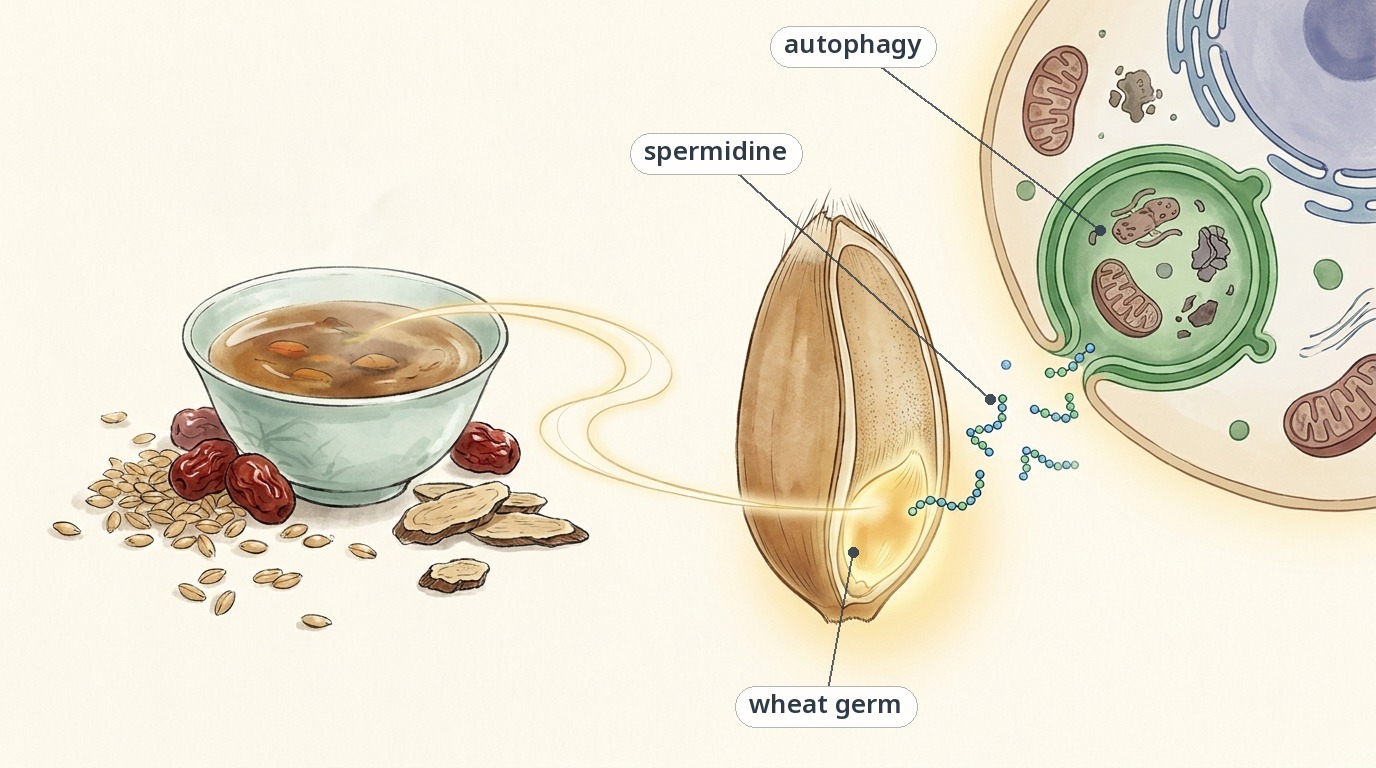
▲ One bowl of an old formula, one grain of wheat: two threads meet in wheat, but neither is evidence for the other
🔬 Going deeper: why we can't say "the ancients already knew about autophagy"
The "wheat" in the formula is whole wheat grain (often floating wheat or Huai wheat), not purified germ. How the formula works has only been studied in animals, and whether it has anything to do with spermidine has never been tested. Each thread stands on its own; where they meet is an interesting coincidence, and neither can serve as evidence for the other.How solid is the evidence? (C): - The formula: there's a meta-analysis, but the trials are few and low-quality, and the authors themselves call for more rigorous studies. The mechanism comes from animal experiments. - Wheat germ and spermidine: the food content is well established; human trials of spermidine supplements were not impressive (see Spermidine and Wheat Germ). - Why not B: there are no high-quality, large randomized trials in humans.
For programmers: in an emotional slump, give yourself a cheap breakfast ritual: a bowl of oats with wheat germ. It's not medicine, but it's kinder to your body than late-night takeout.
Limits: - Use the formula under a Chinese medicine practitioner. It is not a substitute for psychiatric treatment, and don't swap it in and out with antidepressants on your own. - The formula contains licorice, which in large amounts over long periods can raise blood pressure and lower potassium. People with high blood pressure or heart disease should be especially careful to follow medical advice. - People with celiac disease or gluten sensitivity should avoid wheat products.
Author's note: This is the most story-rich section in the guide. I'm not saying "the ancients already knew." I'm saying: one good food has held up under two completely different systems of knowledge. Tell the story beautifully; state the evidence honestly.
📚 References (2, verified on PubMed)
1. Yeung WF, et al. A meta-analysis of the efficacy and safety of traditional Chinese medicine formula Ganmai Dazao decoction for depression. *J Ethnopharmacol*. 2014;153(2):309-17. (PMID: 24632021) 2. Zhang B, et al. Gan-Mai-Da-Zao decoction ameliorates depressive-like behaviors in CUMS mice via the microbiota-metabolism-inflammation axis. *Phytomedicine*. 2025;145:157018. (PMID: 40580692)Baduanjin and the "Jin" ⭐
Evidence B (sarcopenia, balance) + D (fascia mechanism mapping) | 🧪 Worth a try | Pain point: stiff from sitting, losing muscle | Pillar: H4 Loss of proteostasis
In one line: Baduanjin, a traditional Chinese exercise of eight movements, has randomized-trial evidence for muscle and balance in older adults. The explanation that it "trains the jin" (roughly, sinews) only goes halfway.
Sound familiar? After a day of sitting, your back feels rusty when you stand up. You'd like to exercise but don't want to change clothes and go to the gym. The Baduanjin the retirees do in the park looks so slow. Does it actually do anything?
How: - Follow a video for 15–20 minutes a day. One round of the eight movements takes about 12 minutes. - The key is pull, stretch, twist: each movement should give a stretching feeling, but no pain. - Even simpler: do just the first movement, "Holding Up the Sky with Both Hands": interlace your fingers, push up with palms facing the ceiling, and stretch 5 times.
Why:
This section shows the method of the whole guide: say exactly as much as each layer of evidence supports.
- Movement layer (strongest evidence): a 2025 randomized controlled trial in Chengdu split 90 people aged 60–77 with sarcopenia (age-related muscle loss) into two groups. One did Baduanjin, the other resistance training; both trained 3 times a week, 60 minutes a session, for 24 weeks. The Baduanjin group improved more than the resistance group on physical function score, balance, leg strength and leg muscle mass.
- Tissue layer (reviews): in modern anatomy, jin corresponds to tendons, ligaments and fascia. Here we focus on fascia: the white connective tissue that wraps your muscles and links the whole body into one web. A 2025 systematic review redefined it as a "hub for mechanical signals" and a reservoir of stem cells.
- Molecular layer (reasoning): fascia is mostly collagen. Keeping proteins properly folded and maintained (proteostasis) is one of the twelve hallmarks of aging. That's where "jin = protein structure" lands in science. To be clear, though: collagen sits outside cells, while "proteostasis" in the hallmarks of aging is mainly about proteins inside cells. They're close relatives, not the same thing.
- Concept layer (blank): Chinese medicine ideas like "the liver governs the jin" have no testable counterpart that we could find in the English-language literature. We leave that blank, honestly.
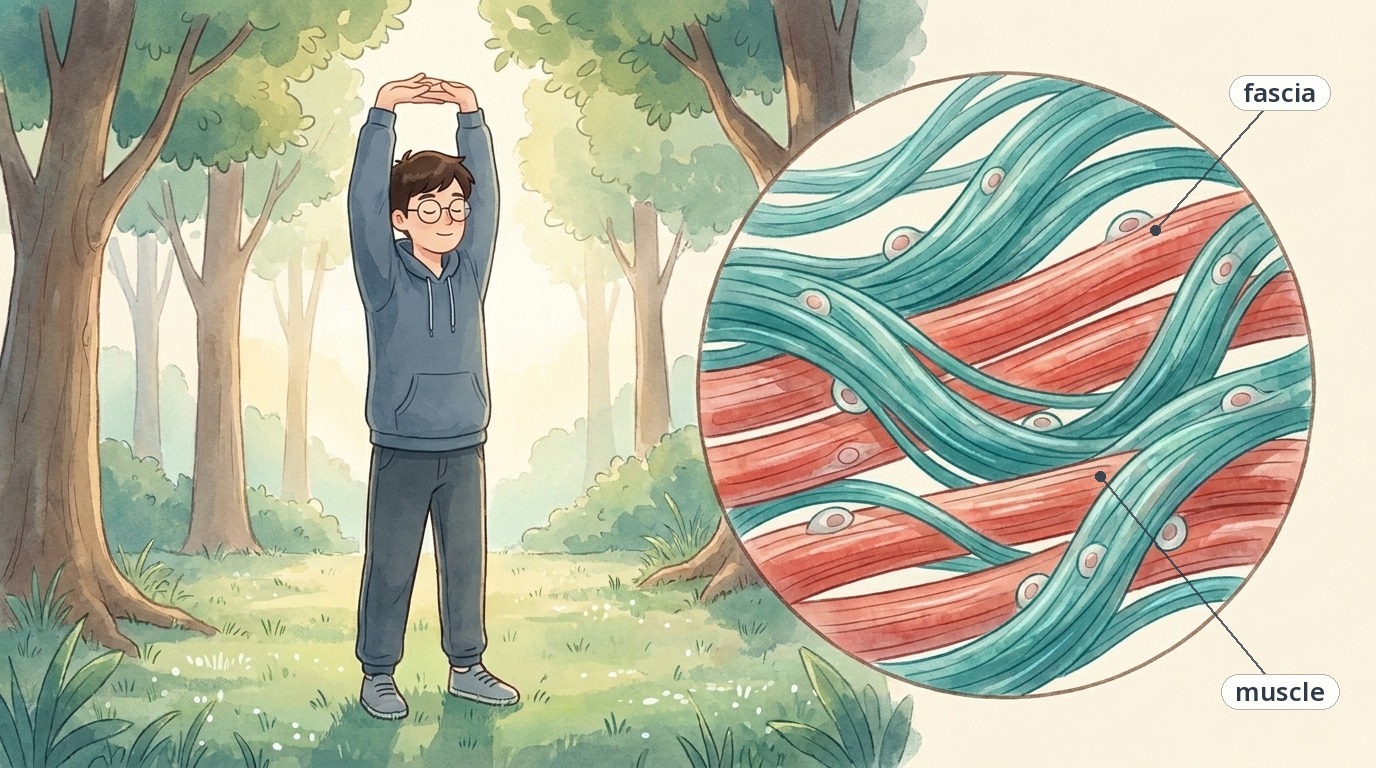
▲ Baduanjin's "Holding Up the Sky" and fascia: collagen fibers wrapping muscle
🔬 Going deeper: why slow movements still count as strength work
Many Baduanjin movements are sustained isometric holds (muscles working while joints stay still, as in horse stance) and multi-joint stretches: horse stance, twists, overhead reaches. For people who don't usually exercise and for older adults, that's enough mechanical load for muscle, so it's not that surprising it beat resistance training in the trial above. But that was a single-center trial, almost nine in ten participants were women, and all already had sarcopenia. For younger people who want to build muscle, the progressively heavier resistance training in *Strength Training Twice a Week* is still the main tool. Ideally do both.How solid is the evidence? (B for movement, D for mechanism): - Movement layer: there's a randomized controlled trial, but only 90 people at one center, all older adults with sarcopenia. - Mechanism layer: fascia research is at the review level; the chain "Baduanjin → better fascia → slower aging" has not been tested directly. - Why not A: small samples and short follow-up, with little data on younger people.
For programmers: the reverse operation for desk sitting. Before your lunch break or after work, do a round of Baduanjin instead of scrolling short videos; between meetings, do one "Holding Up the Sky."
Limits: people with chronic conditions should build up gradually. If your knees bother you, don't squat as deep in horse stance. Stop if anything hurts.
Author's note: Four layers of evidence, each weaker than the last, with the final layer honestly left blank: that's the guide's method demonstrating itself. Is a traditional exercise worth doing? The movement layer alone already answers "yes." It doesn't need mysticism for extra credit.
📚 References (3, verified on PubMed)
1. Wu K, et al. Efficacy of Baduanjin Exercise for Sarcopenia in Older Adults: A 24-Week Randomized Controlled Trial. *J Cachexia Sarcopenia Muscle*. 2025;16(6):e70163. (PMID: 41371252) 2. Pirri C, et al. Redefining Fascia: A Mechanobiological Hub and Stem Cell Reservoir in Regeneration-A Systematic Review. *Int J Mol Sci*. 2025;26(20). (PMID: 41155456) 3. López-Otín C, et al. Hallmarks of aging: An expanding universe. *Cell*. 2023;186(2):243-278. (PMID: 36599349)Vinegar and Acetate
Evidence B (post-meal blood sugar) | 🧪 Worth a try | Pain point: sleepy after meals, blood sugar on a roller coaster | Pillars: H6 Deregulated nutrient-sensing · H12 Dysbiosis
In one line: A little vinegar with a meal can bring your post-meal blood sugar down a bit. If you want to feed your gut bacteria, that takes dietary fiber, not vinegar.
Sound familiar? A big bowl of rice for lunch, and by 2 p.m. your eyelids are fighting you. You've heard "vinegar lowers blood sugar" and "vinegar detoxes" and don't know which is true.
How: - With cold dishes, dumplings or noodles, add 1–2 tablespoons of vinegar (black vinegar, rice vinegar or apple cider vinegar all work). Don't drink vinegar on an empty stomach. - Also eat enough fiber: oats, beans, vegetables and fruit. That's what feeds your gut bacteria. - Keep the two separate in your head. "Drinking vinegar" is not "feeding your gut bacteria."
Why:
This section is about one molecule, two routes.
Route one: the vinegar you eat. Vinegar's main ingredient is acetic acid (acetate). Vinegar with a meal slows down how fast your stomach empties, so carbs reach your blood more slowly and the post-meal blood sugar peak gets flattened. A 2017 systematic review and meta-analysis of clinical trials concluded that vinegar can blunt post-meal glucose and insulin peaks.
Route two: the acetate your gut bacteria make. Your body can't digest dietary fiber; it reaches the large intestine, where bacteria ferment it into short-chain fatty acids, and acetate is the most abundant of them. Short-chain fatty acids fuel the cells lining your gut and help regulate metabolism and immunity (Cell 2016 review).
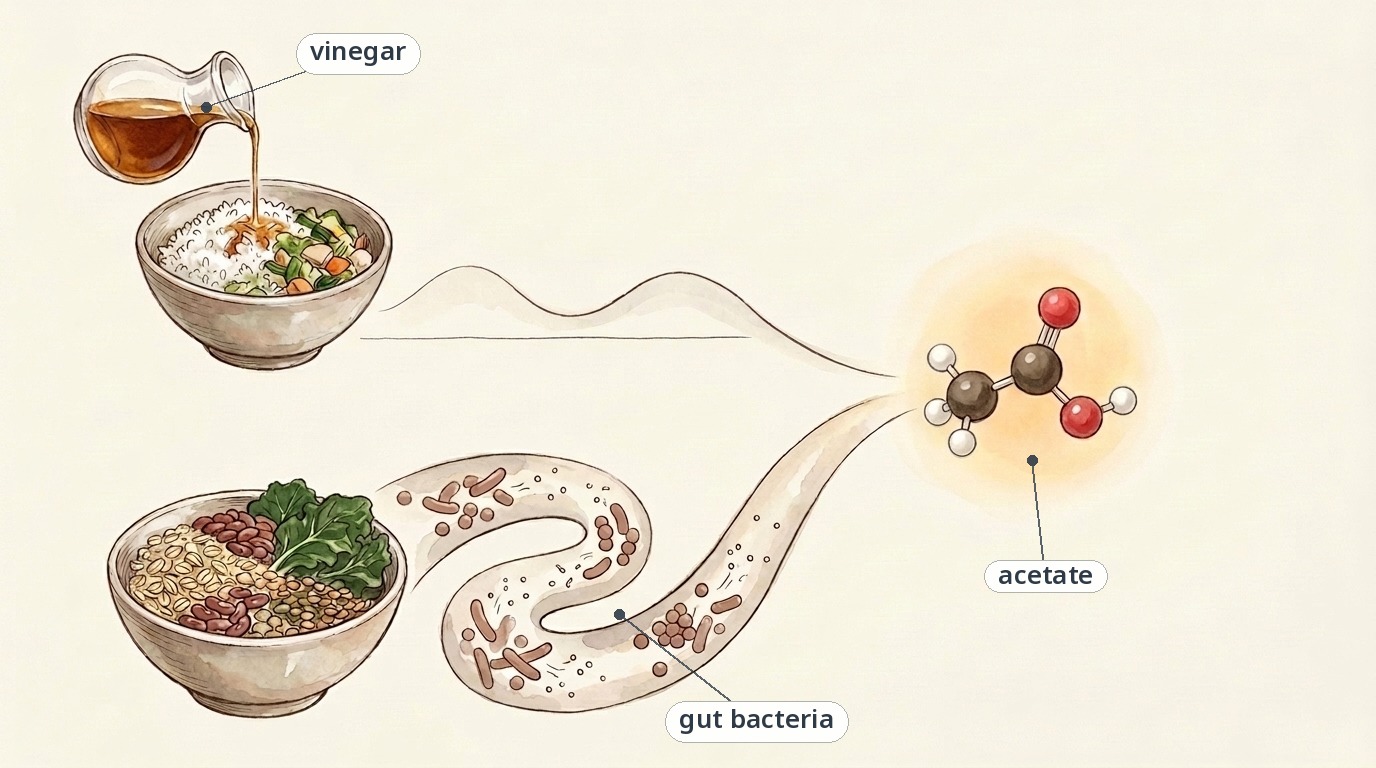
▲ One acetate, two routes: vinegar with meals, and gut bacteria fermenting fiber
🔬 Going deeper: why "drinking vinegar = topping up short-chain fatty acids" is wrong
Most of the acetate you swallow is absorbed in the stomach and upper small intestine and never reaches the large intestine. The acetate your bacteria make is produced and used right there in the large intestine. Same molecule, completely different location and evidence chain. The evidence for vinegar is in the post-meal blood sugar curve; the benefits of gut bacteria have to be earned with fiber.How solid is the evidence? (B): - Post-meal blood sugar: a systematic review plus several small randomized trials. Individual trials don't fully agree, but pooled together, post-meal glucose and insulin peaks are both lowered, by a moderate amount. - Why not A: the trials are small and short, and there's no hard-outcome evidence that "eating vinegar long-term means less diabetes."
For programmers: for the most carb-heavy takeout meal of your day, add a dish of vinegar. It's the cheapest post-meal blood sugar management there is.
Limits: people with acid reflux or stomach ulcers should be careful. Don't drink vinegar on an empty stomach or drink it undiluted: it can damage tooth enamel and your esophagus. Vinegar is not a "detox miracle."
Author's note: This section shows where a clever connection ends and a wrong one begins. The acetate in vinegar and the acetate your gut bacteria make are the same molecule, which is delightful. But if you conclude "drinking vinegar feeds your gut bacteria," you've gone wrong. Each evidence chain stands on its own; leave the meeting point for the reader to enjoy.
📚 References (2, verified on PubMed)
1. Shishehbor F, et al. Vinegar consumption can attenuate postprandial glucose and insulin responses; a systematic review and meta-analysis of clinical trials. *Diabetes Res Clin Pract*. 2017;127:1-9. (PMID: 28292654) 2. Koh A, et al. From Dietary Fiber to Host Physiology: Short-Chain Fatty Acids as Key Bacterial Metabolites. *Cell*. 2016;165(6):1332-1345. (PMID: 27259147)NAC and Phlegm
Evidence B (phlegm in chronic bronchitis and COPD; nothing to do with longevity) | 📖 Good to know (it's a medicine) | Pain point: sticky phlegm after a cold that won't come up | Pillar: H11 Chronic inflammation
In one line: NAC is a long-standing phlegm medicine in the pharmacopeia. Its day job is thinning mucus, not being an everyday supplement.
Sound familiar? Your cold is half gone, but there's a lump of sticky phlegm in your throat you can't cough up or swallow, and it wakes you several times a night.
How: - When phlegm is thick and hard to cough up, you can use N-acetylcysteine (NAC) under a doctor's or pharmacist's guidance, following the label. - Drinking plenty of water and keeping the air humid are the basics of loosening phlegm. - We don't recommend taking NAC on your own as a long-term daily supplement.
Why:
Think of sticky phlegm as a net held together by lots of little "buttons." The buttons are disulfide bonds between mucus proteins. NAC carries a reactive sulfur atom that can undo these buttons. The net falls apart, the phlegm thins, and the tiny hairs (cilia) lining your airways can sweep it out.
The evidence is clear, but the effect is smaller than you might think: - A Cochrane systematic review (2019, 38 trials, over 10,000 people): in people with chronic bronchitis or COPD, mucus-thinning drugs (including NAC) slightly reduced flare-ups. For roughly every 8 people treated, one more stayed flare-up-free during the study. And the newer and longer the trial, the smaller the effect. - A 2000 analysis focused on oral NAC: over 12–24 weeks, about half of people on NAC had no flare-up, versus about three in ten on placebo; side effects were similar to placebo. - Note: all this evidence comes from people with chronic airway disease. Phlegm that lingers after a cold usually clears up on its own, and there's much less evidence for how much NAC helps there.
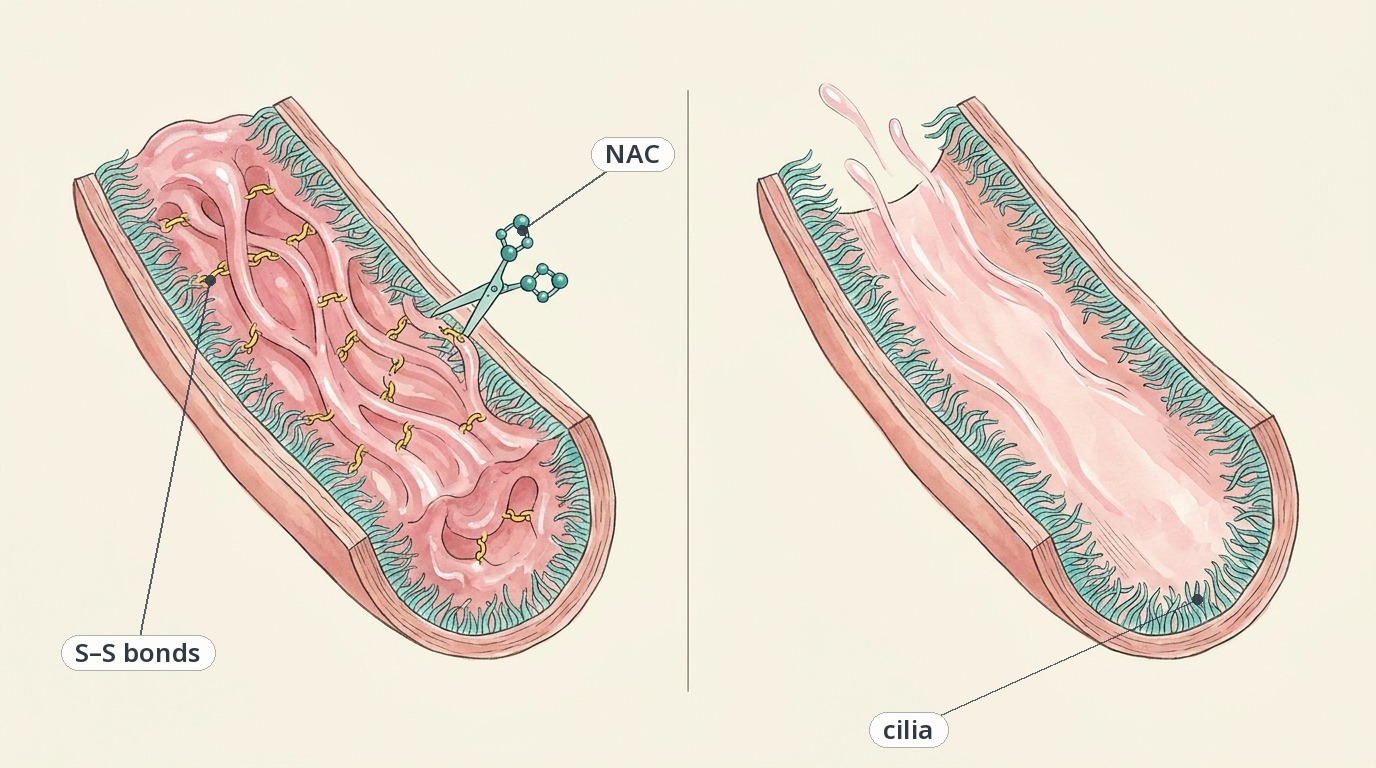
▲ NAC cuts the disulfide bonds in mucus: thick phlegm thins out, cilia can sweep it away
🔬 Going deeper: NAC's "side gig"
In the body, NAC can become cysteine, one of the building blocks of glutathione, the cell's most important antioxidant molecule. That's why NAC is famous in anti-aging circles: the glycine + NAC combination, see *GlyNAC*. But that's its side gig, with different evidence and different people it applies to.How solid is the evidence? (B, for phlegm): - Fewer flare-ups of chronic bronchitis and COPD: a Cochrane systematic review plus a meta-analysis. The effect is small but consistent. - Note: this grade is for phlegm only. It has nothing to do with longevity, which is why the action label is "Good to know."
For programmers: in autumn and winter, one of the old medicines worth keeping in the cabinet. Before you actually take it, ask a doctor or pharmacist.
Limits: it's a medicine. Inhaled forms can trigger bronchospasm, so people with asthma must ask a doctor first. People with stomach ulcers should be careful. Don't take it long-term on your own.
Author's note: Old, cheap, with clear evidence: NAC is the least mystical entry in Old Remedies, New Lens. Thinning phlegm is its day job and anti-aging is its side gig. Don't mix them up.
📚 References (2, verified on PubMed)
1. Poole P, et al. Mucolytic agents versus placebo for chronic bronchitis or chronic obstructive pulmonary disease. *Cochrane Database Syst Rev*. 2019;5(5):CD001287. (PMID: 31107966) 2. Stey C, et al. The effect of oral N-acetylcysteine in chronic bronchitis: a quantitative systematic review. *Eur Respir J*. 2000;16(2):253-62. (PMID: 10968500)Singing Bowls
Evidence D | 🧪 Worth a try (as a relaxation ritual) | Pain point: your brain won't shut off at bedtime | Pillar: none
In one line: The sound of a singing bowl can help you relax quickly, so it works as a bedtime ritual. "Frequency healing" is marketing, not science.
Sound familiar? You've shut the laptop, but your brain is still running code. You lie down, and the day's meetings replay on a loop.
How: - For 10–15 minutes before bed, listen to singing bowls, white noise or slow low-pitched music, at low volume. - Pair it with Screen Curfew an Hour Before Bed: after you put your phone down, use sound to give your brain an "off-duty" signal. - No need to buy an expensive "healing bowl." Free audio is enough.
Why:
Your brain needs a transition from "work mode" to "sleep mode," like a server that stops accepting new requests before going offline. A steady, monotonous sound with a long fade pulls your attention out of your thoughts, and your breathing and heart rate slow down with it. This is a relaxation response.
Research supports this, and only this:
- A 2020 systematic review found just 4 relevant studies. They reported less tension and anxiety and better mood, but most were weakly designed.
- A 2023 randomized controlled trial had 50 adults with high anxiety listen to one session of Tibetan singing bowls. Their anxiety dropped noticeably, and their heart rate variability rose (a sign the body is more relaxed).
- But people in a comparison group who did "progressive muscle relaxation" (tensing and releasing muscle groups one by one) also became less anxious.
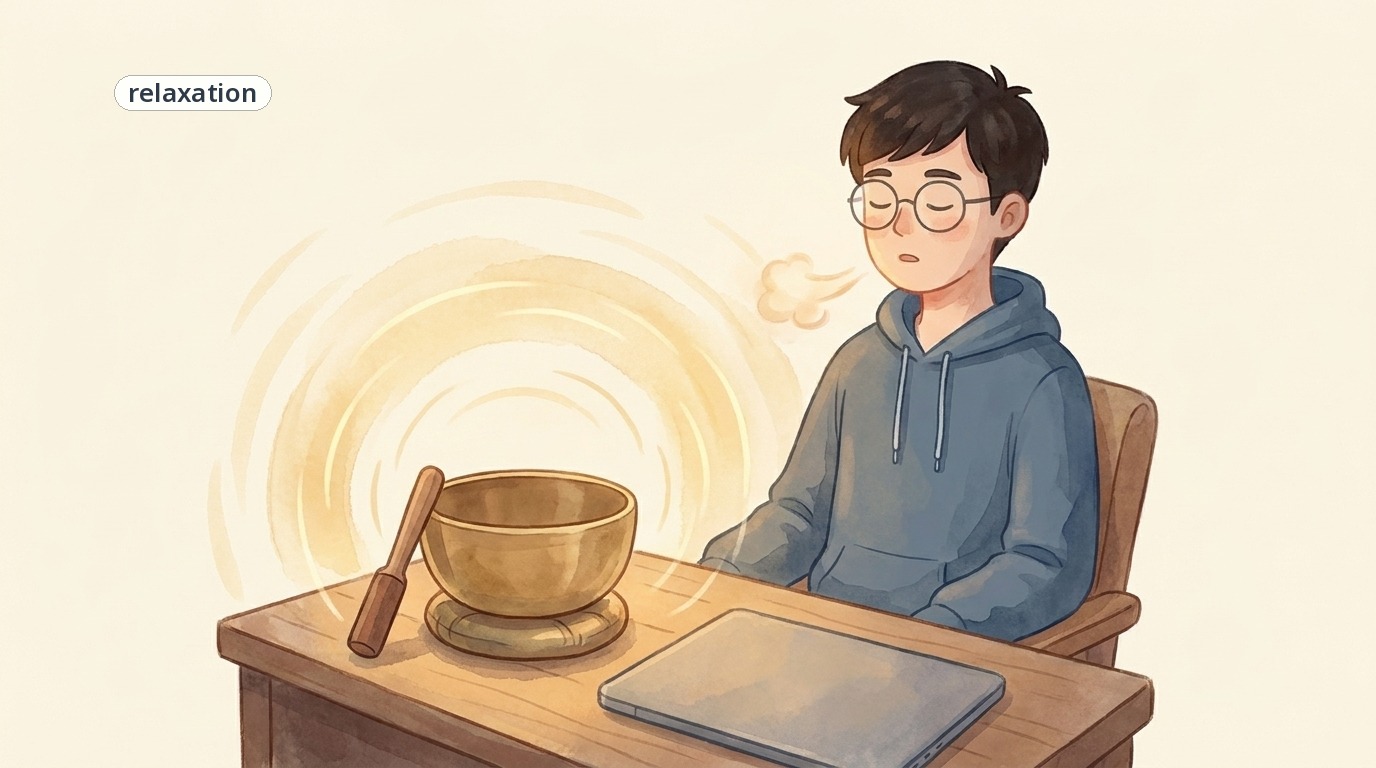
▲ Singing bowls: relaxation in the form of sound, not frequency healing
🔬 Going deeper: why the evidence is only D
These studies are small, their control groups are weak (it's hard to make a "fake singing bowl" placebo), they mostly measure subjective feelings, and most look only at the immediate effect. Claims like "specific frequencies repair cells" or "balance your chakras" have no reliable evidence at all.How solid is the evidence? (D): - Early evidence of a relaxation response; free relaxation methods seem to do about as well. - Claims of "healing" or "curing" don't hold up. - Why not C: few studies, low quality, and outcomes are mostly subjective questionnaires.
For programmers: a 15-minute sound ritual after your screen curfew. It helps you switch from the information stream to bedtime mode. That's all, and that's enough.
Limits: it's no substitute for proper insomnia treatment (for chronic insomnia, cognitive behavioral therapy comes first). If you're sensitive to sound or have tinnitus, pick your own volume and tone.
Author's note: The relaxation response is real; the myths aren't. Use a singing bowl as an audio version of your screen curfew and you've got your money's worth. Pay a premium for "frequency healing" and you've paid a stupidity tax.
📚 References (2, verified on PubMed)
1. Stanhope J, et al. The human health effects of singing bowls: A systematic review. *Complement Ther Med*. 2020;51:102412. (PMID: 32507429) 2. Rio-Alamos C, et al. Acute Relaxation Response Induced by Tibetan Singing Bowl Sounds: A Randomized Controlled Trial. *Eur J Investig Health Psychol Educ*. 2023;13(2):317-330. (PMID: 36826208)Chapter 5 · The Ten Big Rocks
When you fill a jar, put the big rocks in first, then the sand. The ten things below are the "big rocks": all grade A evidence, with effects generally far larger than any supplement in this guide. Supplements, massage and singing bowls are sand. If the rocks aren't in place, no amount of sand will help.
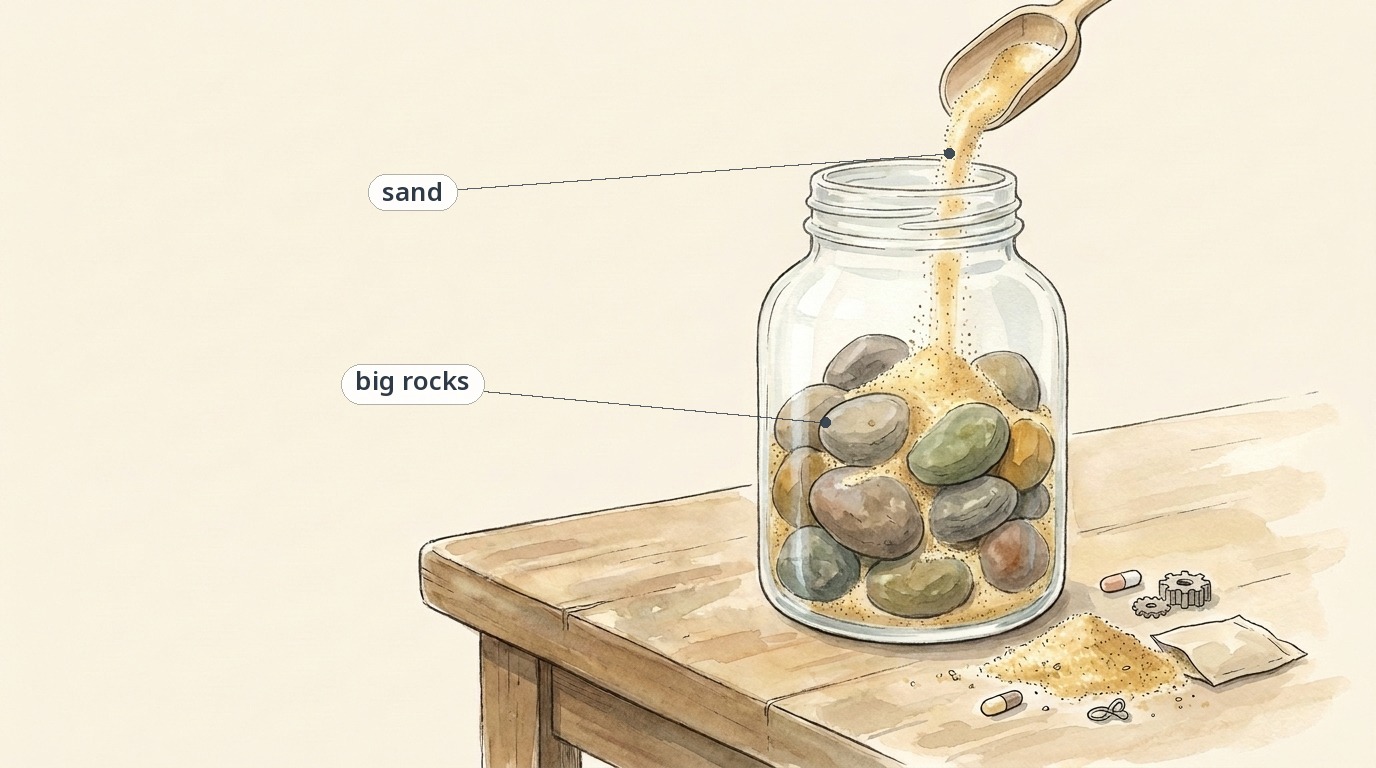
▲ Big rocks and sand: put the big rocks in the jar first, then pour in the sand
| Big rock | In one line | Evidence |
|---|---|---|
| Don't smoke | Quit before your mid-30s and you win back most of the roughly ten years smoking costs | A ✅ |
| Move every day | Steps and cardio fitness are the hardest "lifespan metrics" there are | A ✅ |
| Strength training twice a week | Muscle is your retirement account | A ✅ |
| Sleep about 7 hours | Too little and too much sleep are both linked to earlier death; get snoring checked | A ✅ |
| Drink less | Above about 100 g of pure alcohol a week, the risk of death starts to rise | A ✅ |
| Know your blood pressure | High blood pressure has no symptoms and can show up in your thirties | A ✅ |
| Read the lipids and glucose on your check-up | Every 1 mmol/L drop in "bad cholesterol" means about one fifth fewer heart attacks, strokes and similar events | A ✅ |
| A plant-forward Mediterranean diet | Olive oil, nuts, fish, vegetables and beans: heart protection you can eat | A ✅ |
| Watch your waistline | Weight and waist size are the dashboard for chronic-disease risk | A ✅ |
| Someone to talk to | The link between social ties and lifespan is on the same scale as smoking | A ✅ |
Two notes before you start: - "All-cause mortality," which comes up a lot below, means death from any cause. It's the hardest measure of lifespan there is. - Of these ten, blood pressure, cholesterol and diet have randomized trials; steps, sleep, weight and social ties come mainly from long-term studies following hundreds of thousands of people. Grade A means the evidence is large and the conclusions are stable. It does not mean every item has been proven causal by randomized trials.
Two more things that need no argument: get the cancer screenings recommended for your age, and keep your vaccinations up to date. Ask your doctor about which ones and how often.
Don't Smoke (Including E-Cigarettes) | A ✅
Why: a study following more than 200,000 Americans found that smokers live more than 10 years less than people who never smoked. The good news: quitting always helps. Quit at 25–34 and you gain about 10 years; at 35–44, about 9; at 45–54, about 6. Quitting before 40 avoids about 90% of the extra risk of death from continuing to smoke.
For programmers: "a smoke when I'm stuck" is the most expensive thinking tool there is. Walk downstairs and around the block instead (see The 30-Minute Stand-Up Alarm). It wakes you up about as well and costs you no lifespan.
Limits: e-cigarettes are not "safe cigarettes"; their long-term effects are still being studied. If quitting is hard, hospital smoking-cessation clinics can help.
📚 References
1. Jha P, et al. 21st-century hazards of smoking and benefits of cessation in the United States. *N Engl J Med*. 2013;368(4):341-50. (PMID: 23343063)Move Every Day: Steps and Cardio Fitness | A ✅
Why: - Pooling 15 international studies and nearly 50,000 people: the more steps a day, the lower the risk of all-cause mortality. For people over 60, the benefit levels off at about 6,000–8,000 steps a day; for people under 60, at about 8,000–10,000. - A treadmill-test study of 120,000 people: the fitter people were, the lower their death rate, with no "ceiling" even in the fittest group. The risk from low fitness was as large as, or larger than, the risk from smoking or diabetes.
For programmers: steps are the cheapest monitoring metric around, and your phone already tracks them. For training cardio fitness, see Zone 2 Walking.
Limits: these are long-term observational studies; fitter people may have been healthier to begin with. If you have heart disease or haven't exercised in a long time, start with walking and build up gradually.
📚 References
1. Paluch AE, et al. Daily steps and all-cause mortality: a meta-analysis of 15 international cohorts. *Lancet Public Health*. 2022;7(3):e219-e228. (PMID: 35247352) 2. Mandsager K, et al. Association of Cardiorespiratory Fitness With Long-term Mortality Among Adults Undergoing Exercise Treadmill Testing. *JAMA Netw Open*. 2018;1(6):e183605. (PMID: 30646252)Strength Training Twice a Week | A ✅
Why: pooling 16 long-term studies: people who did strength training had a 10–17% lower risk of all-cause mortality, cardiovascular disease and cancer. The benefit peaked at around 30–60 minutes a week; more than that showed no extra benefit. Muscle isn't just for lifting things. It's also the body's biggest "glucose sink," and the older you get, the harder it is to build back.
For programmers: no gym membership needed. Push-ups, squats, resistance bands: 20–30 minutes a session, twice a week, lands right in that range.
Limits: start with bodyweight; good form matters more than heavy weights. If you have joint injuries, ask a doctor first.
📚 References
1. Momma H, et al. Muscle-strengthening activities are associated with lower risk and mortality in major non-communicable diseases: a systematic review and meta-analysis of cohort studies. *Br J Sports Med*. 2022;56(13):755-763. (PMID: 35228201)Sleep About 7 Hours | A ✅
Why: pooling long-term studies of more than 1.3 million people: short sleepers had about a 12% higher risk of all-cause mortality, and long sleepers about 30% higher. Sleeping too long is more likely a sign that something is already wrong than its cause.
For programmers: for fixing your sleep, see Ten Minutes of Morning Light, Sleep Debt Repayment Plan and Screen Curfew an Hour Before Bed. Loud snoring and constant daytime sleepiness can mean sleep apnea; it's worth one visit to a sleep clinic.
Limits: these are association studies. "7 hours" is a population average, not a personal KPI.
📚 References
1. Cappuccio FP, et al. Sleep duration and all-cause mortality: a systematic review and meta-analysis of prospective studies. *Sleep*. 2010;33(5):585-92. (PMID: 20469800)Drink Less | A ✅
Why: an analysis of nearly 600,000 drinkers found that above about 100 g of pure alcohol a week, the risk of all-cause mortality starts to rise, and keeps rising with more. 100 g is roughly six or seven 500 ml bottles of ordinary Chinese lager, or about 250 ml of 52% baijiu (about seven US standard drinks). Compared with people drinking up to 100 g a week, people drinking more than 350 g a week had a life expectancy at age 40 about 4–5 years shorter.
What about "a little alcohol is good for the heart"? In the same study, drinking was indeed linked to a slightly lower risk of heart attack, but stroke, heart failure and other cardiovascular diseases all rose with the amount. On the whole, drinking doesn't pay off.
For programmers: at launch parties and team dinners, raise a glass, but you don't have to drain it.
Limits: be especially careful if your face turns red after a little alcohol. That's usually because the enzyme that breaks down acetaldehyde (ALDH2) isn't working well, which is common in East Asians. For these people, drinking carries a much higher risk of esophageal cancer.
📚 References
1. Wood AM, et al. Risk thresholds for alcohol consumption: combined analysis of individual-participant data for 599 912 current drinkers in 83 prospective studies. *Lancet*. 2018;391(10129):1513-1523. (PMID: 29676281) 2. Brooks PJ, et al. The alcohol flushing response: an unrecognized risk factor for esophageal cancer from alcohol consumption. *PLoS Med*. 2009;6(3):e50. (PMID: 19320537)Know Your Blood Pressure | A ✅
Why: high blood pressure has no symptoms, but it slowly damages the heart, brain and kidneys. In the SPRINT randomized trial, adults at high cardiovascular risk who brought their systolic pressure (the top number) below 120, compared with below 140, had about a quarter fewer heart attacks, strokes, heart failure and similar events, and about a quarter fewer deaths from any cause.
For programmers: buy a home electronic blood pressure monitor, measure once a month, and log it in your notes. It's like adding monitoring to production.
Limits: SPRINT participants were 50 or older, at high cardiovascular risk and without diabetes; going lower also brought more low blood pressure, fainting and kidney problems. Blood pressure targets differ from person to person. Diagnosis and medication are for your doctor; don't adjust your own medication.
📚 References
1. SPRINT Research Group. A Randomized Trial of Intensive versus Standard Blood-Pressure Control. *N Engl J Med*. 2015;373(22):2103-16. (PMID: 26551272)Read the Lipids and Glucose on Your Check-Up | A ✅
Why: pooling 26 randomized trials and 170,000 people: for every 1 mmol/L (about 39 mg/dL) that statins lowered LDL cholesterol ("bad cholesterol"), major vascular events such as heart attack and stroke fell by about 22%. High blood sugar is likewise a slow, chronic burden on the heart and kidneys.
For programmers: don't just check your report for arrows. Put LDL-C, fasting glucose and HbA1c (your average blood sugar over the past three months) into a spreadsheet and watch the year-over-year trend.
Limits: whether to take medication is for your doctor to decide, based on your overall risk.
📚 References
1. Cholesterol Treatment Trialists' (CTT) Collaboration. Efficacy and safety of more intensive lowering of LDL cholesterol: a meta-analysis of data from 170,000 participants in 26 randomised trials. *Lancet*. 2010;376(9753):1670-81. (PMID: 21067804)A Plant-Forward Mediterranean Diet | A ✅
Why: Spain's PREDIMED randomized trial enrolled 7,447 people aged 55–80 at high cardiovascular risk. The two groups on a Mediterranean diet plus extra-virgin olive oil or nuts had about 30% fewer heart attacks, strokes and cardiovascular deaths than the low-fat control group.
A note on transparency: after first publication in 2013, the trial was retracted because randomization at some sites hadn't been done properly. It was re-analyzed without the problem data and republished in 2018, with essentially the same conclusion.
For programmers: you can do this with takeout: more vegetables and beans, whole grains instead of white rice, add a portion of fish, swap snacks for nuts.
📚 References
1. Estruch R, et al. Primary Prevention of Cardiovascular Disease with a Mediterranean Diet Supplemented with Extra-Virgin Olive Oil or Nuts. *N Engl J Med*. 2018;378(25):e34. (PMID: 29897866)Watch Your Waistline | A ✅
Why: - Weight: pooling 239 studies across four continents and over ten million people, among never-smokers the death rate was lowest at a body mass index (BMI) of 20–25; both overweight and obesity raised the risk. Chinese standards for adults are stricter: BMI ≥24 is overweight, ≥28 is obese. - Waist: a European study of 360,000 people found that even at the same BMI, people in the fifth with the largest waists had about twice (men) and 1.8 times (women) the risk of death of those in the fifth with the smallest.
For programmers: your waist is more worth watching than your weight, because it reflects visceral fat. Measure it once a month and log it with your blood pressure. By Chinese standards, a waist of 90 cm or more for men, or 85 cm or more for women, counts as abdominal obesity.
Limits: BMI is inaccurate for very muscular people; being too thin isn't healthy either.
📚 References
1. Global BMI Mortality Collaboration. Body-mass index and all-cause mortality: individual-participant-data meta-analysis of 239 prospective studies in four continents. *Lancet*. 2016;388(10046):776-86. (PMID: 27423262) 2. Pischon T, et al. General and abdominal adiposity and risk of death in Europe. *N Engl J Med*. 2008;359(20):2105-20. (PMID: 19005195)Someone to Talk To | A ✅
Why: pooling 148 studies and more than 300,000 people: people with stronger social relationships were about 50% more likely to survive during the study period. The authors judged this to be on the same scale as well-established risk factors such as smoking and obesity.
For programmers: ten hours alone debugging in front of a screen, then takeout alone? Aim for at least one meal or one phone call with someone each week.
Limits: this is an association study; people in poor health may also socialize less. If loneliness or depression persists, get professional help.
📚 References
1. Holt-Lunstad J, et al. Social relationships and mortality risk: a meta-analytic review. *PLoS Med*. 2010;7(7):e1000316. (PMID: 20668659)Chapter 6 · A Day Built for Longevity
Follow the day in order: get light in the morning, stand up during the day, look after your eyes, and stop caffeine in the afternoon.
Ten Minutes of Morning Light
Evidence B | ✅ Do it | Pain point: body clock flipped, can't fall asleep at night | Pillar: none (rhythm is the foundation of the whole guide)
In one line: if you want to sleep earlier, get up and get some daylight first.
Sound familiar? At 1 a.m. on Sunday you're wide awake; at 9 a.m. on Monday you feel dragged out of bed. You promise yourself "lights out at 11 tonight," then scroll your phone in bed until 2.
How: within an hour of getting up, spend 10–30 minutes outdoors (or by an open window). Cloudy days work too; just stay out a bit longer. You don't need to look at the sun. The ambient light is enough.
Why:
Think of it this way: your body has a system clock (a small region of the brain called the suprachiasmatic nucleus). It doesn't sync over the network. It syncs with the light your eyes see. Bright morning light is like an NTP sync that tells the clock "it's daytime now." Once the clock is set, the evening release of melatonin, the "time to sleep" signal, moves earlier too.
What matters is the brightness gap. Office lighting is usually under 500 lux (a unit of brightness); a cloudy day outdoors is several thousand, and a sunny day can reach 100,000. Inside versus outside the window is a difference of dozens of times.
So the way out of the late-to-bed, late-to-rise loop isn't forcing yourself to sleep early tonight. It's setting the clock right first thing tomorrow morning.
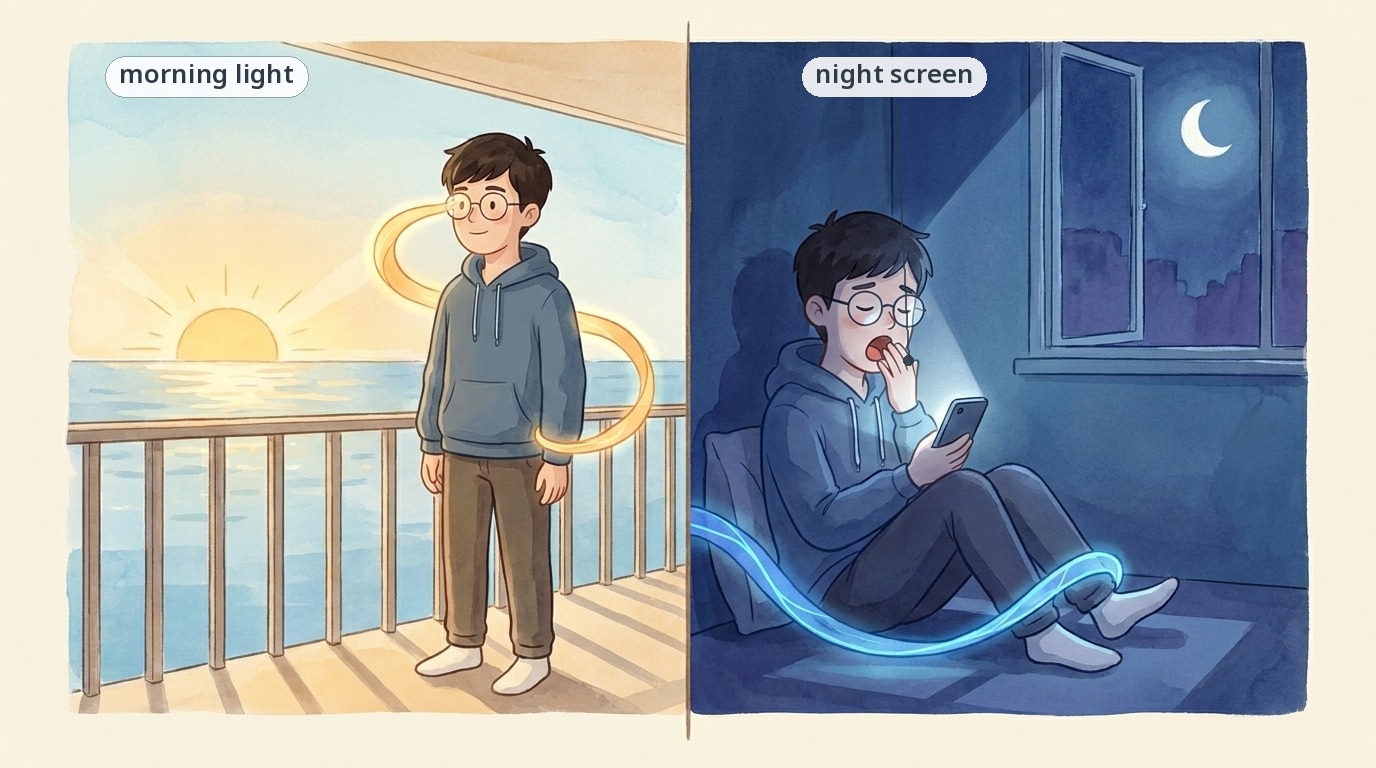
▲ Morning light sets the body clock right; screens at night drag it later
🔬 Going deeper: the "light meter" in your eye
Besides the rods and cones that let you see, the retina has another type of cell: **intrinsically photosensitive retinal ganglion cells (ipRGCs)**. They don't form images. They just measure brightness, are most sensitive to blue light, and connect directly to the body's master clock. Bright morning light travels along this line to suppress melatonin and anchor the master clock: more alert during the day, melatonin rising on time at night.How solid is the evidence? (B): - A controlled human study: after a week of camping outdoors with only natural light, participants' melatonin rhythm moved clearly earlier and lined up with sunrise and sunset (Wright 2013). - A lab study mapped out how light "resets" the body clock: the brighter the light and the longer the exposure, the more the clock shifts (Zeitzer 2000). This study tested light at night, which also explains why you should avoid bright light in the evening (see Screen Curfew an Hour Before Bed). - Morning light therapy is a drug-free treatment used in clinics (for delayed sleep phase, where the whole body clock has shifted late and you can't fall asleep early even when you try). - Why not A: the outcomes are in-between measures like the melatonin rhythm, not final outcomes like lifespan or disease. There's no hard-endpoint trial showing "morning light → longer life."
For programmers: spend the 10 minutes before stand-up walking downstairs for a coffee. Working remotely? Take your first meeting on the balcony.
Limits: people with bipolar disorder should only do light therapy under medical supervision. Don't look directly at the sun.
Author's note: This one is counterintuitive: the way out of late nights isn't at night, it's in the morning. To sleep earlier, get up and get light first. Get the order backwards and the harder you try, the worse you sleep. This is where A Day Built for Longevity begins.
📚 References (2, verified on PubMed)
1. Wright KP Jr, et al. Entrainment of the human circadian clock to the natural light-dark cycle. *Curr Biol*. 2013;23(16):1554-8. (PMID: 23910656) 2. Zeitzer JM, et al. Sensitivity of the human circadian pacemaker to nocturnal light: melatonin phase resetting and suppression. *J Physiol*. 2000;526 Pt 3:695-702. (PMID: 10922269)The 30-Minute Stand-Up Alarm
Evidence B | ✅ Do it | Pain point: stiff lower back, sleepy after meals | Pillar: H6 Deregulated nutrient-sensing
In one line: for every 30 minutes sitting, get up and move for 2. The lowest-tech, highest-leverage item in the guide.
Sound familiar? You sit down to fix a bug, look up, and three hours have gone by: stiff back, numb legs, foggy head. In the evening you do an hour at the gym and think "that cancels out today's sitting, right?"
How: - Set a silent reminder that repeats every 30 minutes (phone, watch, or Pomodoro timer all work). - When it goes off, stand up for 2–3 minutes: get some water, go to the bathroom, do 5 squats, walk to the window and look at something far away. - It doesn't need to be intense. What matters is breaking up the sitting.
Why:
Think of it this way: muscle is the body's biggest "recycling center" for blood sugar and blood fats. When you sit still, the recycling center goes into standby, and the sugar and fat in your blood queue up with no one to process them. Stand up and walk a few steps, and it comes straight back online.
Population data shows that sitting costs you on two accounts: - Total time: an analysis pooling data from more than a million people found that the more hours a day people sat, the higher their risk of death. Only about 60–75 minutes a day of moderate-to-vigorous activity offset that risk. - Unbroken stretches: a study of nearly 8,000 Americans aged 45 and over, measured objectively with wearable activity trackers, found that more total sitting and longer unbroken bouts were both linked to higher risk of death. People who were high on both (sat a lot, and often for 10+ minutes without moving) had the highest risk. But the two accounts are hard to separate completely, and how much "how long each bout lasts" matters on its own is still unsettled.
So an hour at the gym is great, but it doesn't pay off three unbroken hours in the chair.
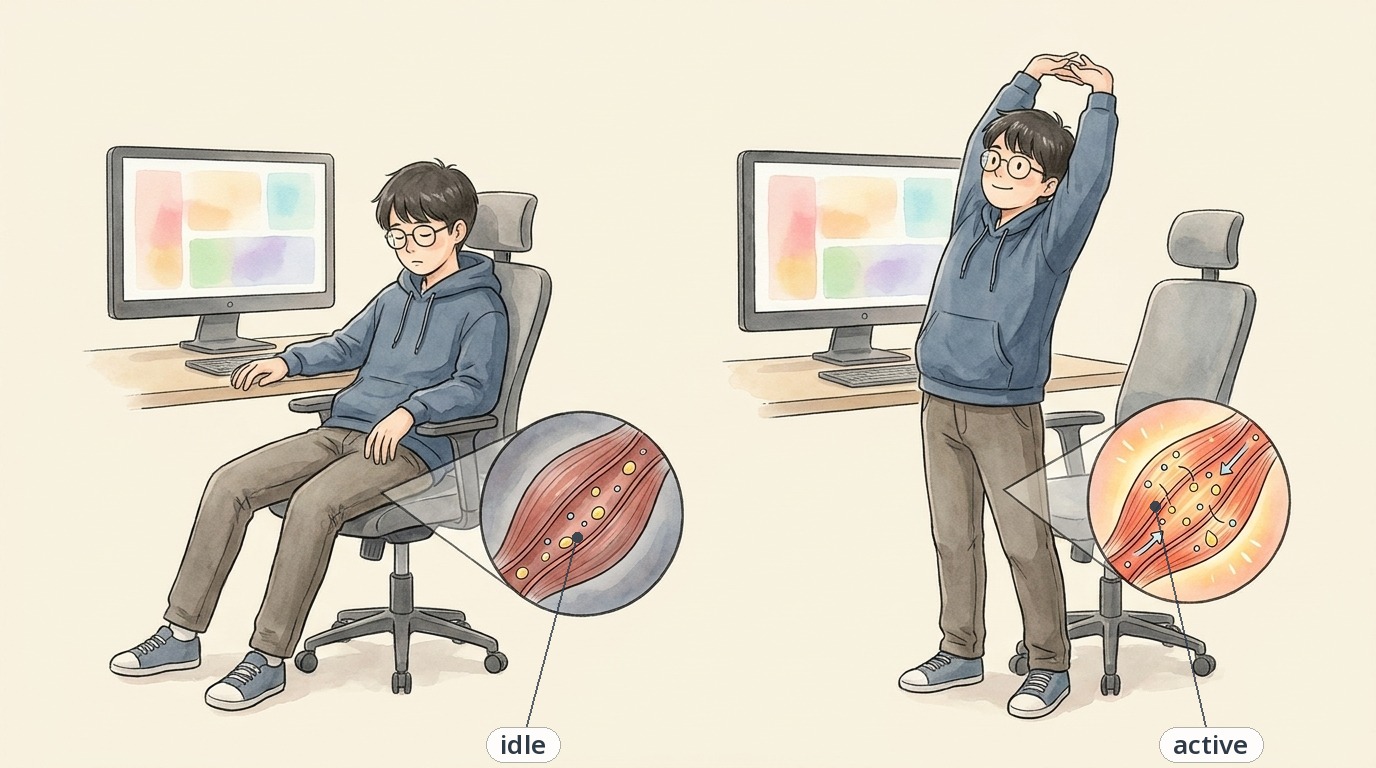
▲ Sit too long and your muscles go idle; stand up and they're back online in minutes
🔬 Going deeper: why muscle goes into "standby"
Animal studies found that during long periods of inactivity, the activity of lipoprotein lipase (LPL), the enzyme in skeletal muscle that breaks down blood fats, drops sharply. Human experiments also found that breaking up sitting with short bouts of activity every 20–30 minutes lowers blood sugar and insulin after meals. Contracting muscle pulls glucose into cells on its own, without relying entirely on insulin.How solid is the evidence? (B): - A large population study (Ekelund 2016) and a cohort study with objective measurement (Diaz 2017) point the same way. - A short-term human experiment: breaking up sitting with short bouts of activity lowered post-meal blood sugar and insulin (Dunstan 2012). - Why not A: these are observational studies; there's no long-term randomized trial of "stand up every 30 minutes → longer life."
For programmers: waiting for a compile, a build, a test run or CI is a built-in cue to stand up. Turn waiting time into standing time.
Limits: gentle movement is enough. If you have orthostatic hypotension (getting dizzy when you stand up), pause for a few seconds at the edge of the bed or chair before getting up.
Author's note: The lowest-tech item in the whole guide, and maybe the highest-leverage one. I've seen too many people buy a standing desk costing thousands, then lower it all the way down and use it sitting.
📚 References (3, verified on PubMed)
1. Ekelund U, et al. Does physical activity attenuate, or even eliminate, the detrimental association of sitting time with mortality? A harmonised meta-analysis of data from more than 1 million men and women. *Lancet*. 2016;388(10051):1302-10. (PMID: 27475271) 2. Diaz KM, et al. Patterns of Sedentary Behavior and Mortality in U.S. Middle-Aged and Older Adults: A National Cohort Study. *Ann Intern Med*. 2017;167(7):465-475. (PMID: 28892811) 3. Dunstan DW, et al. Breaking up prolonged sitting reduces postprandial glucose and insulin responses. *Diabetes Care*. 2012;35(5):976-83. (PMID: 22374636)The 20-20-20 Rule for Your Eyes
Evidence C | 🧪 Worth a try | Pain point: dry, sore eyes, blurry after long screen time | Pillar: none
In one line: every 20 minutes of screen time, look at something 6 meters (20 feet) away for 20 seconds, and blink firmly a few times while you're at it.
Sound familiar? By 4 p.m. your eyes are dry and gritty and the text on the screen starts to blur. Eye drops help for ten minutes, then you're back where you started.
How: - Every 20 minutes, look at something 20 feet (about 6 meters) away for 20 seconds: a tree outside, the wall at the end of the hallway. - At the same time, blink slowly and fully 5–10 times. - Combine it with The 30-Minute Stand-Up Alarm: stand up, look into the distance, blink, all in one go.
Why:
Think of it this way: when you look at something close, a ring of small muscle in your eye called the ciliary muscle has to stay tight, like holding a fist clenched. Only when you look 6 meters away can that "fist" relax.
The other problem is blinking. A blink is like a windshield wiper: each one spreads the tear film, the thin layer of liquid covering the surface of your eye, evenly again. When you're focused on a screen, you blink much less, and often not all the way. The tear film evaporates faster than it's replaced, and your eyes dry out (a 2023 review by the TFOS international expert panel).
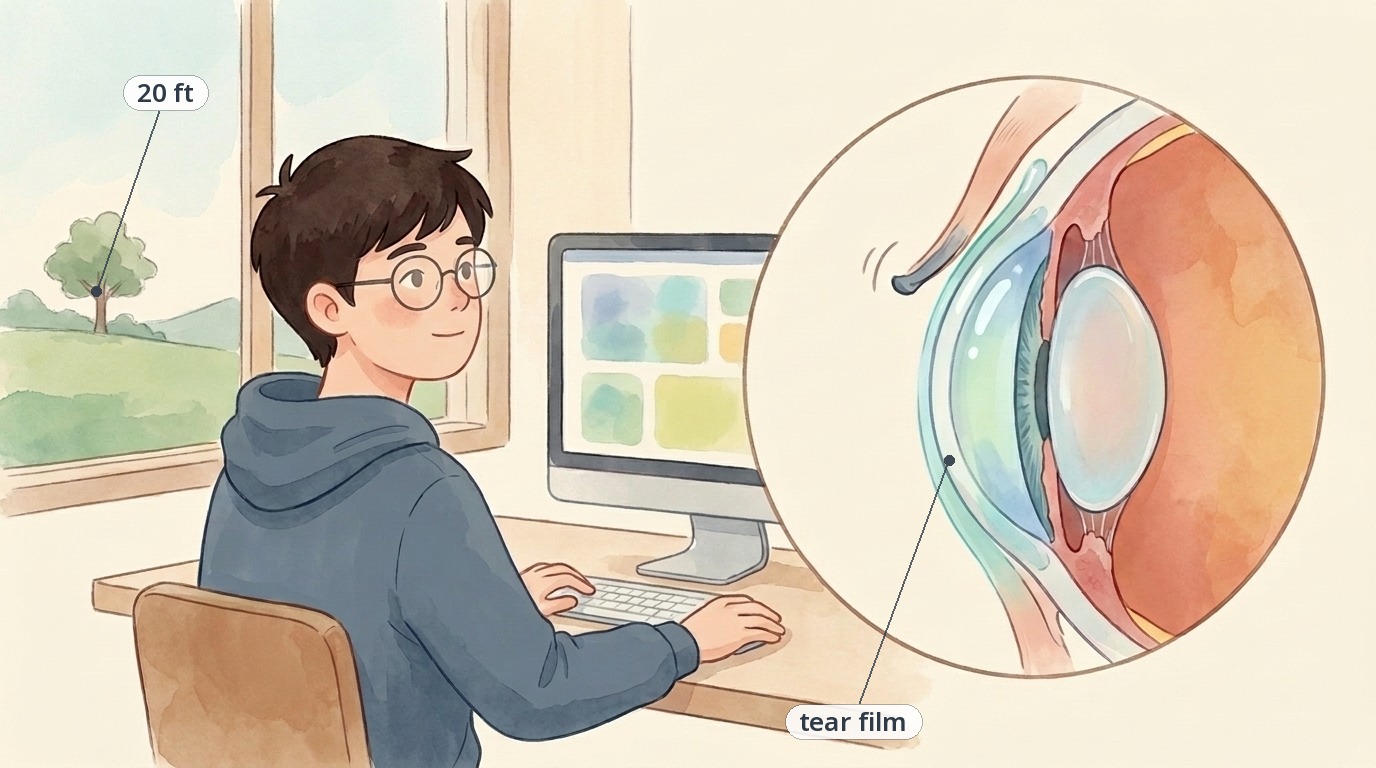
▲ Look far away, blink: give the tear film a refresh
🔬 Going deeper: why "incomplete blinks" are worse than "fewer blinks"
In an incomplete blink, the upper eyelid doesn't come all the way down. The tear film on the lower half of the eye isn't renewed, and the oil from the meibomian glands in the eyelids isn't squeezed out. That oil layer keeps tears from evaporating. Over time this can lead to meibomian gland dysfunction, one of the most common causes of dry eye.How solid is the evidence? (C): - The link between screen use and dry, tired eyes is well established; the American Academy of Ophthalmology and other bodies recommend 20-20-20. - A small trial of 29 people: with a 20-20-20 reminder installed on their computers, eye strain and dryness both improved after two weeks. But once the reminders stopped, the effect was gone within a week (Talens-Estarelles 2023). - Why not B: there are only small trials without control groups. "20 minutes, 6 meters, 20 seconds" are rule-of-thumb numbers, never rigorously tested. The mechanism is right, the numbers were picked to be easy to remember, and it only works if you keep doing it.
For programmers: put a timer on "forgetting to blink." If you already use a Pomodoro timer, do it at the end of each Pomodoro.
Limits: persistent eye strain, a sudden drop in vision, or double vision means seeing an eye doctor. That's not just a screen problem.
Author's note: Blinking is the first instinct a screen hijacks: the deeper you get into the code, the less you blink, and you don't even notice your tear film drying out. At its core, 20-20-20 is an external reminder for that instinct.
📚 References (3)
1. Wolffsohn JS, et al. TFOS Lifestyle: Impact of the digital environment on the ocular surface. *Ocul Surf*. 2023;28:213-252. (PMID: 37062428) 2. Talens-Estarelles C, et al. The effects of breaks on digital eye strain, dry eye and binocular vision: Testing the 20-20-20 rule. *Cont Lens Anterior Eye*. 2023;46(2):101744. (PMID: 35963776) 3. American Academy of Ophthalmology. Computers, Digital Devices and Eye Strain. [AAO guidance](https://www.aao.org/eye-health/tips-prevention/computer-usage) (professional guidance, regularly updated)The 2 p.m. Caffeine Cutoff
Evidence B | ✅ Do it | Pain point: tired but can't fall asleep, wake up unrefreshed | Pillar: none
In one line: a coffee after 2 p.m. keeps "drinking" itself until midnight.
Sound familiar? An Americano at 4 p.m. to get through the afternoon, then at midnight you lie in bed tossing and turning. Or "I drink coffee and still fall asleep instantly," yet the next day you still feel short on sleep.
How: - No caffeine after 2 p.m. - Caffeine isn't just in coffee: strong tea, milk tea, cola, energy drinks, and some painkillers and cold medicines have it too. - Need a lift in the afternoon? Walk around the block, get a few minutes of sun, or switch to decaf.
Why:
Think of it this way: while you're awake, your brain keeps building up a molecule called adenosine, the "sleepiness signal." Once enough builds up, you feel sleepy. Caffeine looks a lot like adenosine. It occupies adenosine's receptors without passing the signal on, like taping over a doorbell button: the sleepiness is still there, you just can't hear the bell.
The catch is that it leaves slowly. Caffeine's half-life (the time it takes for half of it to clear) is about 5 hours, with wide individual variation (roughly 2–10 hours). Drink a cup at 2 p.m. and about half is still in your blood at 7 p.m., a quarter at midnight.
The experiments are unforgiving. In a 2013 trial, participants took 400 mg of caffeine (about two large Americanos) 0, 3 or 6 hours before bed. Even the 6-hours-before group lost more than an hour of total sleep as measured by instruments, while the participants themselves noticed much less. That trial had only 12 people, though, and the dose was on the high side.
A 2023 meta-analysis pooled 24 studies: caffeine cut total sleep by about 45 minutes on average. By its estimate, a regular cup of coffee (about 100 mg) should be finished at least 8.8 hours before bed. If you sleep at 11 p.m., that's around 2 p.m.
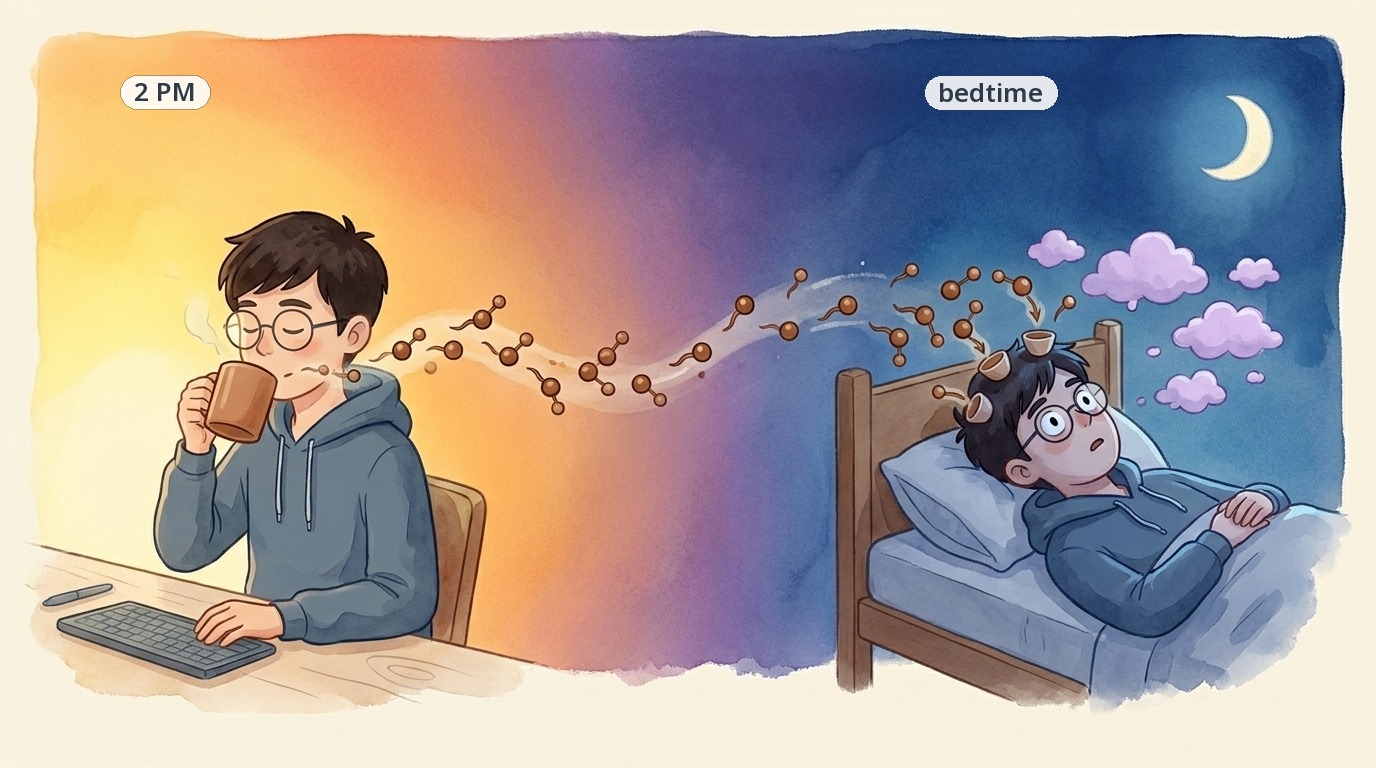
▲ The second half of your 2 p.m. coffee: by bedtime, the caffeine still hasn't cleared
🔬 Going deeper: why "coffee doesn't affect my sleep" isn't reliable
Caffeine won't necessarily keep you awake, but it changes how you sleep: slower to fall asleep, more light sleep, more waking during the night. People usually don't notice these changes. Caffeine is broken down mainly by an enzyme in the liver called CYP1A2, and its activity depends on genes, smoking, birth control pills, pregnancy and more. That's why some people feel nothing and others can't sleep after one cup.How solid is the evidence? (B): - A randomized controlled trial (Drake 2013) + a meta-analysis of 24 studies (Gardiner 2023) + well-established pharmacology (Fredholm 1999). - Why not A: the outcomes are sleep measures, not long-term health outcomes; the trial dose was high and the sample small.
For programmers: a late coffee to hit a deadline is trading tomorrow's performance for tonight's alertness, and sleep debt compounds (see Sleep Debt Repayment Plan).
Limits: caffeine clears much more slowly during pregnancy, so follow your doctor's advice on intake. People with heart rhythm problems or anxiety disorders are more sensitive to caffeine.
Author's note: I call it a "cutoff" rather than a "suggestion" for one reason: on this point, how you feel can't be trusted. Coffee six hours before bed still steals an hour of sleep, while the person drinking it thinks "I metabolize fast, I'm fine."
📚 References (3, verified on PubMed)
1. Drake C, et al. Caffeine effects on sleep taken 0, 3, or 6 hours before going to bed. *J Clin Sleep Med*. 2013;9(11):1195-200. (PMID: 24235903) 2. Gardiner C, et al. The effect of caffeine on subsequent sleep: A systematic review and meta-analysis. *Sleep Med Rev*. 2023;69:101764. (PMID: 36870101) 3. Fredholm BB, et al. Actions of caffeine in the brain with special reference to factors that contribute to its widespread use. *Pharmacol Rev*. 1999;51(1):83-133. (PMID: 10049999)Chapter 7 · Repair and Maintenance
Sleep is the body's garbage collection: how to pay back a late night, and how to shut down before bed. Plus, for the desk you sit at eight hours a day, how to set it up so it doesn't wreck your neck, back and wrists.
Sleep Debt Repayment Plan
Evidence B | ✅ Do it | Pain point: the aftermath of a late night | Pillar: none
In one line: pay sleep debt back slowly over three nights. Don't sleep 12 hours in one go on the weekend.
Sound familiar? Release week, five hours a night, and you feel "fine, I'm used to it." Saturday you sleep until 2 p.m., Sunday night you can't fall asleep, and Monday you're even more tired.
How: after a late night, pay it back in three steps: 1. Go to bed 30–60 minutes earlier that night, instead of sleeping until noon the next day. 2. Keep the next day's nap under 20 minutes, ideally before 3 p.m. 3. Keep a normal schedule for 3 nights in a row: same wake-up time as usual, and use morning light to set the clock back (see Ten Minutes of Morning Light).
Why:
Think of it this way: not getting enough sleep is like a memory leak. Each short night leaks a little. The system doesn't crash right away, but it gets slower and slower. Worse, the monitoring dashboard stops working: you feel "I've adjusted," while performance keeps dropping.
The lab data is clear. After two weeks of only 6 hours a night, attention-test scores kept falling, until they matched two nights in a row with no sleep at all. Yet how sleepy the participants said they felt rose only slightly (Van Dongen 2003).
Paying back is also slower than borrowing. In another experiment, participants had their sleep restricted for a week, then got a full 8 hours a night to recover. After 3 nights, the groups that had slept least still hadn't returned to where they started (Belenky 2003).
So why not catch up all at once on the weekend? Because sleeping into the afternoon pushes your body clock several hours later. You can't fall asleep Sunday night, and Monday you're borrowing again. The old debt isn't cleared, and you've added "jet-lag debt" on top.
Weekend catch-up sleep isn't useless, though. The evidence cuts both ways: - A study following 44,000 Swedes found that among people under 65, those who slept short on weekdays and long on weekends had the same death rate as people who slept 6–7 hours every night. Only those who consistently slept under 5 hours had a higher death rate (Åkerstedt 2019). - But a lab study found that "short sleep on weekdays, sleep as much as you like on weekends" didn't prevent a drop in insulin sensitivity (how well the body handles blood sugar), and pushed the body clock later after the weekend (Depner 2019).
So sleeping a bit more on the weekend is fine, just not into the afternoon. The real fix is not borrowing on weekdays.
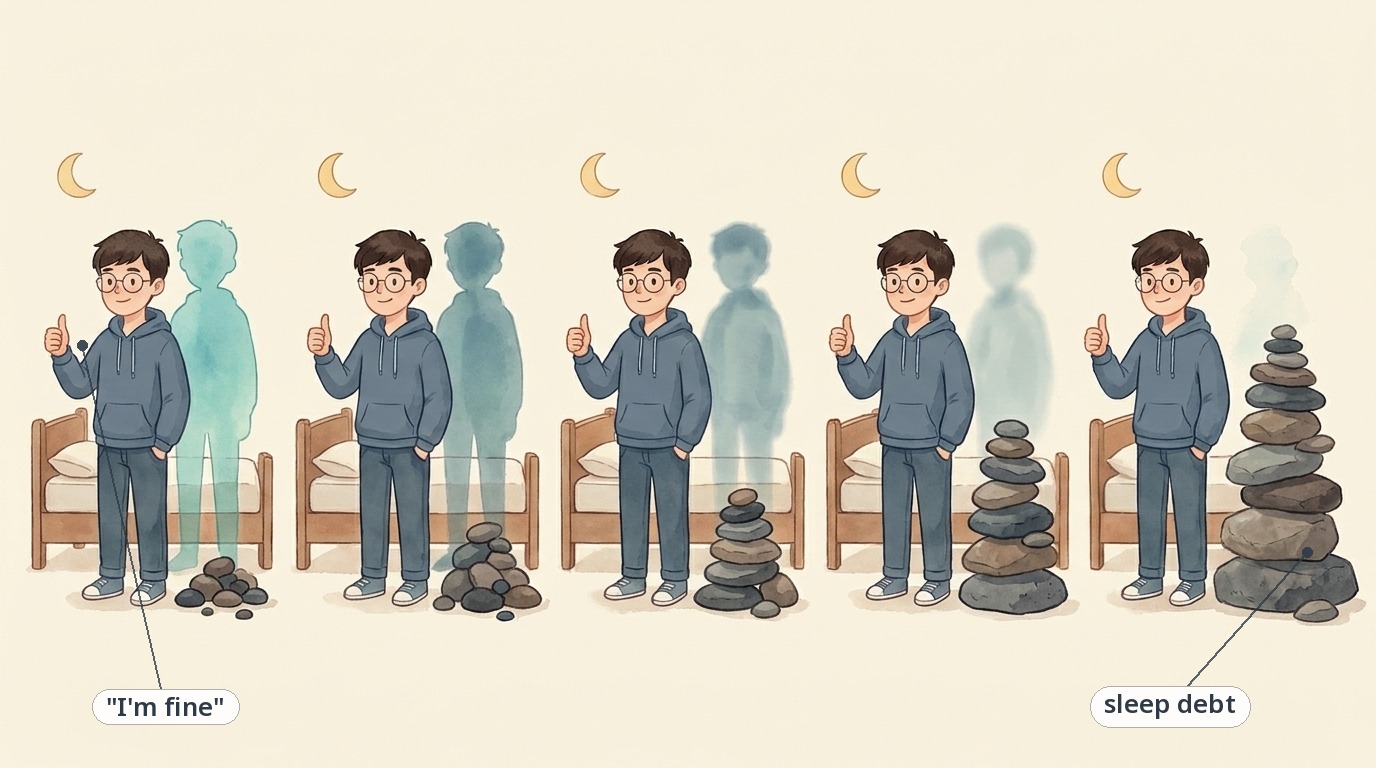
▲ Sleep debt: the more you owe, the flatter it feels
🔬 Going deeper: why "I feel fine" isn't reliable
How sleepy you feel and how well you actually perform are two different curves. In the first few days of sleep restriction, sleepiness rises noticeably, then levels off. But reaction lapses measured by the "psychomotor vigilance test" (press a button when you see a signal) keep piling up with each day of debt. The brain adapts to the feeling of being sleepy, but not to the lack of sleep itself. So to judge whether you're getting enough sleep, don't ask how you feel. Look at your sleep log.How solid is the evidence? (B): - Two tightly controlled lab studies show a clear pattern: the less you sleep, the greater the impairment, and it accumulates (Van Dongen 2003; Belenky 2003). - Weekend catch-up sleep: population data suggests it may offset some of the risk (Åkerstedt 2019), but experiments show it doesn't block the metabolic damage (Depner 2019). - Paying back over three nights and skipping the long lie-in comes from clinical consensus in sleep medicine and research on body rhythms. - Why not A: the "three-night repayment" method itself has never been tested head to head in a controlled trial, and the lab outcomes are cognitive tests, not long-term health outcomes.
For programmers: after a release night, the worst move is "sleep until the afternoon on the weekend." The right way: go to bed early Friday, get up at your usual time Saturday and get some sun, and take a 20-minute nap in the afternoon.
Limits: if it takes you more than 30 minutes to fall asleep, more than 3 nights a week, for 3 months, that's chronic insomnia. It's a medical condition, not a discipline problem; see a sleep clinic.
Author's note: The sneakiest finding in sleep research: the more debt piles up, the flatter the sleepiness feels, so people genuinely believe "I'm fine." When it comes to sleep, your feelings are a broken dashboard. Trust the log, not the feeling.
📚 References (4, verified on PubMed)
1. Van Dongen HP, et al. The cumulative cost of additional wakefulness: dose-response effects on neurobehavioral functions and sleep physiology from chronic sleep restriction and total sleep deprivation. *Sleep*. 2003;26(2):117-26. (PMID: 12683469) 2. Belenky G, et al. Patterns of performance degradation and restoration during sleep restriction and subsequent recovery: a sleep dose-response study. *J Sleep Res*. 2003;12(1):1-12. (PMID: 12603781) 3. Åkerstedt T, et al. Sleep duration and mortality - Does weekend sleep matter? *J Sleep Res*. 2019;28(1):e12712. (PMID: 29790200) 4. Depner CM, et al. Ad libitum Weekend Recovery Sleep Fails to Prevent Metabolic Dysregulation during a Repeating Pattern of Insufficient Sleep and Weekend Recovery Sleep. *Curr Biol*. 2019;29(6):957-967.e4. (PMID: 30827911)Screen Curfew an Hour Before Bed
Evidence B | ✅ Do it | Pain point: trouble falling asleep | Pillar: none
In one line: put your phone down an hour before bed and hand falling asleep back to your brain.
Sound familiar? In bed at 11, "just two minutes of scrolling," and you look up and it's 1 a.m. Lights off, and your head is still spinning on that thread you just read.
How: 1. An hour before bed, put down your phone, tablet and laptop. Charge your phone somewhere you can't reach. 2. Fill the hour with a paper book, a podcast, stretching or a hot shower. 3. If you really can't, at least turn the screen all the way down and only look at "boring" content. Don't count on Night Shift: an experiment comparing iPhone Night Shift on and off found no difference in sleep (Duraccio 2021).
Why:
Think of it this way: before sleep, the brain does a "graceful shutdown": first it lowers the load, then it releases melatonin, the "time to sleep" signal. Screens interrupt both steps.
First, light. Screen light (especially blue light) tells your body clock "it's still daytime," suppressing melatonin and pushing the whole clock later. Second, content. Feeds, messages and short videos keep your brain revved up, like spawning ten new processes right before shutdown.
In a controlled experiment, adults read an e-book on a tablet for 4 hours before bed for 5 nights, compared with reading a printed book. With the tablet, they fell asleep about 10 minutes later on average, evening melatonin was suppressed, the body clock shifted later, and they were groggier the next morning (Chang 2015).
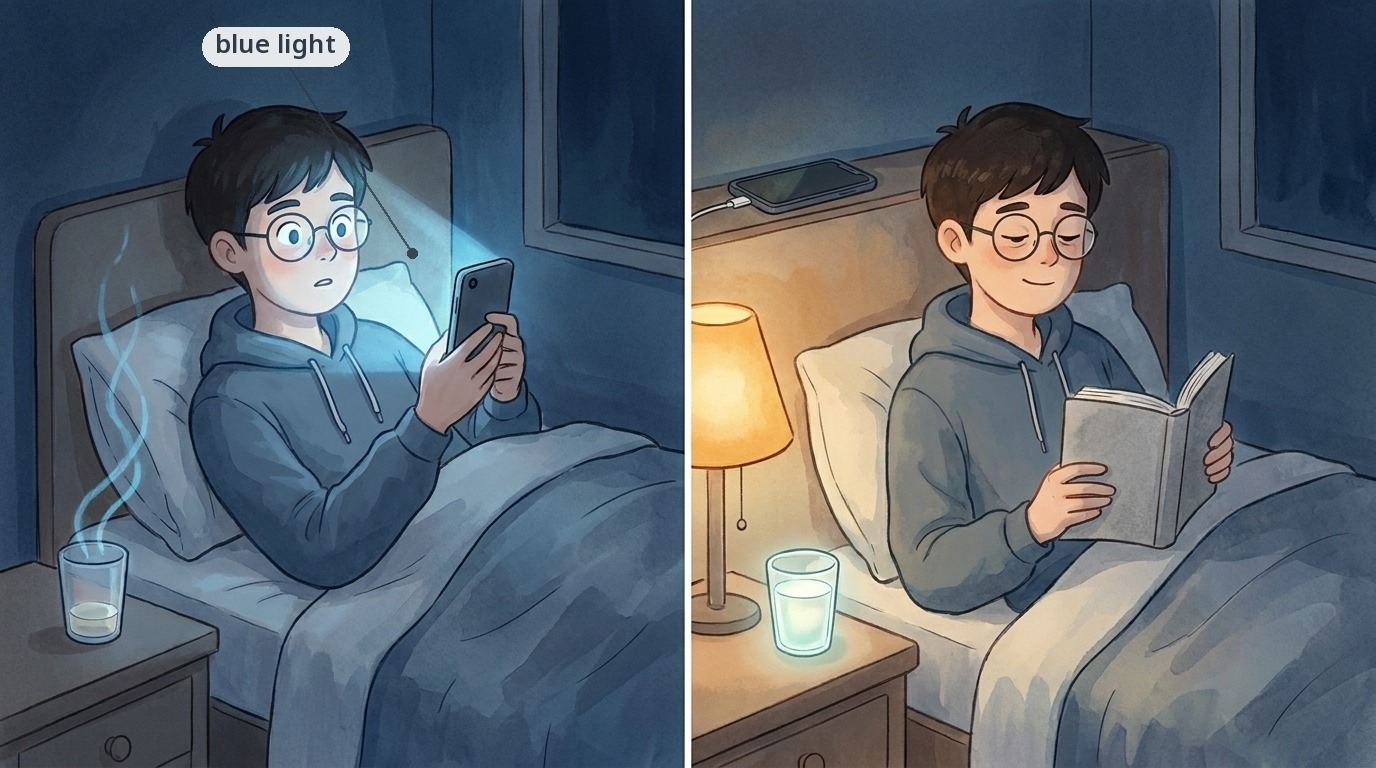
▲ That last hour of screen time steals more than an hour
🔬 Going deeper: why light "delays" the clock
Your eyes have cells that specialize in measuring brightness (ipRGCs; see *Ten Minutes of Morning Light*). They're most sensitive to blue light and connect directly to the master clock. The same light shifts the clock earlier in the morning and later at night. So: more light in the morning, less at night. Two sides of the same mechanism.How solid is the evidence? (B): - A controlled experiment showed that using a light-emitting screen before bed delays sleep, suppresses melatonin and shifts the body clock later (Chang 2015). - A survey of nearly 10,000 Norwegian teenagers found that the more they used electronic devices before bed, the less they slept and the harder it was to fall asleep (Hysing 2015). - Why not A: the experiment was small and the effect modest (around 10 minutes); the large dataset is from teenagers and shows correlation, which can't prove cause and effect directly.
For programmers: "scrolling in bed for a bit" is the last piece of the late-night loop. Charge your phone in the living room and buy the cheapest alarm clock you can find. Best value-for-money sleep upgrade there is.
Limits: night-shift workers and people who often cross time zones need a personalized rhythm plan. Severe insomnia usually has more causes than screens; see a doctor.
Author's note: A 10-minute delay in falling asleep sounds harmless, until you realize it happens every night, and that's before counting what the stimulating content does. An hour of curfew buys back your whole window for falling asleep.
📚 References (3, verified on PubMed)
1. Chang AM, et al. Evening use of light-emitting eReaders negatively affects sleep, circadian timing, and next-morning alertness. *Proc Natl Acad Sci U S A*. 2015;112(4):1232-7. (PMID: 25535358) 2. Hysing M, et al. Sleep and use of electronic devices in adolescence: results from a large population-based study. *BMJ Open*. 2015;5(1):e006748. (PMID: 25643702) 3. Duraccio KM, et al. Does iPhone night shift mitigate negative effects of smartphone use on sleep outcomes in emerging adults? *Sleep Health*. 2021;7(4):478-484. (PMID: 33867308)Late Nights and Vitamin C (A Cushion, Not a Free Pass)
Evidence C | 🧪 Worth a try | Pain point: damage control after a late night | Pillar: none
In one line: after a late night, get some vitamin C from fruit and vegetables as damage control, but it's not a license to stay up.
Sound familiar? You stayed up all night fixing a production incident, then bought a tube of vitamin C fizzy tablets in the morning, hoping to undo some of the damage.
How: 1. The night of, or the day after, eat more vitamin C-rich fruit and vegetables: oranges, kiwis, bell peppers, broccoli. One kiwi plus one orange covers a day's worth. 2. If you can't get fruit and vegetables, a standard-dose supplement (100–200 mg a day) is fine. 3. Don't megadose to "cancel it out": several grams a day just gets excreted and may upset your stomach.
Why:
Think of it this way: a late night is a house fire, and vitamin C is a fire blanket. It can smother one corner of the flames, but the house is still burning.
Staying up raises the stress hormone cortisol, and "oxidative damage" (think of it as cells rusting) goes up too. Vitamin C is one of the main antioxidants in the body's fluids. In rat experiments, vitamin C held down the rise in cortisol and oxidative damage caused by sleep deprivation (Olayaki 2015) and reduced the memory impairment it caused (Mhaidat 2015).
But keep things in proportion: vitamin C only covers the small slice that is oxidative damage. The main harms of a late night, slower thinking, weaker immunity, disrupted metabolism, are beyond its reach. There's no chemical antidote to sleep debt. Only sleep pays it back (see Sleep Debt Repayment Plan).
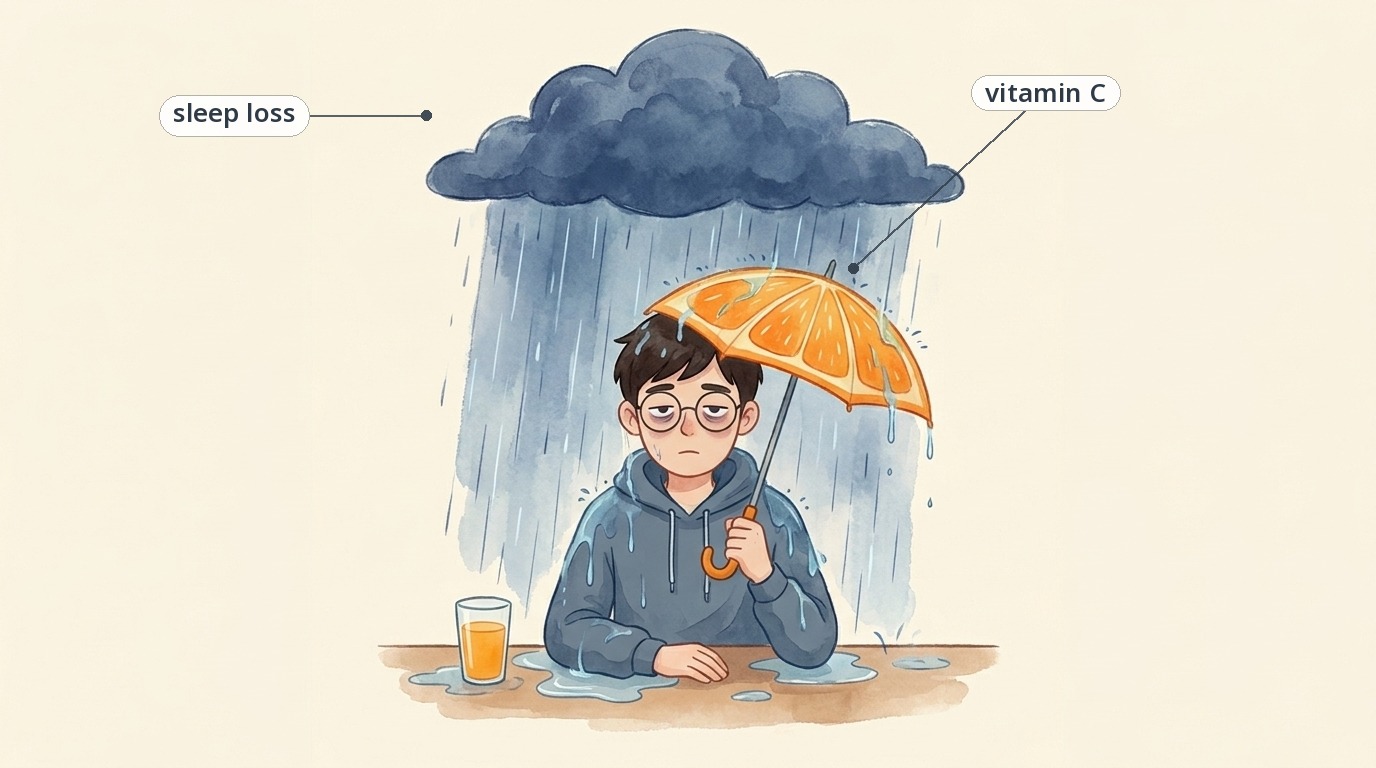
▲ Vitamin C is a cushion, not a free pass
🔬 Going deeper: why a bigger dose isn't better
Your body absorbs vitamin C through transporter proteins in the gut, and they saturate. At a few hundred milligrams a day, blood levels are close to their ceiling. At higher doses, the share absorbed drops and the excess leaves in your urine. So taking 1 or 2 grams at once doesn't multiply the vitamin C in your blood. It just makes diarrhea more likely.How solid is the evidence? (C): - Animal studies: vitamin C can buffer the rise in cortisol and oxidative damage caused by sleep deprivation, and reduce memory impairment (two rat studies). - Human evidence is mostly reviews and indirect associations (Otocka-Kmiecik 2020). - Why not B: there are no high-quality randomized human trials specifically on vitamin C for people who stay up late.
For programmers: the release-night "damage control kit": some fruit and vegetables for vitamin C, an early night the same day (see Sleep Debt Repayment Plan), and sunlight first thing the next morning (see Ten Minutes of Morning Light). The kit makes it hurt less, but the debt still has to be paid.
Limits: more than 2 grams a day (the tolerable upper intake level set in both China and the US) can cause diarrhea and stomach upset; long-term high doses are linked to kidney stone risk. If you've had kidney stones, don't take high doses on your own. If you often work night shifts, the focus is managing your rhythm (see Screen Curfew an Hour Before Bed); supplements are a supporting act.
Author's note: This is the guide's first "firefighting" item. I didn't write it to hand out licenses for late nights: vitamin C only buffers the small slice that is oxidative damage, and doesn't cancel a cent of the debt to your brain or your sleep. That's why it comes after Sleep Debt Repayment Plan and Screen Curfew an Hour Before Bed. Get those two right first; only then does this one come into play.
📚 References (3, verified on PubMed)
1. Olayaki LA, et al. Vitamin C Prevents Sleep Deprivation-induced Elevation in Cortisol and Lipid Peroxidation in the Rat Plasma. *Niger J Physiol Sci*. 2015;30(1-2):5-9. (PMID: 27507778) 2. Mhaidat NM, et al. Exploring the effect of vitamin C on sleep deprivation induced memory impairment. *Brain Res Bull*. 2015;113:41-7. (PMID: 25724146) 3. Otocka-Kmiecik A, et al. The Role of Vitamin C in Two Distinct Physiological States: Physical Activity and Sleep. *Nutrients*. 2020;12(12). (PMID: 33371359)The Desk Ergonomics Trio
Evidence B | ✅ Do it | Pain point: sore neck, aching back, numb wrists | Pillar: none
In one line: raise the screen, support your lower back, keep your wrists flat. Get these three right and your neck, back and wrists suffer less.
Sound familiar? You code with your laptop on the couch, in bed, at a café. By the end of the day your neck feels like lead, and your wrists go numb now and then until you shake them out.
How: 1. Screen: top edge at eye level, about an arm's length away (50–70 cm). On a laptop, add a stand plus an external keyboard and mouse. 2. Wrists: elbows bent at 90–100 degrees, wrists straight, not bent upward. 3. Lower back: sit all the way back in the chair, with a cushion or the chair's lumbar support behind your lower back.
Why:
Think of it this way: an adult head weighs about 5 kg, about the same as a bowling ball. With your head upright, your neck carries just those 5 kg. As your head tips forward, the lever arm gets longer, like holding a bowling ball out on the end of a pole: the further forward, the heavier it gets. One mechanical model estimated that tilting your head 15 degrees puts about 12 kg of force on your neck, and at 60 degrees, close to 27 kg (Hansraj 2014). That's a computer model, not a measurement on real people.
The lower back is similar. Classic measurements of spinal disc pressure found that sitting puts about 40% more pressure on the discs than standing, and leaning forward while sitting nearly doubles it (Nachemson 1981). But a 1999 re-test with more precise sensors found that relaxed sitting is about the same as standing; only leaning forward raises the pressure significantly (Wilke 1999). So the thing to avoid is leaning forward while sitting, not sitting itself.
When your wrists bend upward, pressure inside the carpal tunnel rises and squeezes the median nerve (the main nerve running through the wrist). That's the direct mechanism behind carpal tunnel syndrome.
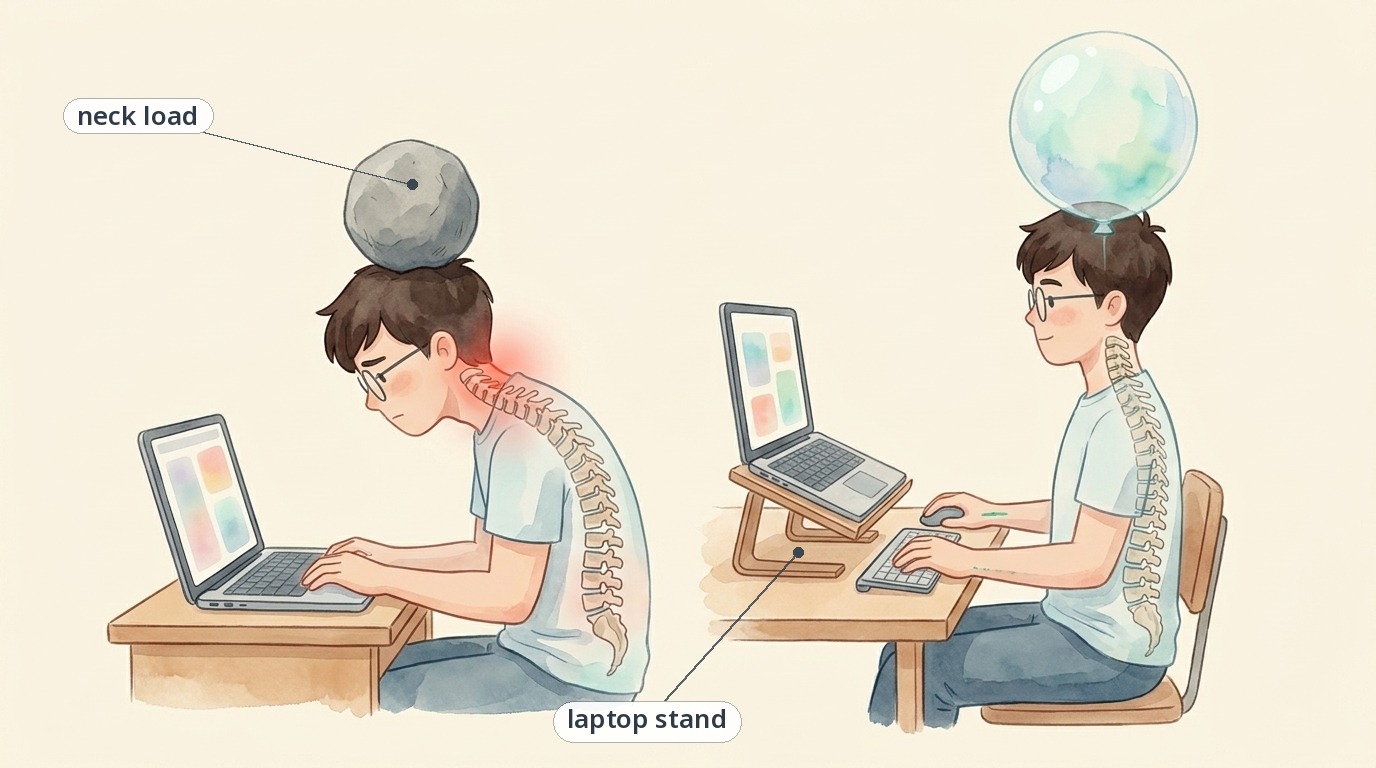
▲ Every inch your head drops, your neck carries more weight: a stand plus an external keyboard
🔬 Going deeper: why laptops are bad ergonomics by design
On a laptop, the screen and keyboard are joined. Put the screen at eye level and the keyboard is too high to type on; put the keyboard at the right height and the screen is so low you have to look down. You can only get one right, so for long-term work you need to separate them: a stand to raise the screen, an external keyboard down low.How solid is the evidence? (B): - The biomechanical evidence is solid (mechanical measurements and models). - But "bad posture always means neck pain" is less certain: a study of 150 young people aged 18–21 found no link between head-down texting posture and neck pain (Damasceno 2018). Whether it hurts also depends on how long you sit and how much you move, so pair this with The 30-Minute Stand-Up Alarm. - Why not A: randomized trials of whether workstation changes prevent carpal tunnel syndrome or neck problems have mixed results.
For programmers: a laptop stand plus an external keyboard and mouse fixes your neck and wrists at the same time for a modest price. Best value-for-money workstation upgrade there is.
Limits: if you already have persistent numbness in your hands (especially numbness that wakes you at night) or weaker grip, get a nerve test at a hospital. Workstation changes can't fix nerves that are already damaged.
Author's note: Laptops are designed for "occasional use on the move." Use one for eight hours a day and it becomes an instrument of torture. An external keyboard plus a stand is the best value-for-money upgrade I've ever recommended, bar none.
📚 References (4, verified on PubMed)
1. Nachemson AL. Disc pressure measurements. *Spine (Phila Pa 1976)*. 1981;6(1):93-7. (PMID: 7209680) 2. Wilke HJ, et al. New in vivo measurements of pressures in the intervertebral disc in daily life. *Spine (Phila Pa 1976)*. 1999;24(8):755-62. (PMID: 10222525) 3. Hansraj KK. Assessment of stresses in the cervical spine caused by posture and position of the head. *Surg Technol Int*. 2014;25:277-9. (PMID: 25393825) 4. Damasceno GM, et al. Text neck and neck pain in 18-21-year-old young adults. *Eur Spine J*. 2018;27(6):1249-1254. (PMID: 29306972)Chapter 8 · Focus Engineering
Flow, working memory, rhythm, meditation: a programmer's most expensive asset is focus. Here's how to protect it.
Coding and Flow
Evidence C | 🧪 Worth a try | Pain point: interruptions, context-switching costs | Pillar: none
In one line: before you get interrupted, leave a one-line "resume comment," a breakpoint for your future self.
Sound familiar? You've just untangled a nasty bug when a colleague taps your shoulder: "Got a sec? Quick question." Five minutes later you're back, staring at the screen: "What was I doing?"
How:
1. Block out do-not-disturb time: put a 2-hour "focus time" block on your calendar and set your chat status to "Do not disturb."
2. Leave a resume comment: before an interruption, spend 10 seconds writing one line, e.g. // TODO next: check whether we retry when the token expires. When you come back, read that line first.
3. Leave one at the end of the day too, and start right there the next morning.
Why:
Flow is that state of total absorption where you lose track of time and the code seems to write itself. Interruptions are what it fears most.
Think of it this way: the task running in your head is like a process in a debugger, with its variables, call stack and next steps all held in memory. An interruption is like killing the process: memory wiped. A resume comment is a breakpoint plus a snapshot: the most important context written to disk, so you don't have to rebuild it from scratch when you return.
Software engineering research confirms the cost. A study of about ten thousand programming sessions from nearly a hundred programmers found that work gets chopped into many short sessions, and after an interruption it often takes a while before programmers start editing code again. In a survey, programmers also said they commonly rely on leaving notes and revisiting their most recent changes to find their way back (Parnin & Rugaber 2011).
Not all of the cost shows up in your progress. In an office-task experiment, people who were interrupted actually finished faster, with no drop in quality, because they sped up to compensate. The price: more stress, more frustration, more time pressure (Mark 2008).
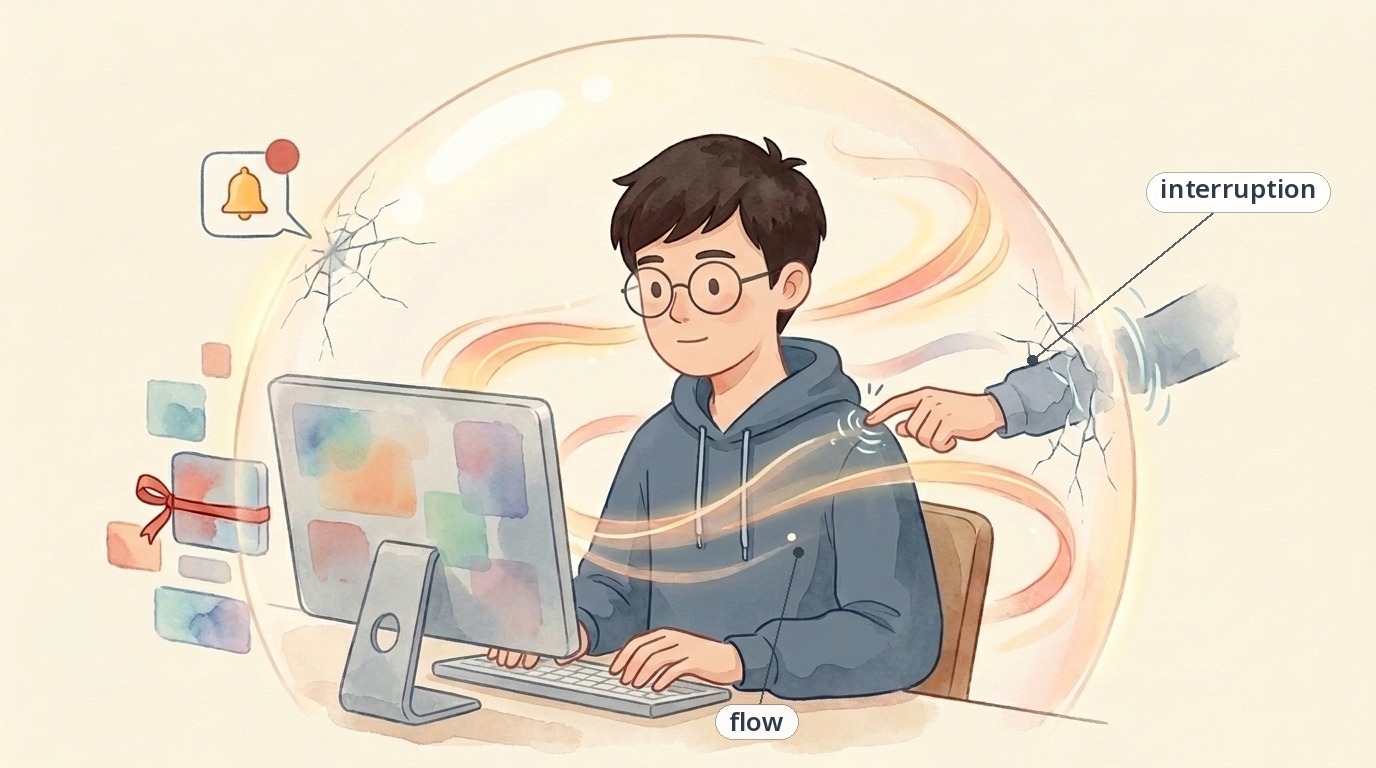
▲ Flow and interruptions: leave a "breakpoint" and you can pick up where you left off
🔬 Going deeper: what your brain does when it "rebuilds context"
Cognitive science calls this "goal deactivation and reactivation." When a task is interrupted, the brain shelves the current goal; when you return, it has to retrieve the goal, recall where you were and reload the relevant details. Interestingly, **brief switches you know are coming** actually help: one experiment found that during a long, monotonous task, briefly switching goals now and then prevented attention from sliding over time (Ariga 2011). The difference: with a switch you expect, you know where you stopped; with a sudden interruption, you don't. A resume comment turns a sudden interruption into a "deliberate save."How solid is the evidence? (C): - Empirical software engineering research (log analysis + survey): interruption costs are real, and programmers commonly rely on leaving markers to recover (Parnin & Rugaber 2011). - An office-task experiment: interruptions make people more stressed (Mark 2008). - Cognitive experiments support the idea that "brief, expected switches" help sustain attention (Ariga 2011). - Why not B: there's no randomized trial of "resume comment vs. no resume comment," and the outcome is productivity, not health.
For programmers: see the product manager heading your way? Cmd+S first, then a resume comment. The division of labor is simple: use a Pomodoro timer to pace routine tasks (see The Physiology of the Pomodoro), and protect flow for deep work.
Limits: flow isn't the best state for every task; code review and hunting down weird bugs sometimes call for more wandering, divergent thinking. And don't turn "protecting flow" into "nobody talk to me." Collaborating with your team is work too.
Author's note: Those ten seconds of "what was I doing?" after an interruption are context reconstruction, and it's billing you. The resume comment is the cheapest habit in the whole guide: one line of comment buys you a fast resume.
📚 References (3)
1. Parnin C, Rugaber S. Resumption strategies for interrupted programming tasks. *Software Quality Journal*. 2011;19(1):5-34. (DOI: 10.1007/s11219-010-9104-9) 2. Ariga A, et al. Brief and rare mental "breaks" keep you focused: deactivation and reactivation of task goals preempt vigilance decrements. *Cognition*. 2011;118(3):439-43. (PMID: 21211793) 3. Mark G, Gudith D, Klocke U. The cost of interrupted work: more speed and stress. *Proceedings of the SIGCHI Conference on Human Factors in Computing Systems (CHI '08)*. 2008:107-110. (DOI: 10.1145/1357054.1357072)Memory Management for Your Brain
Evidence C | 🧪 Worth a try | Pain point: too much to hold in your head, cognitive overload | Pillar: none
In one line: don't store things in your head. Writing them down isn't lazy; it's adding capacity.
Sound familiar? Your head is holding three feature requests, two bugs, an afternoon meeting and "remember to call Mom." You haven't forgotten any of them, but you're not doing any of them well.
How: move things from "in my head" to "outside my head": 1. Before you write code, write a few lines of pseudocode or steps. 2. Put every to-do into one list (the tool doesn't matter; just use one). 3. Leave a resume comment before an interruption (see Coding and Flow). 4. Keep a sheet of scratch paper on your desk and dump ideas onto it as they come.
Why:
Think of it this way: your brain's working memory (the handful of things you're holding and processing right now) is like CPU registers: very fast, but very few, holding only a few items at a time. Cram in ten things and it has to keep swapping them in and out, leaving no room for actual computing. Writing things down moves data from registers to disk, freeing the registers to focus on computing.
Cognitive science calls this "cognitive offloading." A review summarizing many experiments found that when people hand "things to do later" to external reminders (sticky notes, calendars, alerts), they remember them more reliably and with less effort (Gilbert 2023).
On the flip side, trying to "train your brain" to add more registers basically doesn't work. An analysis pooling 87 studies found that working memory training only makes you better at the game you trained on. Switch to a different task (reasoning, intelligence tests) and the benefit disappears (Melby-Lervåg 2016).
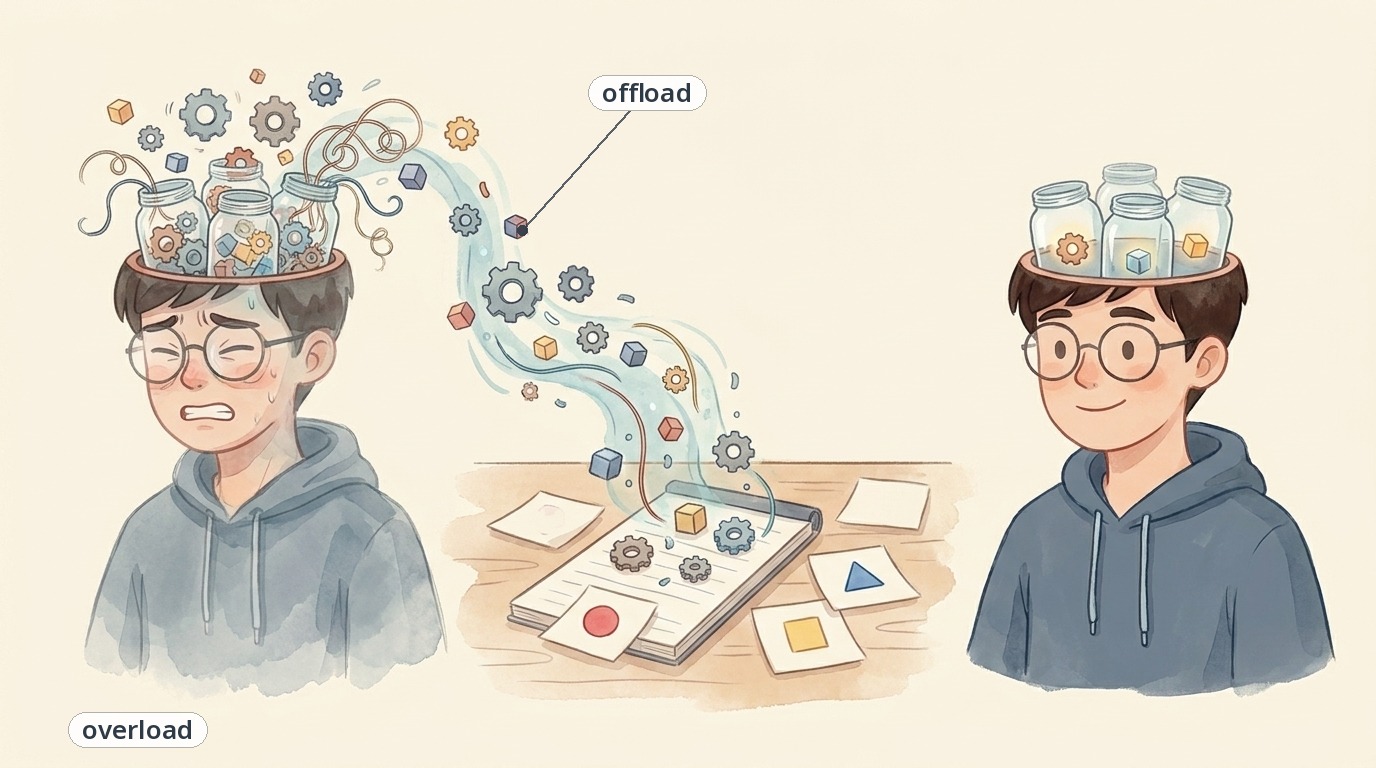
▲ Memory management for your brain: writing it down adds capacity
🔬 Going deeper: does offloading make you "dumber"?
Some researchers worry that handing everything to tools will weaken memory. So far, the evidence looks more like a "division of labor": you remember less of what you hand to the tool, but the freed-up resources go to other things, and overall performance is often better. The condition is that the tool is reliable and you can get the information back when it counts.How solid is the evidence? (C): - Cognitive offloading is backed by a systematic review, though mostly with lab tasks (Gilbert 2023). - "Brain training doesn't carry over to other abilities" is backed by a meta-analysis (Melby-Lervåg 2016). - Why not B: there are no randomized trials of how "writing lists" affects long-term cognition or health.
For programmers: you already do this: comments, TODOs, whiteboards. This item just tells you that your instinct has cognitive science behind it, and it's more reliable than buying a brain-training app.
Limits: offloading doesn't mean not thinking. To really understand a piece of code, you still have to load it into your head and think it through. What you offload is "remembering," not "thinking."
Author's note: "Writing it down adds capacity": engineers understand external storage better than anyone. It's the people selling brain-training apps who should read that meta-analysis. Skip the subscription and buy a good stack of scratch paper.
📚 References (2, verified on PubMed)
1. Gilbert SJ, et al. Outsourcing Memory to External Tools: A Review of 'Intention Offloading'. *Psychon Bull Rev*. 2023;30(1):60-76. (PMID: 35789477) 2. Melby-Lervåg M, et al. Working Memory Training Does Not Improve Performance on Measures of Intelligence or Other Measures of "Far Transfer": Evidence From a Meta-Analytic Review. *Perspect Psychol Sci*. 2016;11(4):512-34. (PMID: 27474138)The Physiology of the Pomodoro
Evidence C | 🧪 Worth a try | Pain point: scattered attention | Pillar: none
In one line: at its core, the Pomodoro is a rhythm: focus for a while, recover for a bit. 25 minutes is not a magic number.
Sound familiar? You sit for three hours, and the last hour you're actually rereading the same chunk of logs over and over. Or the opposite: checking messages, then browsing, then messages again, and the whole morning goes by with nothing done.
How: 1. Focus for 25 minutes, rest for 5: that's one cycle. After 4 cycles, take a longer break. 2. During breaks, get away from the screen: look into the distance and blink (see The 20-20-20 Rule for Your Eyes), stand up and walk a few steps (see The 30-Minute Stand-Up Alarm). 3. Adjust the numbers. For complex code, try 50 + 10. What matters is focusing and recovering in a rhythm.
Why:
Think of it this way: attention is like a phone battery. Under constant heavy load it drains and heats up. The Pomodoro doesn't make the battery bigger; it plugs in the charger on a schedule.
Experiments found that when you stare at one monotonous task for a long time, attention slides over time, and brief, occasional switches in between prevent that slide (Ariga 2011). That's the scientific basis for the focus–recover cycle.
But let's be honest: the "25 minutes" has no physiological basis. It comes from the tomato-shaped kitchen timer Francesco Cirillo used as a university student in the late 1980s. It was a personal habit, not something derived from experiments.
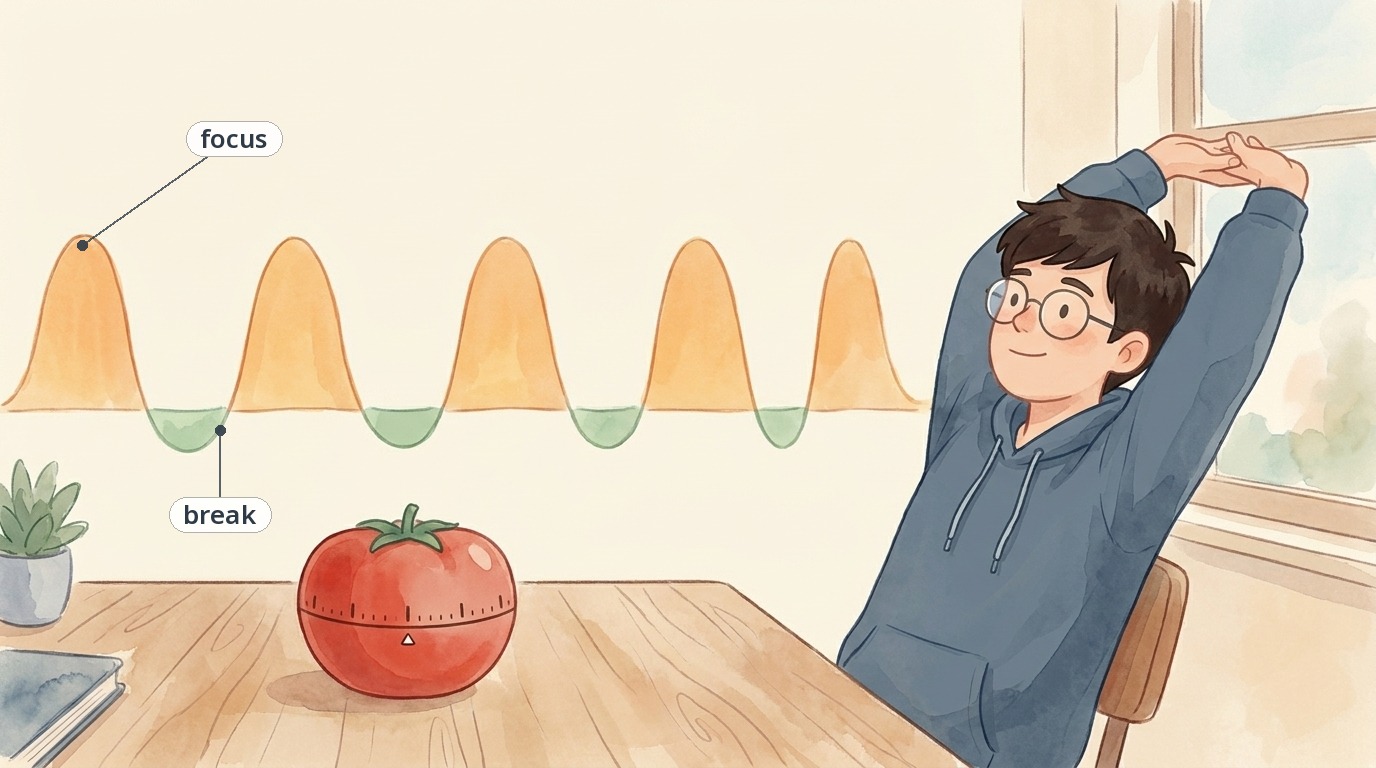
▲ Focus for a while, rest for a bit: the rhythm matters more than the number
🔬 Going deeper: is the 90-minute "ultradian rhythm" real?
During sleep, you go through a cycle about every 90 minutes; that's well established. Some researchers proposed that attention during the day has a similar 90-minute ebb and flow (the "basic rest–activity cycle" hypothesis), but the daytime evidence is much weaker and varies a lot between people. So rather than trusting any particular number, watch yourself: when you start rereading the same line, that's your signal to take a break.How solid is the evidence? (C): - Brief breaks help sustain attention, backed by experiments (Ariga 2011). - The Pomodoro itself has only a few small experiments with university students, and the results are mixed: - One found that a fixed "24 minutes of study + 6 minutes of rest" left students less tired and more focused than stopping whenever they felt like it, with the same amount done (Biwer 2023, 87 people). - Two others found that deciding for yourself when to rest worked just as well, or even left people in a better mood (Smits 2025, 94 people; Göksu 2026, 176 people). - In all three, learning outcomes didn't differ. - Why not B: "25 minutes is optimal" has never been directly tested; the few experiments that exist are small, lasted only a day or two, and contradict each other.
For programmers: treat the Pomodoro as a "forced pause protocol": when the timer goes off, look up, blink, stand up, all three at once. Its biggest value is the rhythm, not the number.
Limits: getting interrupted by a timer during deep coding has a cost too (see Coding and Flow). When you're in flow, stretch the cycle. No need to be dogmatic.
Author's note: What I like about this one is its honesty: "25 minutes" was an Italian university student's personal convention, not physiology. A method can be engineered, but mistaking an engineering convention for a law of nature is exactly what this guide keeps debunking.
📚 References (5)
1. Cirillo F. The Pomodoro Technique. (Origin of the method; not a scientific source) 2. Ariga A, et al. Brief and rare mental "breaks" keep you focused: deactivation and reactivation of task goals preempt vigilance decrements. *Cognition*. 2011;118(3):439-43. (PMID: 21211793) 3. Biwer F, et al. Understanding effort regulation: Comparing 'Pomodoro' breaks and self-regulated breaks. *Br J Educ Psychol*. 2023;93 Suppl 2:353-367. (PMID: 36859717) 4. Smits EJC, et al. Investigating the Effectiveness of Self-Regulated, Pomodoro, and Flowtime Break-Taking Techniques Among Students. *Behav Sci (Basel)*. 2025;15(7). (PMID: 40723645) 5. Göksu A, et al. When to Take a Break: Comparing Effects of Systematic Short (Pomodoro) and Self-Regulated Breaks on Subjective Experience and Actual Learning. *Behav Sci (Basel)*. 2026;16(7). (PMID: 42510279)Ten Minutes of Meditation
Evidence B | ✅ Do it | Pain point: stress, anxiety | Pillars: H2 Telomere attrition · H11 Chronic inflammation
In one line: count your breaths for 10 minutes a day. When your mind wanders, bring it back; that act of bringing it back is the training.
Sound familiar? You downloaded a meditation app, sat for two minutes with your head full of spec docs and unanswered messages, decided "meditation isn't for me," and deleted it.
How: 1. 10 minutes a day. Sit up straight, eyes closed or looking at the floor. 2. Put your attention on your breath: count 1 on the in-breath, 2 on the out-breath, up to 10, then start again from 1. 3. Your mind will wander; that's normal. When you notice, bring your attention back to your breath. That act of bringing it back is the training itself.
Why:
Think of it this way: meditation isn't "emptying your mind." It's practicing one function: return_to_breath(). Each time you wander and come back, that's one call. The more you call it, the faster it runs. You think "my mind keeps wandering" means you're failing, but that's exactly the practice.
This practice really does reduce anxiety. An analysis pooling 47 randomized trials and more than 3,500 people found that mindfulness meditation programs brought small-to-moderate improvements in anxiety, depression and pain (Goyal 2014). A pooled analysis of 23 workplace studies also found that mindfulness training lowers work stress (Bartlett 2019).
To be clear: the programs in these trials mostly ran about 8 weeks, with weekly classes plus daily practice, adding up to far more than 10 minutes. Ten minutes a day is an easy starting dose to stick with, and the effect is probably smaller than in the trials.
There are some molecular clues too: an analysis pooling 4 small trials with 190 people in total found that meditation was associated with higher activity of telomerase, the enzyme that helps maintain the protective "caps" on the ends of chromosomes (Schutte 2014). For the link between attention and inflammation, see Attention Can Tune Inflammation.
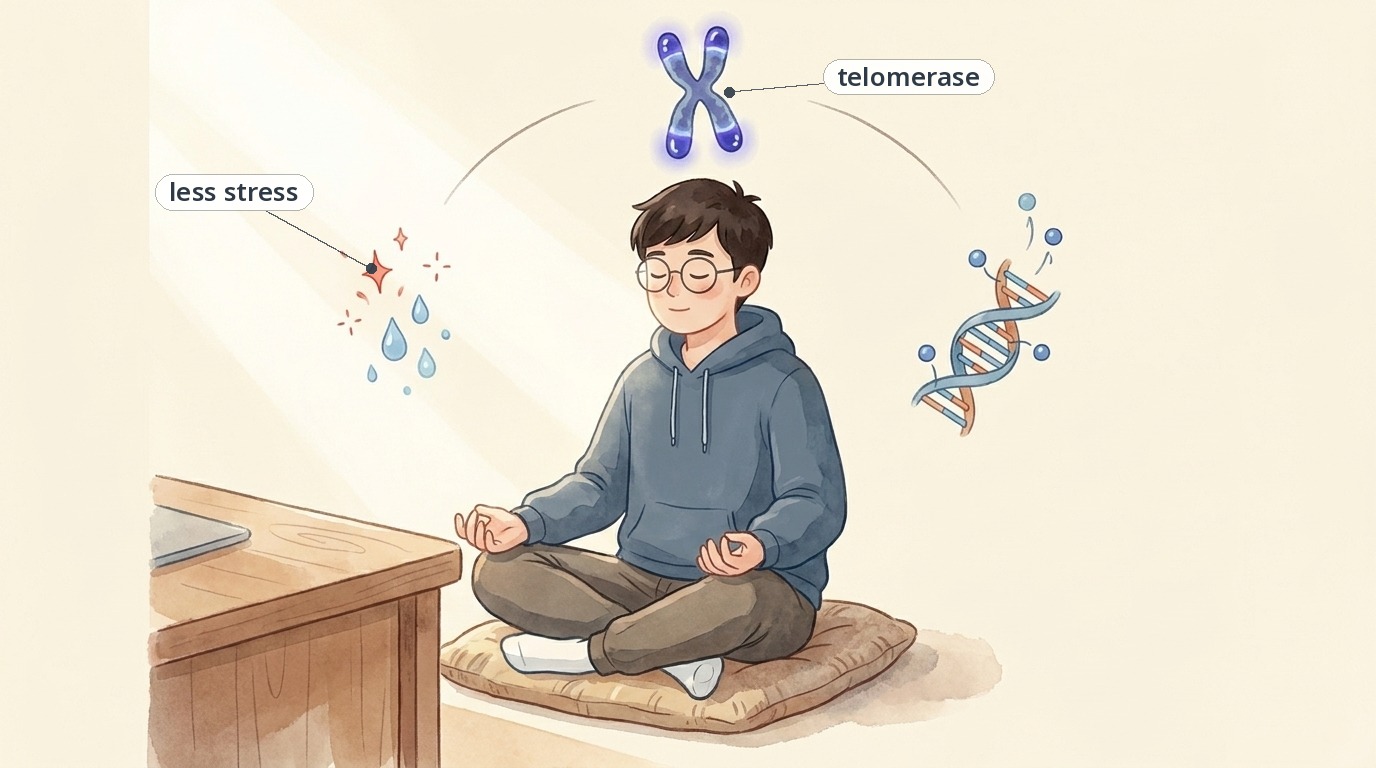
▲ Ten minutes of meditation: less stress first; telomerase is just a clue
🔬 Going deeper: from "stress" to "chromosomes"
Long-term stress keeps stress hormones elevated and raises inflammatory signals, which is linked to shorter telomeres (see *Emotion and Genome Stability*). Meditation dampens the stress response, so in theory it could ease the load along this chain. But the telomerase evidence comes from pooling a few small trials. It's more of a "signal pointing the same way" than a conclusion that "meditation lengthens telomeres."How solid is the evidence? (B): - Less anxiety, depression and stress: multiple randomized trials and meta-analyses (Goyal 2014; Bartlett 2019). - Molecular level (telomerase): a pooled analysis of small samples, signal-level only (Schutte 2014). - Why not A: the improvements are moderate to small. Meditation is hard to compare against a "fake meditation" control (unlike a pill, which can be swapped for a placebo), so it's hard to fully rule out the effect of believing it works. And the trial programs were much heavier than 10 minutes a day.
For programmers: waiting for a compile, between two meetings, before bed: 10 minutes is no longer than one short-video binge.
Limits: meditation doesn't replace psychiatric treatment. If you've been diagnosed with depression or an anxiety disorder, professional treatment comes first and meditation is a supplement. A small number of people feel unwell during long, intensive meditation; if that happens, stop.
Author's note: For this one, the psychological evidence is the most solid and the molecular evidence is still early. Even counting only "a bit less anxiety," 10 minutes a day is well worth it. Telomerase is a bonus clue, not the reason to do it.
📚 References (3, verified on PubMed)
1. Goyal M, et al. Meditation programs for psychological stress and well-being: a systematic review and meta-analysis. *JAMA Intern Med*. 2014;174(3):357-68. (PMID: 24395196) 2. Bartlett L, et al. A systematic review and meta-analysis of workplace mindfulness training randomized controlled trials. *J Occup Health Psychol*. 2019;24(1):108-126. (PMID: 30714811) 3. Schutte NS, et al. A meta-analytic review of the effects of mindfulness meditation on telomerase activity. *Psychoneuroendocrinology*. 2014;42:45-8. (PMID: 24636500)Chapter 9 · Food and Supplements
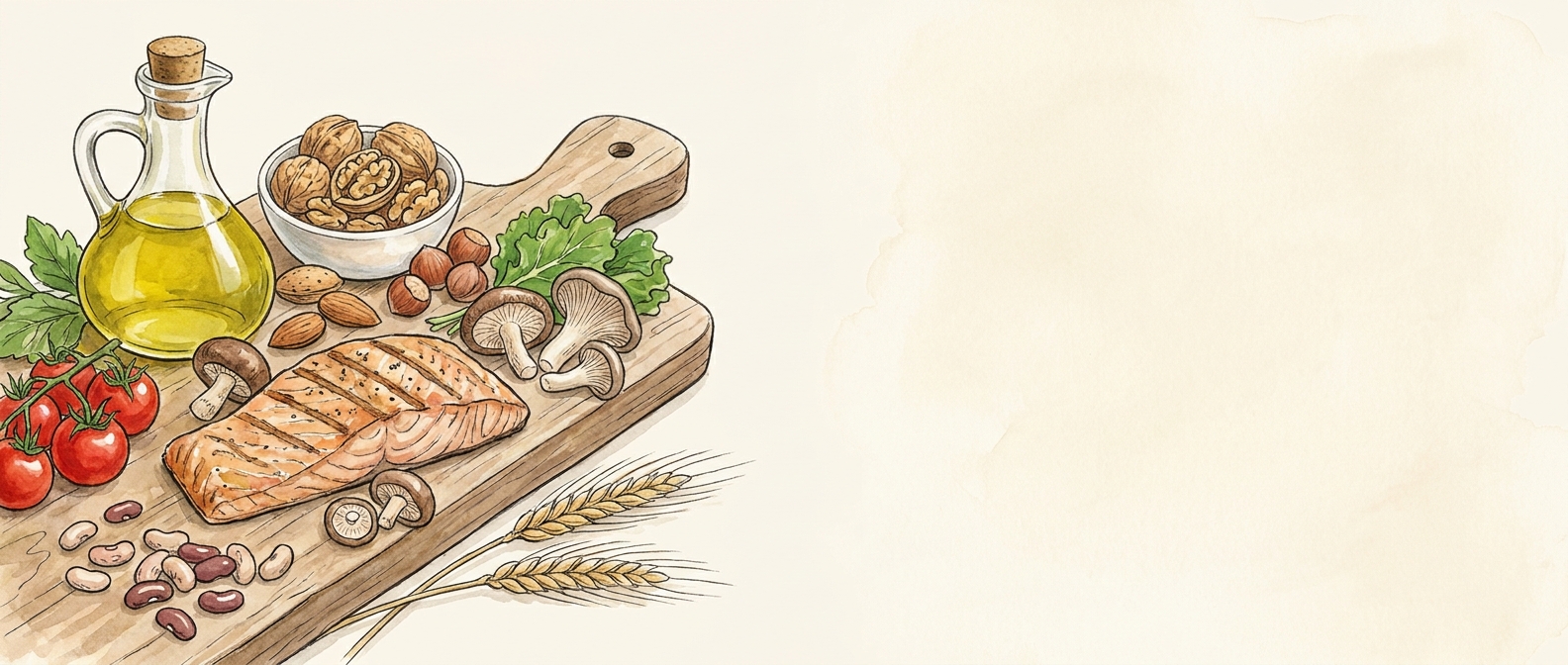
Nuts, fish oil, DHA, spermidine, GlyNAC: which belong on your plate, which supplements you can skip, and which are really for your parents.
A Handful of Nuts
Evidence B | ✅ Do it | Pain point: daily snacking | Pillar: H6 Deregulated nutrient-sensing
In one line: a small handful of unsalted nuts a day, about 28 g, is one of the best snacks there is.
Sound familiar? At 4 p.m., the chips, cookies and spicy snacks in your drawer are calling. You eat them and end up hungrier, and sleepy.
How: 1. One small handful a day, about 28 g: roughly what fits in your palm. 2. Choose plain, unsalted, unsweetened, not fried. 3. Rotate walnuts, almonds, pistachios and hazelnuts.
Why:
Think of it this way: chips are a one-off power surge that spikes your blood sugar and then crashes it. Nuts are a steady battery: fat, protein and fiber release energy slowly.
The large population data is consistent. An analysis pooling 18 long-term studies (record what people eat, then see who has died years later) found that people who ate the most nuts had about a 20% lower risk of all-cause mortality than those who ate the least (Chen 2017). Another pooled analysis worked it out by dose: each extra 28 g of nuts a day was linked to about a 22% lower risk of all-cause mortality and a lower risk of coronary heart disease, with most of the benefit reached within a handful a day (Aune 2016).
There's some support from randomized trials too: in a large Mediterranean diet trial, the group that added a daily handful of nuts had fewer heart attacks, strokes and similar events than the control group (see A Plant-Forward Mediterranean Diet).
Nuts pack more than one good thing: unsaturated fats that help your lipids, fiber that feeds your gut bacteria, plus vitamin E, magnesium and polyphenols.
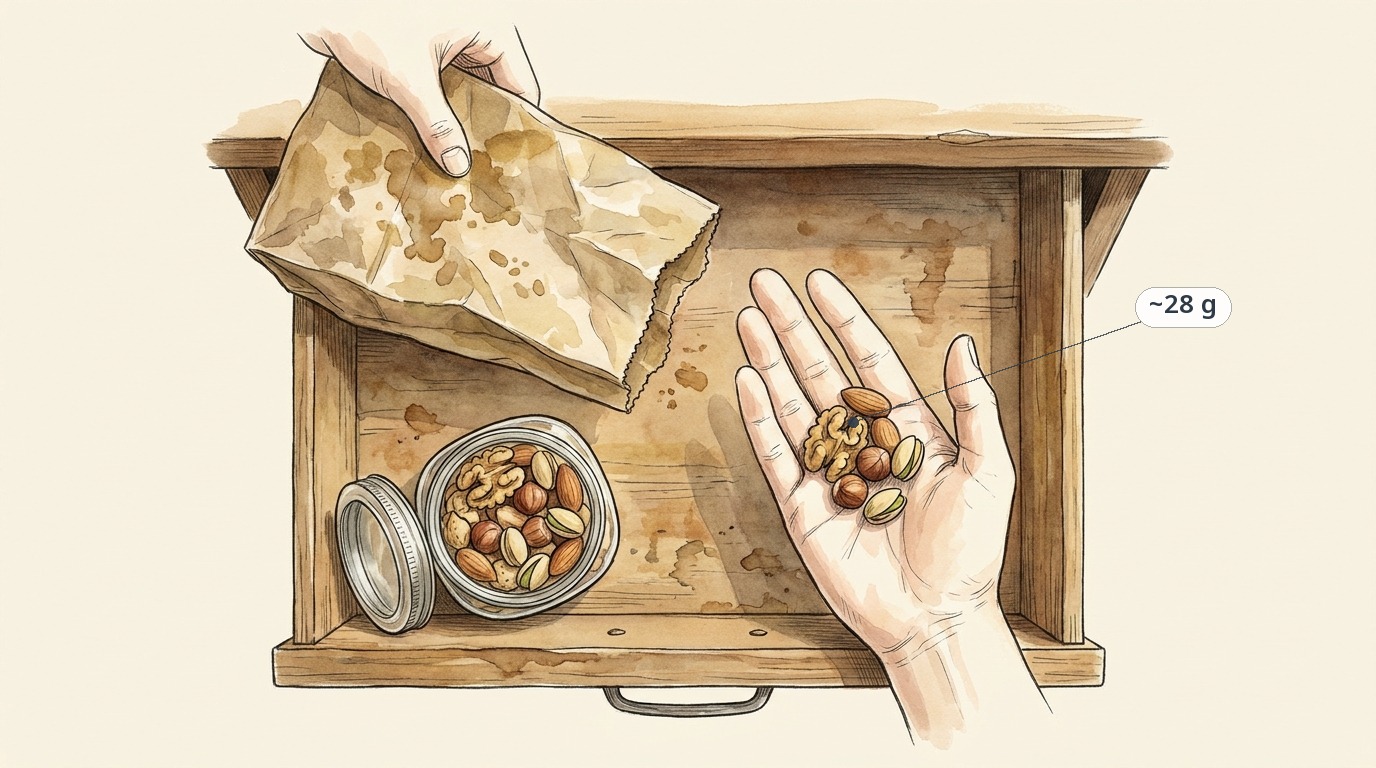
▲ A handful of nuts: swap the chips for a small handful of unsalted nuts
🔬 Going deeper: why "a handful," not "a jar"
Nuts are calorie-dense: 28 g is about 160–200 kcal. In the studies, the "highest intake" groups mostly ate about a small handful a day. Beyond that, the extra benefit isn't clear, but your weight may go up. So the dose in the evidence is "a small handful."How solid is the evidence? (B): - Several long-term studies and meta-analyses point the same way: the more nuts, the lower the risk, leveling off at around a handful (Chen 2017; Aune 2016). - In a Mediterranean diet randomized trial, the added-nuts group had fewer cardiovascular events. - Why not A: the main evidence is observational, and people who eat nuts may already be more health-conscious; that can't be fully ruled out. In the randomized trial, nuts came as part of a whole Mediterranean diet, so it's hard to credit the nuts alone.
For programmers: swap the chips in your desk drawer for a jar of unsalted mixed nuts and a small scoop. One scoop a day. Don't graze while coding, or half the jar disappears.
Limits: people with nut allergies must avoid them completely. Salted, honey-roasted, candied or fried "nut snacks" don't count. Whole nuts are a choking risk for young children.
Author's note: The easiest item in the whole book to act on: swap chips for nuts. A handful a day, mixed, and don't polish off half a jar at once. "A small handful" isn't me being cautious. It's the dose in the evidence.
📚 References (2, verified on PubMed)
1. Chen GC, et al. Nut consumption in relation to all-cause and cause-specific mortality: a meta-analysis 18 prospective studies. *Food Funct*. 2017;8(11):3893-3905. (PMID: 28875220) 2. Aune D, et al. Nut consumption and risk of cardiovascular disease, total cancer, all-cause and cause-specific mortality: a systematic review and dose-response meta-analysis of prospective studies. *BMC Med*. 2016;14(1):207. (PMID: 27916000)Omega-3 and Dry Eye
Evidence B (large RCT was negative) | food 🧪; supplements 💸 | Pain point: supplements for your eyes | Pillar: none
In one line: if you have dry eyes, eat more oily fish; but the largest fish oil trial was negative, so don't spend money on supplements for it.
Sound familiar? Your eyes feel dry and gritty. You search "eye health," buy a big bottle of fish oil, take it for two months, and it maybe helps, or maybe doesn't.
How: 1. Start with the free stuff: blink more at the screen, and look into the distance every 20 minutes (see The 20-20-20 Rule for Your Eyes). 2. Food: oily fish twice a week (salmon, mackerel, sardines). 3. Don't buy fish oil specifically for dry eye. If you already take it and notice nothing after 3 months, stop. Don't increase the dose. 4. If your dry eye is severe, see an eye doctor. They have treatments that actually work.
Why:
Think of it this way: the omega-3s in fish oil (EPA and DHA) act like firefighters that calm inflammation. Dry eye is linked to chronic inflammation on the surface of the eye, so "fish oil for your eyes" sounds reasonable.
But sounding reasonable doesn't mean it works. Some small trials and pooled analyses saw improvements (Wang 2023). But the largest and most rigorous trial, DREAM, gave 535 people with moderate-to-severe dry eye 3,000 mg of EPA + DHA a day for 12 months. They improved just as much as the people taking an olive oil "placebo" (DREAM 2018). A systematic review of treatments for "computer vision syndrome" also found the evidence limited (Singh 2022).
When small trials and a big trial disagree, the big trial usually wins.
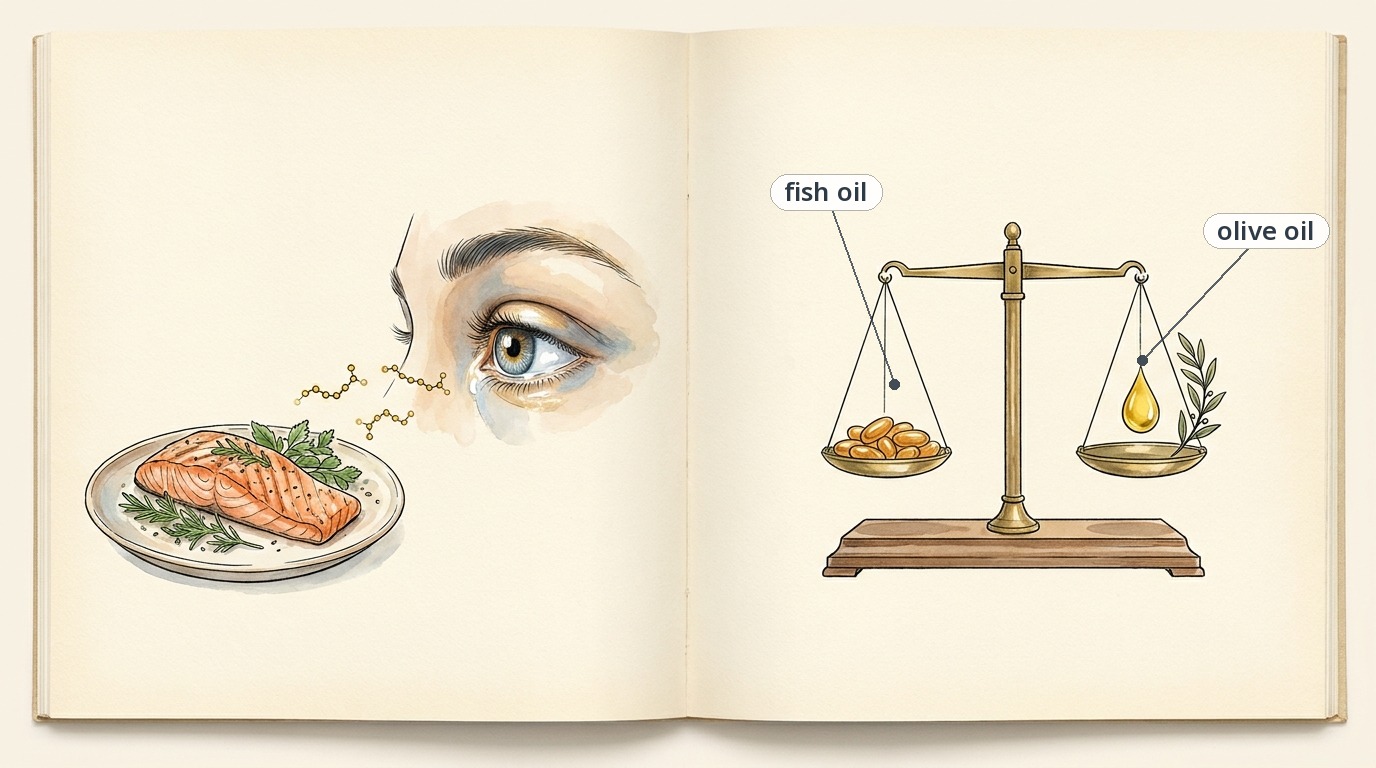
▲ Omega-3 and dry eye: eating fish is fine; in the big trial, fish oil tied with an olive oil placebo
🔬 Going deeper: why small trials "work" so easily
The main outcome in dry eye is a symptom score, which is very subjective, and the placebo effect is strong (both groups in DREAM improved a lot). Small trials have few people and a lot of chance variation, and positive results are more likely to get published, so pooled results tilt toward "it works." DREAM had a big enough sample and a credible placebo, which kept those biases down.How solid is the evidence? (B, negative): - The largest, most rigorous randomized trial was negative (DREAM 2018). - Small trials and meta-analyses lean positive, so the evidence is split (Wang 2023; Singh 2022). - Bottom line: eating fish is worth a try; buying fish oil specifically for dry eye isn't worth the money.
For programmers: many people go eye drops → fish oil → blink reminders. Flip it: blink and look into the distance first, then eat fish, and only then consider anything else.
Limits: high-dose fish oil can increase bleeding risk. If you take blood thinners, ask your doctor first, and tell your doctor before any surgery.
Author's note: This is the section where the evidence "fights" the most, and I kept it on purpose. Showing split evidence honestly is exactly what this grading system is for.
📚 References (3, verified on PubMed)
1. Wang WX, et al. Efficacy of Omega-3 Intake in Managing Dry Eye Disease: A Systematic Review and Meta-Analysis of Randomized Controlled Trials. *J Clin Med*. 2023;12(22). (PMID: 38002640) 2. Singh S, et al. Interventions for the Management of Computer Vision Syndrome: A Systematic Review and Meta-analysis. *Ophthalmology*. 2022;129(10):1192-1215. (PMID: 35597519) 3. Dry Eye Assessment and Management Study Research Group, et al. n-3 Fatty Acid Supplementation for the Treatment of Dry Eye Disease. *N Engl J Med*. 2018;378(18):1681-1690. (PMID: 29652551)APOE4 and Long-Chain Fatty Acids
Evidence C | 📖 Good to know (eating fish is fine; buying supplements to protect your brain 💸) | Pain point: genes × nutrition | Pillar: H1 Genomic instability
In one line: the brains of APOE4 carriers "burn" DHA faster, but extra DHA didn't bring better cognition. Eating fish is enough.
Sound familiar? You did a genetic test, the report says "APOE4 carrier, increased risk of Alzheimer's disease," and that night you ordered three bottles of high-dose DHA.
How: 1. No need to panic about this gene, and no need to get tested for it specifically. 2. Carrier or not, get the basics in this guide right: exercise (see Zone 2 Walking), sleep (see Sleep About 7 Hours), blood pressure (see Know Your Blood Pressure). 3. Eat oily fish twice a week. 4. There's currently no evidence for buying high-dose DHA supplements to protect your brain.
Why:
First, APOE. It's a protein that helps carry fats around the body, and it comes in several "models." APOE4 is the most common genetic risk factor for Alzheimer's disease: the more copies you carry, the higher the risk and the earlier it tends to start (Corder 1993).
DHA is the most abundant omega-3 fatty acid in the brain. A PET study (a scan that shows where molecules go in the body) used labeled DHA to track it entering the brain. It found that APOE4 carriers' brains aren't "unable to take in" DHA. In some brain regions they actually took up more (about 16% more). The researchers read this as a sign that their brains use DHA up faster (Yassine 2017).
Think of it this way: both computers can be refueled just fine, but the APOE4 one has higher "fuel consumption."
So can topping up make up for the extra burn? A randomized controlled trial published in 2026 tested exactly that: 365 people aged 55–80 who ate little DHA and were at risk of dementia took 2 g of DHA a day for 24 months. DHA in their cerebrospinal fluid did go up, equally in carriers and non-carriers. But their cognition and brain volume were no better than the placebo group's (Yassine 2026).
To be fair, though: the trial's main goal was to see whether DHA reaches the brain; cognition and brain volume were only secondary outcomes. It also ran into COVID-19, and 38% of participants didn't make it to the end. So it doesn't prove "DHA definitely doesn't work," only that "no benefit has been seen so far."
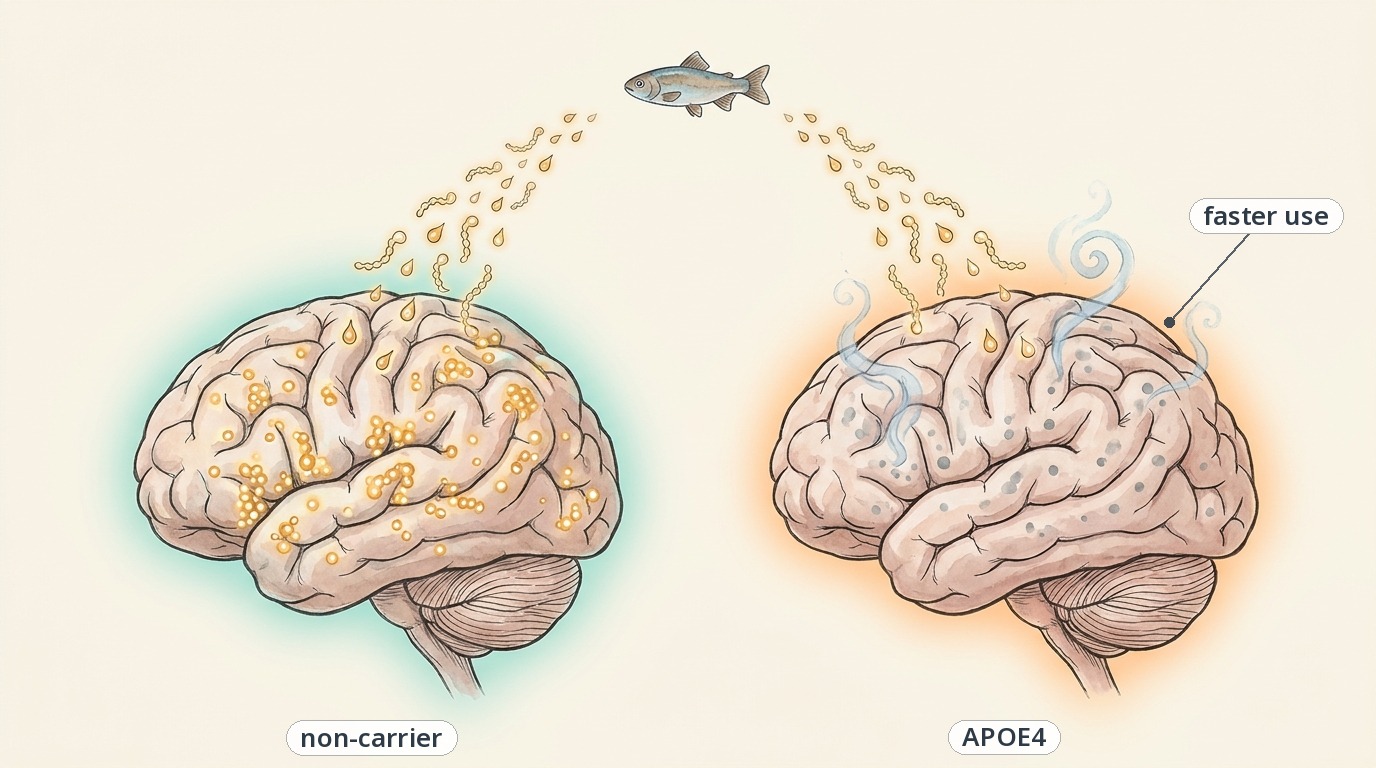
▲ APOE4 and long-chain fatty acids: both brains take up DHA, but APOE4 carriers' brains use it faster
🔬 Going deeper: "it got in" doesn't mean "it worked"
This trial is a great lesson in nutrition research. It first showed "delivery": the extra DHA really did reach the brain and spinal cord (the central nervous system). But the next step, clinical benefit, didn't show up. A lot of supplement ads stop at step one ("X reaches the brain," "X raises blood levels") and jump straight to "so it protects your brain." That jump is exactly where evidence is needed most.How solid is the evidence? (C): - APOE4 raises Alzheimer's risk: classic genetics, a solid conclusion (Corder 1993). - APOE4 brains use DHA faster: a 22-person PET study, exploratory evidence (Yassine 2017). - Two years of high-dose DHA: a randomized controlled trial with no benefit for cognition or brain volume, though these were secondary outcomes and dropout was high (Yassine 2026). - Why only "good to know": the mechanism is interesting, but the only intervention trial so far was negative.
For programmers: the biggest use of this section is installing a "supplement ad detector": when you see "X reaches the brain," ask "and then? Did cognition improve?"
Limits: genes aren't destiny. Most APOE4 carriers never get Alzheimer's, and many lifestyle factors can be changed. APOE testing can be stressful and may affect insurance. If you want to be tested, talk to a genetic counselor first.
Author's note: I originally treated this section as a trailer for "precision nutrition." After checking the latest trial, I changed my tune: APOE4 brains really do "burn more fuel," but adding more fuel didn't make them run better. This is the most common step in nutrition science, and the one ads most often skip. Eat fish, and save the money for running shoes.
📚 References (3, verified on PubMed)
1. Corder EH, et al. Gene dose of apolipoprotein E type 4 allele and the risk of Alzheimer's disease in late onset families. *Science*. 1993;261(5123):921-3. (PMID: 8346443) 2. Yassine HN, et al. DHA brain uptake and APOE4 status: a PET study with [1-(11)C]-DHA. *Alzheimers Res Ther*. 2017;9(1):23. (PMID: 28335828) 3. Yassine HN, et al. CNS target engagement of high-dose DHA supplementation in older adults at risk for dementia: a randomised, double-blind, placebo-controlled trial. *EBioMedicine*. 2026;129:106316. (PMID: 42315445)Spermidine and Wheat Germ
Evidence C | 🧪 food is worth a try; supplements 💸 | Pain point: wanting to switch on autophagy | Pillar: H5 Disabled macroautophagy
In one line: get spermidine from wheat germ, natto and cheese; the human trials of supplements aren't impressive.
Sound familiar? A short video pitches "spermidine, the longevity miracle: activates cellular autophagy, reverses aging." A bottle costs a small fortune, and you're wondering whether to buy.
How: 1. Food first: wheat germ (sprinkled on oatmeal or yogurt), natto, aged cheese, mushrooms, beans. 2. Supplements aren't recommended for now. The human trials don't yet justify the money.
Why:
First, autophagy. Think of it this way: cells pile up "garbage" too, like broken proteins and worn-out mitochondria. Autophagy is the cell's garbage collection: it breaks the garbage down and recycles it. The older you get, the slower it runs.
Spermidine is a small molecule found naturally in food, and it can switch on this recycling system. In yeast, worms, fruit flies and mice, spermidine extends lifespan, and that evidence is quite solid. In mice, adding spermidine to drinking water extended lifespan and improved heart health (Eisenberg 2016).
In humans, though, the results are underwhelming. In a randomized controlled trial, 100 older adults worried about their memory took wheat-germ-derived spermidine for 12 months. The primary outcome (memory) didn't improve; there were only hints in some exploratory measures (verbal memory, inflammation markers) (Schwarz 2022). In another trial, older men took 40 mg of spermidine a day, and blood levels of polyamines (the family of molecules spermidine belongs to) barely changed (Keohane 2024). There's still a gap between "swallowed" and "arrived."
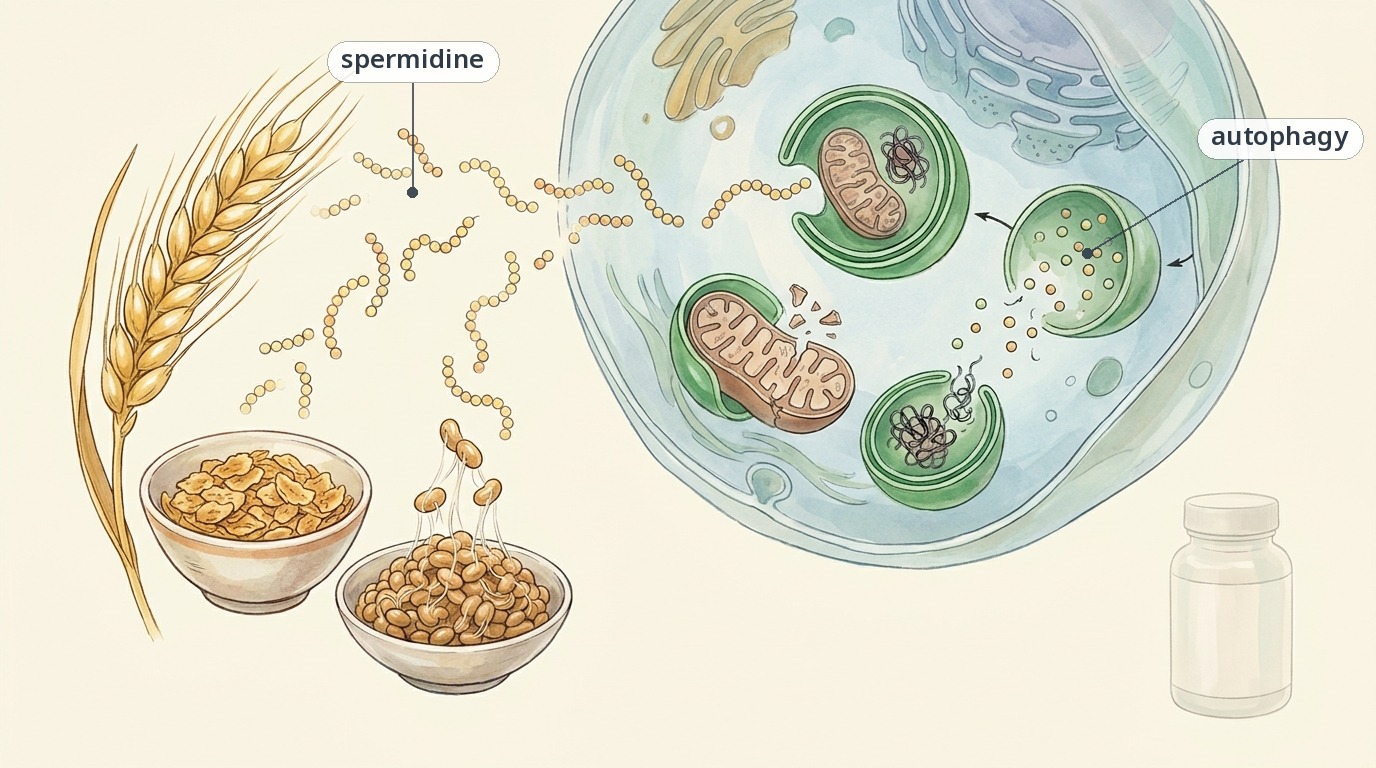
▲ Spermidine in food can switch on the cell's garbage collection (autophagy)
🔬 Going deeper: why it works in animals but not clearly in people
There are a few likely reasons. Animal doses, adjusted for body weight, are far higher than what people can get from food. Gut bacteria in people make polyamines too, so a small extra dose is a small share. And aging outcomes in humans take many years to show up, which a one- or two-year trial can hardly capture. All of this says it's too early to conclude "it extends human life."How solid is the evidence? (C): - Strong mechanistic and animal lifespan evidence (Eisenberg 2016). - Human randomized trials: primary outcome negative, only exploratory signals (Schwarz 2022); 40 mg a day barely moved blood polyamines (Keohane 2024). - Why not B: few human trials, all small, and the primary outcome wasn't met.
For programmers: add two spoonfuls of wheat germ to your breakfast oatmeal. It's cheap, and you get extra vitamin E and fiber too. It's the same grain of wheat as in Ganmai Dazao Decoction and Wheat Germ.
Limits: the dose and long-term safety of supplements aren't settled. If you're pregnant, breastfeeding or being treated for cancer, don't take it on your own. Wheat germ contains gluten, so people with celiac disease (a gut disease triggered by gluten) should avoid it.
Author's note: Spermidine is the textbook case of "beautiful animal data, flat human data." From food, zero risk; supplements, wait for bigger trials. Don't pay a premium for a story that hasn't come true in people yet.
📚 References (3, verified on PubMed)
1. Eisenberg T, et al. Cardioprotection and lifespan extension by the natural polyamine spermidine. *Nat Med*. 2016;22(12):1428-1438. (PMID: 27841876) 2. Schwarz C, et al. Effects of Spermidine Supplementation on Cognition and Biomarkers in Older Adults With Subjective Cognitive Decline: A Randomized Clinical Trial. *JAMA Netw Open*. 2022;5(5):e2213875. (PMID: 35616942) 3. Keohane P, et al. Supplementation of spermidine at 40 mg/day has minimal effects on circulating polyamines: An exploratory double-blind randomized controlled trial in older men. *Nutr Res*. 2024;132:1-14. (PMID: 39405978)GlyNAC
Evidence C | 📖 Good to know (for your parents) | Pain point: supplement combos for older adults | Pillar: H7 Mitochondrial dysfunction
In one line: GlyNAC (glycine + NAC) is one for your parents to read; young people don't need to rush.
Sound familiar? Your parents forward you an article from their family group chat about a "new anti-aging combo" and ask: "Is this legit? Should we buy it?"
How: 1. This section is mainly to help you answer your parents' question. 2. Young people usually aren't short on glutathione and don't need to supplement. 3. If your parents want to try it, have a doctor or pharmacist review the medicines they already take first.
Why:
First, glutathione. Think of it this way: it's the cell's "fire extinguisher," handling the "sparks" thrown off by mitochondria (the cell's power plants), that is, oxidative damage. As you age, the extinguisher runs low.
Glutathione is built from three ingredients, and two of them, glycine and cysteine, often run short in older adults. GlyNAC tops up both at once: glycine, plus NAC (N-acetylcysteine), which the body turns into cysteine.
A team at Baylor College of Medicine in the US ran a series of studies:
- First, an open-label trial (everyone knew what they were taking; no placebo) in older people living with HIV (Kumar 2020);
- Then a small 8-person pilot trial in ordinary older adults (Kumar 2021);
- Finally, a randomized controlled trial with 24 older adults (Kumar 2023).
The results pointed the same way: after supplementing, the older participants improved on many measures, including glutathione levels, oxidative damage, mitochondrial function and physical performance.
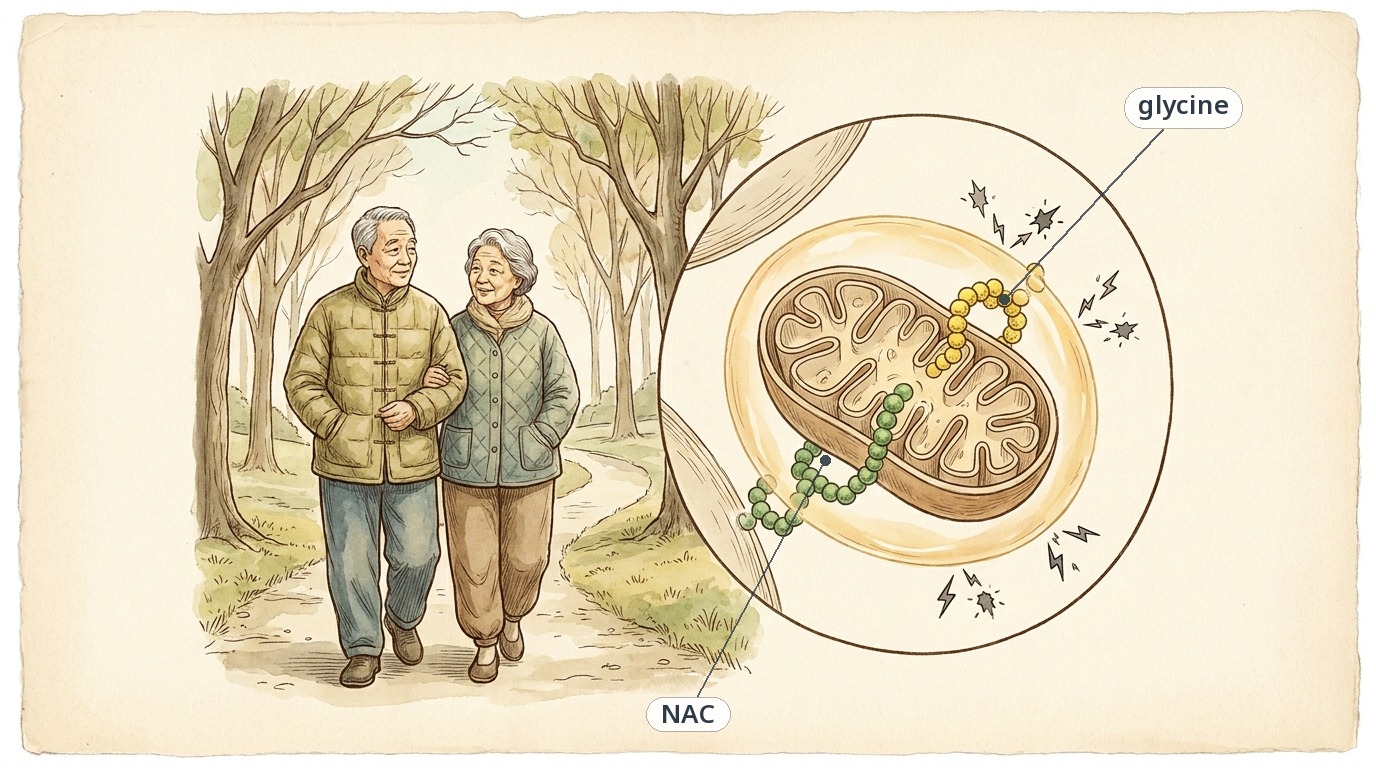
▲ GlyNAC: glycine + NAC restore the glutathione shield for mitochondria
🔬 Going deeper: why not just take glutathione?
Most oral glutathione gets broken down in the gut and has a hard time entering cells intact. Cells prefer to make it themselves from raw ingredients. So supplying the ingredients (glycine + cysteine) makes more sense than supplying the finished product, and that's the idea behind GlyNAC. For NAC's other use, see *NAC and Phlegm*.How solid is the evidence? (C): - Three studies point the same way, including one randomized controlled trial (Kumar 2023). - Why not B: all from the same team at the same center, each with a few dozen people or fewer; the first study was in older people with HIV; other teams still need to replicate it.
For programmers: on your parents' supplement list, GlyNAC has more solid evidence than most "anti-aging influencer products." But "more solid" doesn't mean "proven." Help them ask a doctor first.
Limits: there's only data in older adults. NAC may interact with some drugs (such as nitroglycerin), and people with asthma should be careful. Have a pharmacist review it before use.
Author's note: This section isn't for coders themselves; it's for your mom and dad. The Baylor team's studies point the same way, but independent replication is still missing. My advice: know about it so you can answer your parents' questions, and if they really want to take it, get past the doctor first.
📚 References (3, verified on PubMed)
1. Kumar P, et al. Supplementing Glycine and N-acetylcysteine (GlyNAC) in Aging HIV Patients Improves Oxidative Stress, Mitochondrial Dysfunction, Inflammation, Endothelial Dysfunction, Insulin Resistance, Genotoxicity, Strength, and Cognition: Results of an Open-Label Clinical Trial. *Biomedicines*. 2020;8(10). (PMID: 33007928) (participants were older people living with HIV) 2. Kumar P, et al. Glycine and N-acetylcysteine (GlyNAC) supplementation in older adults improves glutathione deficiency, oxidative stress, mitochondrial dysfunction, inflammation, insulin resistance, endothelial dysfunction, genotoxicity, muscle strength, and cognition: Results of a pilot clinical trial. *Clin Transl Med*. 2021;11(3):e372. (PMID: 33783984) 3. Kumar P, et al. Supplementing Glycine and N-Acetylcysteine (GlyNAC) in Older Adults Improves Glutathione Deficiency, Oxidative Stress, Mitochondrial Dysfunction, Inflammation, Physical Function, and Aging Hallmarks: A Randomized Clinical Trial. *J Gerontol A Biol Sci Med Sci*. 2023;78(1):75-89. (PMID: 35975308)Chapter 10 · The Twelve Pillars
The scientific backbone of this guide is the twelve hallmarks of aging laid out in the 2023 Cell paper "Hallmarks of aging." Every section's advice maps onto one of these pillars.
López-Otín C, Blasco MA, Partridge L, et al. Hallmarks of aging: An expanding universe. Cell. 2023;186(2):243-278. (PMID: 36599349)
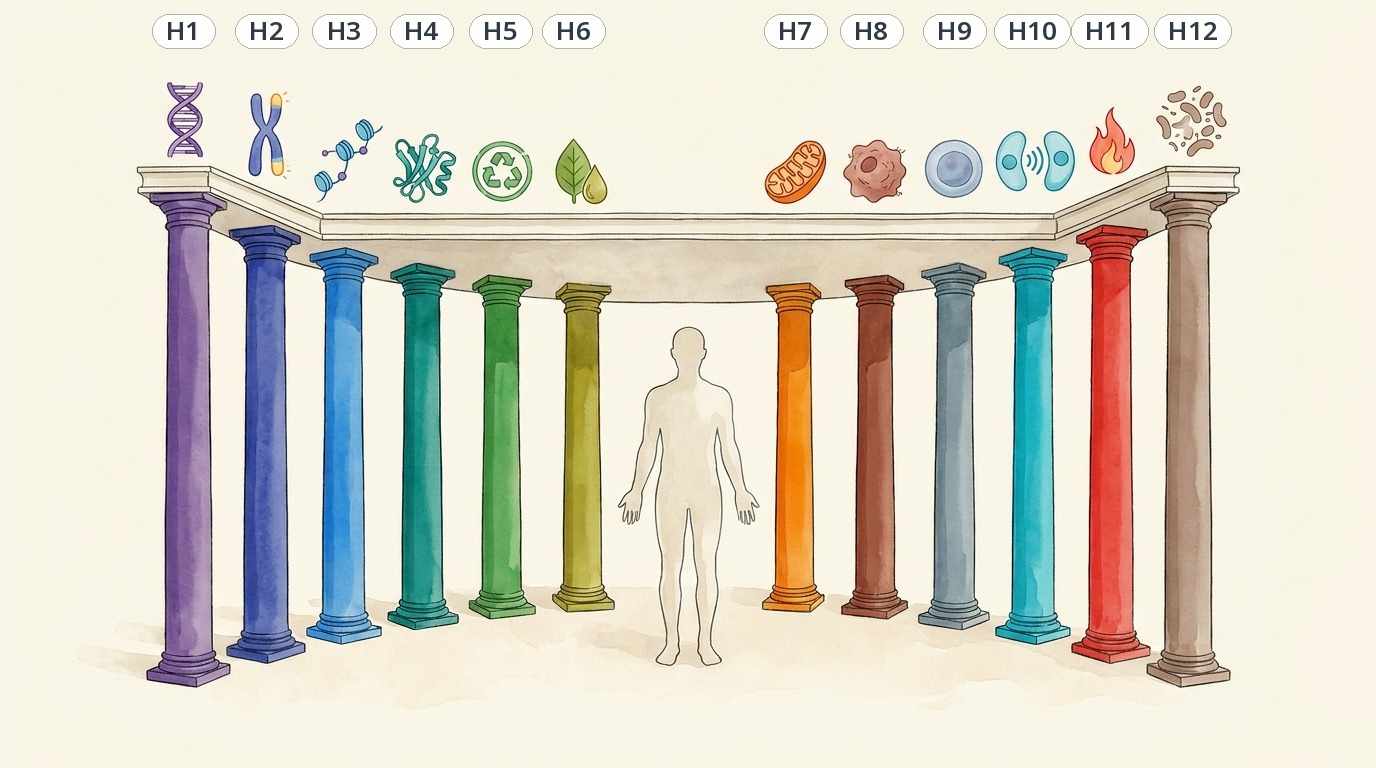
▲ The Twelve Pillars: twelve mechanisms of aging, each pillar with its own color, used throughout the book
| Pillar | Hallmark of aging | Sections |
|---|---|---|
| H1 | Genomic instability | Your Brain Cuts Its Own DNA to Learn · Emotion and Genome Stability · APOE4 and Long-Chain Fatty Acids |
| H2 | Telomere attrition | Emotion and Genome Stability · Ten Minutes of Meditation (telomerase, signal-level) |
| H3 | Epigenetic alterations | The Methylation Clock |
| H4 | Loss of proteostasis | Baduanjin and the "Jin" (mapping-level) |
| H5 | Disabled macroautophagy | Spermidine and Wheat Germ · Ganmai Dazao Decoction and Wheat Germ |
| H6 | Deregulated nutrient-sensing | A Handful of Nuts · Vinegar and Acetate · The 30-Minute Stand-Up Alarm |
| H7 | Mitochondrial dysfunction | Zone 2 Walking · Yang Qi and Mitochondria · Ergothioneine and Mushrooms · GlyNAC |
| H8 | Cellular senescence | Emotion and Genome Stability (chronic stress and p16 senescent cells) |
| H9 | Stem cell exhaustion | No lifestyle-level evidence to act on yet: an honest blank |
| H10 | Altered intercellular communication | Face-and-Neck Lymphatic Massage (brain–lymph drainage) · Attention Can Tune Inflammation (neuro–immune crosstalk) · 40Hz Light-and-Sound Stimulation |
| H11 | Chronic inflammation | Ergothioneine and Mushrooms · Ganmai Dazao Decoction and Wheat Germ · NAC and Phlegm · Ten Minutes of Meditation |
| H12 | Dysbiosis | Vinegar and Acetate (the short-chain fatty acid route) |
The sections on morning light, sleep, eyes, desk setup and focus don't map onto any single pillar. They don't act on one molecular mechanism; they're the shared foundation under all the pillars. When your rhythm is off and you're in sleep debt, no pillar stands steady.
Twelve pillars: eleven with something to act on, one honest blank. When the evidence gets there, so will we.
Appendix
Glossary
| Term | In one line |
|---|---|
| RCT (randomized controlled trial) | People are randomly split into a group that gets the intervention and a group that doesn't, and the results are compared. One of the most reliable ways to judge cause and effect |
| Cohort study | Follows a large group of people for years to see who gets what. Can find associations, but can't prove cause and effect on its own |
| Meta-analysis | Pools the data from several studies and runs the numbers again, for a more stable conclusion |
| Hard endpoint / surrogate marker | A hard endpoint is a real outcome like death or a heart attack; a surrogate marker is an "in-between reading" like blood sugar or cholesterol |
| All-cause mortality | Death from any cause; the most direct measure of lifespan |
| Circadian rhythm / body clock | The body's internal cycle of about 24 hours, governing sleep, hormones and body temperature |
| Melatonin | The "time to sleep" signal the brain releases after dark |
| Mitochondria | The cell's "power plants," turning food into energy |
| Autophagy | The cell recycling its own old parts, like garbage collection |
| Telomeres | The protective "caps" on the ends of chromosomes, getting a little shorter with each cell division |
| DNA methylation | A chemical tag that marks genes "on" or "off" without changing the DNA sequence itself |
| Epigenetic clock | A model that estimates "biological age" from DNA methylation patterns |
| Chronic inflammation | Low-grade inflammation that never fully goes away, thought to be one driver of aging |
| Oxidative stress | When the body's "rusting" reactions outpace its ability to clean up |
| Senescent cells | Cells that have stopped dividing but won't leave, and keep releasing inflammatory signals |
| Gut microbiome | The trillions of microbes in your gut, involved in digestion, immunity and metabolism |
| Short-chain fatty acids (SCFAs) | Produced when gut bacteria ferment fiber; they nourish the gut |
| Glymphatic system | The brain's waste-clearance channels, mainly active during sleep |
| APOE4 | A common gene variant linked to a higher risk of Alzheimer's disease |
| Flow | A state of total absorption where you lose track of time |
Programming metaphors
| Body | In programmer terms | Used in |
|---|---|---|
| Body clock + morning light | NTP sync | Ten Minutes of Morning Light |
| Sleep | Garbage collection + nightly batch jobs | Sleep Debt Repayment Plan · Screen Curfew an Hour Before Bed · Sleep About 7 Hours |
| Sleep debt | Tech debt: compound interest, can't pay it all off in one weekend | Sleep Debt Repayment Plan |
| Autophagy | Garbage collection / cache cleanup | Spermidine and Wheat Germ · Ganmai Dazao Decoction and Wheat Germ |
| Chronic inflammation | A memory leak: no errors, but things keep getting slower | Emotion and Genome Stability · NAC and Phlegm |
| DNA damage and repair | Corrupted data blocks + automatic error correction | Emotion and Genome Stability · Your Brain Cuts Its Own DNA to Learn |
| Telomeres | Storage with a limited number of writes (SSD lifespan) | Ten Minutes of Meditation · Emotion and Genome Stability |
| DNA methylation | Switches in a config file: same code, different behavior | The Methylation Clock |
| Epigenetic clock | The "system uptime" estimate on a monitoring dashboard | The Methylation Clock · Your Face Can Reveal Your Biological Age |
| Mitochondria | Power supply unit | Zone 2 Walking · Yang Qi and Mitochondria |
| Working memory | RAM / registers; writing things down is "flushing to disk" | Memory Management for Your Brain |
| Being interrupted | Context-switching overhead | Coding and Flow |
| The twelve hallmarks of aging | Twelve modules on the system architecture diagram | The Twelve Pillars |
| Blood pressure / lipids / blood sugar | Core production monitoring metrics | Know Your Blood Pressure · Read the Lipids and Glucose on Your Check-Up |
Toolbox
- 30-second symptom check: DeepKang Symptom Explorer. Free, anonymous, no sign-up. Enter a symptom (e.g. "dry eyes," "back pain," "poor sleep") and within 30 seconds see which symptoms it often comes with and the usual directions for causes, plus a summary you can bring to your doctor.
⚠️ Conflict of interest: DeepKang is a product of DeepoMe, the maintainer of this guide.
Contributing
PRs with new sections are welcome. Format: 1. One section, one topic, no numbering: each section stands alone; refer to other sections by name. 2. Use template v2: In one line / Sound familiar? / How / Why (metaphor first, then mechanism) / Going deeper (collapsed) / How solid is the evidence? / For programmers / Limits / References (collapsed). See Ten Minutes of Morning Light for an example. 3. References must be verifiable: only real PMIDs or DOIs. CI checks them automatically; fabricated citations get closed. 4. Grade strictly with both rulers: evidence A–D + action ✅🧪📖💸. If in doubt, grade lower. 5. Challenges to existing grades are welcome; we revise when the evidence changes. 6. Writing: start from feelings and situations, then bring in the mechanism. No jargon on the first screen; link terms to the glossary. 7. Figures: scene and mechanism figures may be AI-assisted, but only with a minimal number of English keywords in the image, and mechanism figures must pass a scientific review. Data figures must be generated by script so they can be reproduced.
About Dr. Xiong
Dr. Xiong (Xiong Jianghui) is the founder of DeepoMe and a researcher in AI for longevity medicine. This guide has one rule: say exactly as much as the evidence supports, and that rule binds us too.
- ✍️ Blog · xiongjianghui.com
- 🌐 DeepoMe
- 🧬 DeepKang health platform / Symptom Explorer
- 💻 GitHub · DeepoMe
- 📄 Selected paper: RootMap (DOI: 10.32388/A1NTLL)
Disclaimer
This guide is popular science, not medical advice. It does not diagnose or treat any condition. Talk to a doctor before changing medication, starting supplements, or if you have symptoms.
License: text and figures under CC BY-NC-ND 4.0. Figures are AI-assisted and human-reviewed, under the same license.